> ## Documentation Index
> Fetch the complete documentation index at: https://notes.kodekloud.com/llms.txt
> Use this file to discover all available pages before exploring further.
# ForEach Part 1
> Explains Kyverno's forEach loop to validate each list item in Kubernetes resources, using JMESPath expressions to enforce container image policies like trusted-registry.io.
In this lesson we cover Kyverno's forEach loop—a concise, declarative way to validate every item in a list inside a Kubernetes resource (for example, `spec.containers` and `spec.initContainers` in a Pod).
Why use forEach?
* Kubernetes objects often include arrays (containers, initContainers, volumeMounts, etc.). Writing index-specific rules for each element is error-prone and unscalable.
* Kyverno’s `forEach` evaluates a JMESPath expression that selects a list from the admission request, then applies a validation clause to each element in that list.
Use case: Alex and the registry policy
* Alex, a platform engineer, must enforce a security requirement: every container image must come from the internal registry `trusted-registry.io`.
* A Pod can contain multiple `initContainers` and `containers`, both of which must be validated.
Example Pod to validate:
```yaml theme={null}
apiVersion: v1
kind: Pod
spec:
initContainers:
- name: init-myservice
image: bad-registry.com/sidecar:1.0 # <--- INVALID
containers:
- name: myapp-container
image: trusted-registry.io/myapp:2.5 # <--- VALID
- name: another-container
image: docker.io/nginx:latest # <--- INVALID
```
Without a loop you'd need separate rules for each index. forEach handles this cleanly in a single rule.
Example Kyverno validate rule using forEach
* The rule below checks both `initContainers` and `containers` by looping over each list and validating the `image` field:
```yaml theme={null}
spec:
rules:
- name: check-registry
match:
any:
- resources:
kinds:
- Pod
validate:
message: "All images must come from trusted-registry.io"
foreach:
- list: "request.object.spec.initContainers"
pattern:
image: "trusted-registry.io/*"
- list: "request.object.spec.containers"
pattern:
image: "trusted-registry.io/*"
```
How forEach works
1. Kyverno evaluates the `list` JMESPath expression (a string) against the admission request (for example: `"request.object.spec.containers"`).
2. If the expression returns an empty array or is missing, that loop entry is skipped.
3. If items exist, Kyverno iterates them and exposes the current item as the implicit variable `element`.
4. The validation clause (`pattern`, `anyPattern`, or `deny`) is evaluated against that `element` object—so fields on the container (like `image`) are referenced directly.
Condensed forEach example (two loops: initContainers and containers):
```yaml theme={null}
foreach:
# Loop 1: Checks all initContainers
- list: "request.object.spec.initContainers"
pattern:
image: "trusted-registry.io/*"
# Loop 2: Checks all containers
- list: "request.object.spec.containers"
pattern:
image: "trusted-registry.io/*"
```
Important details and validation options
* The `list` value is a JMESPath expression written as a string. Do not wrap it in double curly braces.
Write [JMESPath](https://jmespath.org/) expressions directly as strings, for example: `"request.object.spec.containers"`. Do not use `{{ }}`.
* `element` is the implicit variable representing the current item in the iteration (e.g., a single container object).
* Validation clauses available inside a `forEach` entry:
| Clause | When to use | Example |
| ------------ | ------------------------------------------------------------------------------- | ------------------------------------------------------------------------------------ |
| `pattern` | To assert the element matches a given structure or values | `pattern:\n image: "trusted-registry.io/*"` |
| `anyPattern` | When an element may match one of multiple allowable patterns | `anyPattern:\n - image: "trusted-registry.io/*"\n - image: "another-trusted.io/*"` |
| `deny` | To explicitly block a request when a condition evaluates to true for an element | `deny:\n conditions: ...` |
Skeleton showing the different styles:
```yaml theme={null}
foreach:
- list: "request.object.spec.containers"
pattern:
image: "trusted-registry.io/*"
---
foreach:
- list: "request.object.spec.containers"
anyPattern:
- image: "trusted-registry.io/*"
- image: "another-trusted.io/*"
---
foreach:
- list: "request.object.spec.containers"
deny:
# deny logic that evaluates the 'element' and blocks the request
# (deny structure depends on the specific condition syntax you need)
```
Summary
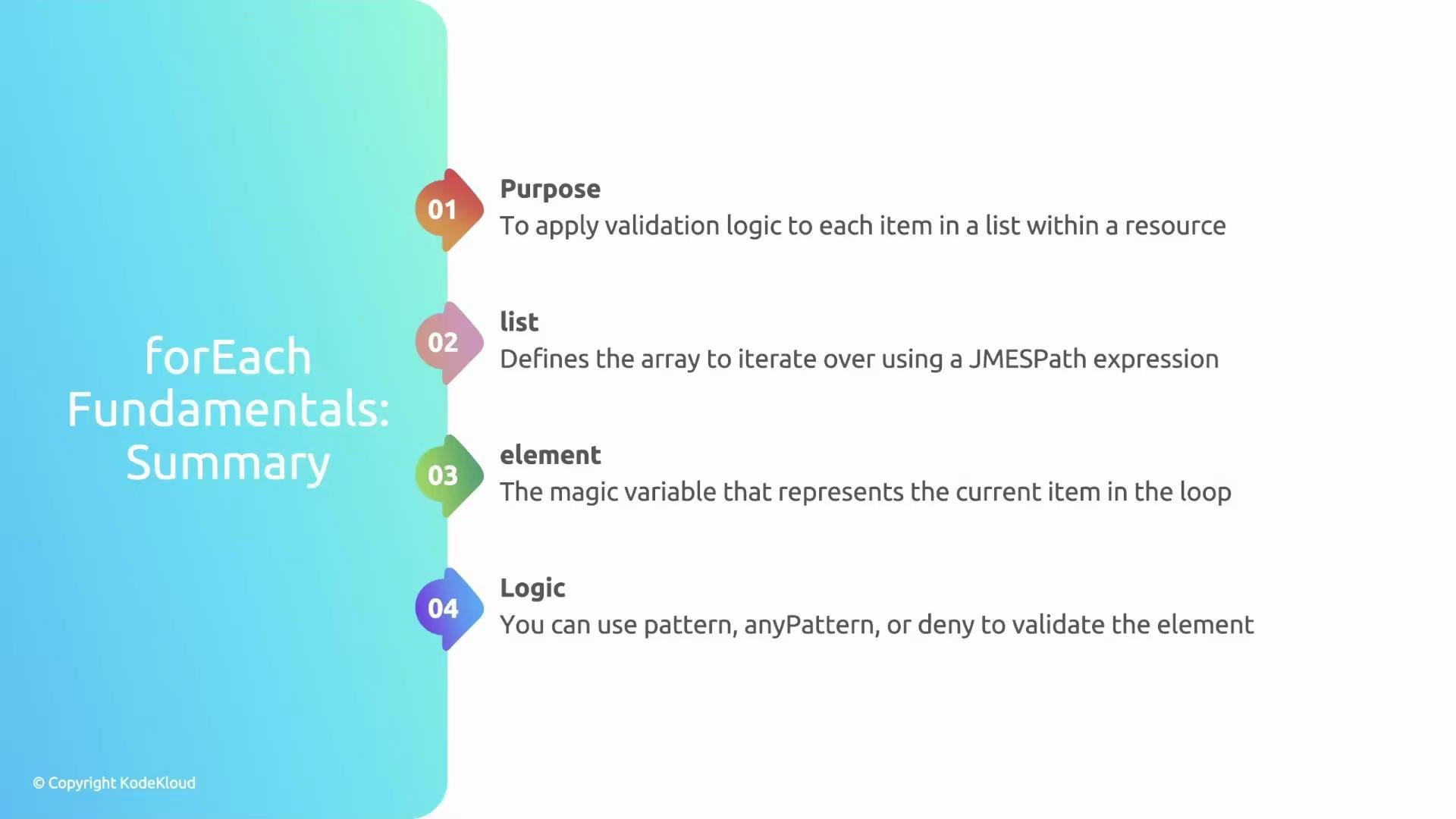
* Use `forEach` to iterate lists inside Kubernetes resources (e.g., `spec.containers`, `spec.initContainers`) using JMESPath expressions.
* For each iteration Kyverno exposes the current item as `element`, and you validate that element using `pattern`, `anyPattern`, or `deny`.
* A single rule with `forEach` can validate every item in a list, keeping policies concise, maintainable, and scalable.
 Links and references
* Kyverno documentation: [https://kyverno.io/](https://kyverno.io/)
* JMESPath specification: [https://jmespath.org/](https://jmespath.org/)
* Kubernetes Pods: [https://kubernetes.io/docs/concepts/workloads/pods/containers/](https://kubernetes.io/docs/concepts/workloads/pods/containers/)
Links and references
* Kyverno documentation: [https://kyverno.io/](https://kyverno.io/)
* JMESPath specification: [https://jmespath.org/](https://jmespath.org/)
* Kubernetes Pods: [https://kubernetes.io/docs/concepts/workloads/pods/containers/](https://kubernetes.io/docs/concepts/workloads/pods/containers/)