> ## Documentation Index
> Fetch the complete documentation index at: https://notes.kodekloud.com/llms.txt
> Use this file to discover all available pages before exploring further.
# The anyPattern OR Logic
> Explains using Kyverno anyPattern to accept either pod-level or per-container runAsNonRoot configurations and prevent unsafe overrides
Previously we gave Alice a set of anchors to express complex conditional logic in Kyverno. Now Alex faces a related but different problem: a resource can be correctly configured in two distinct ways. How can Kyverno accept either configuration without writing two separate rules?
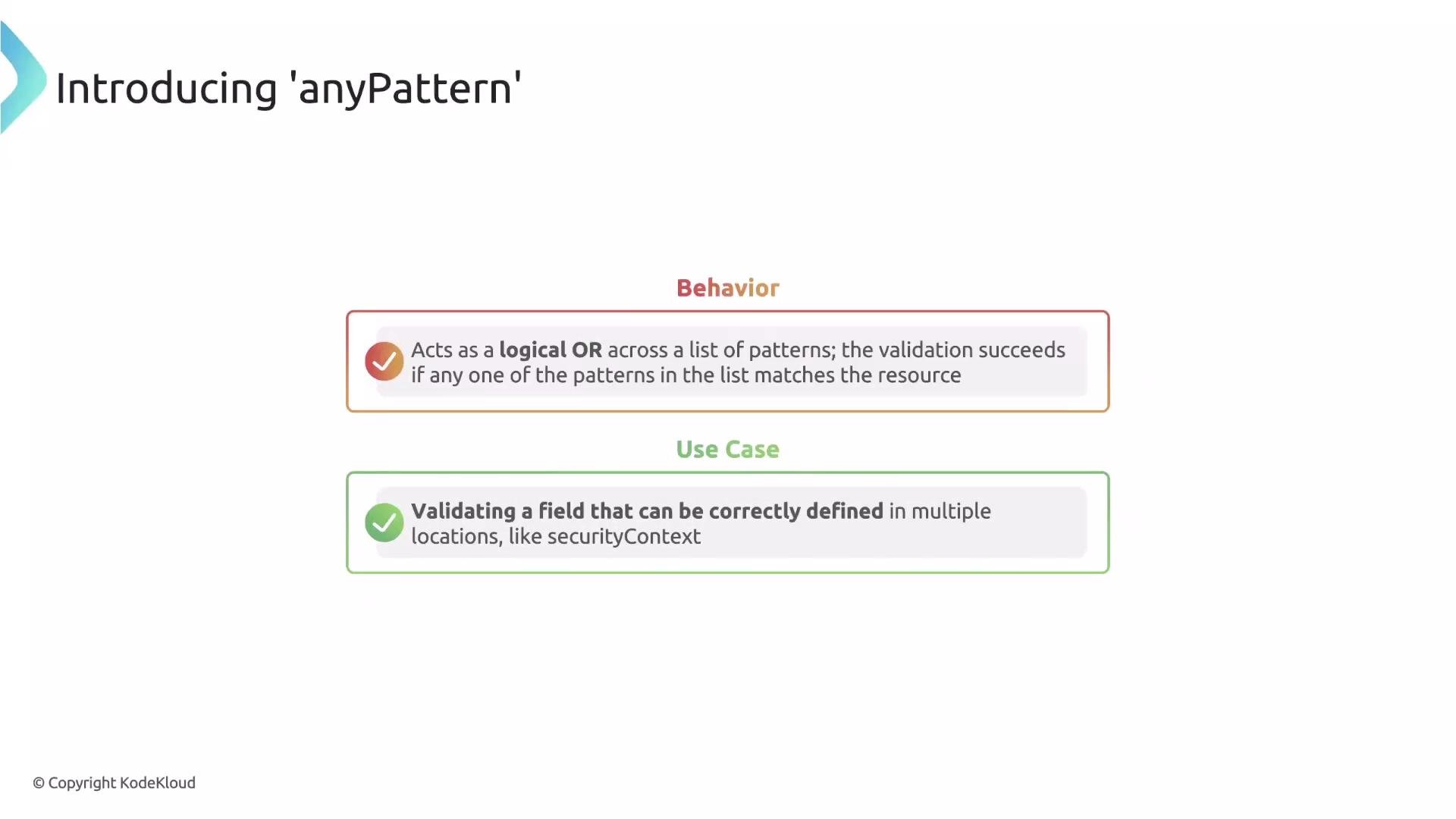
This article explains how to use Kyverno's `anyPattern` to express a logical OR inside a single validation rule so the rule accepts a resource if it matches any one of the supplied patterns.
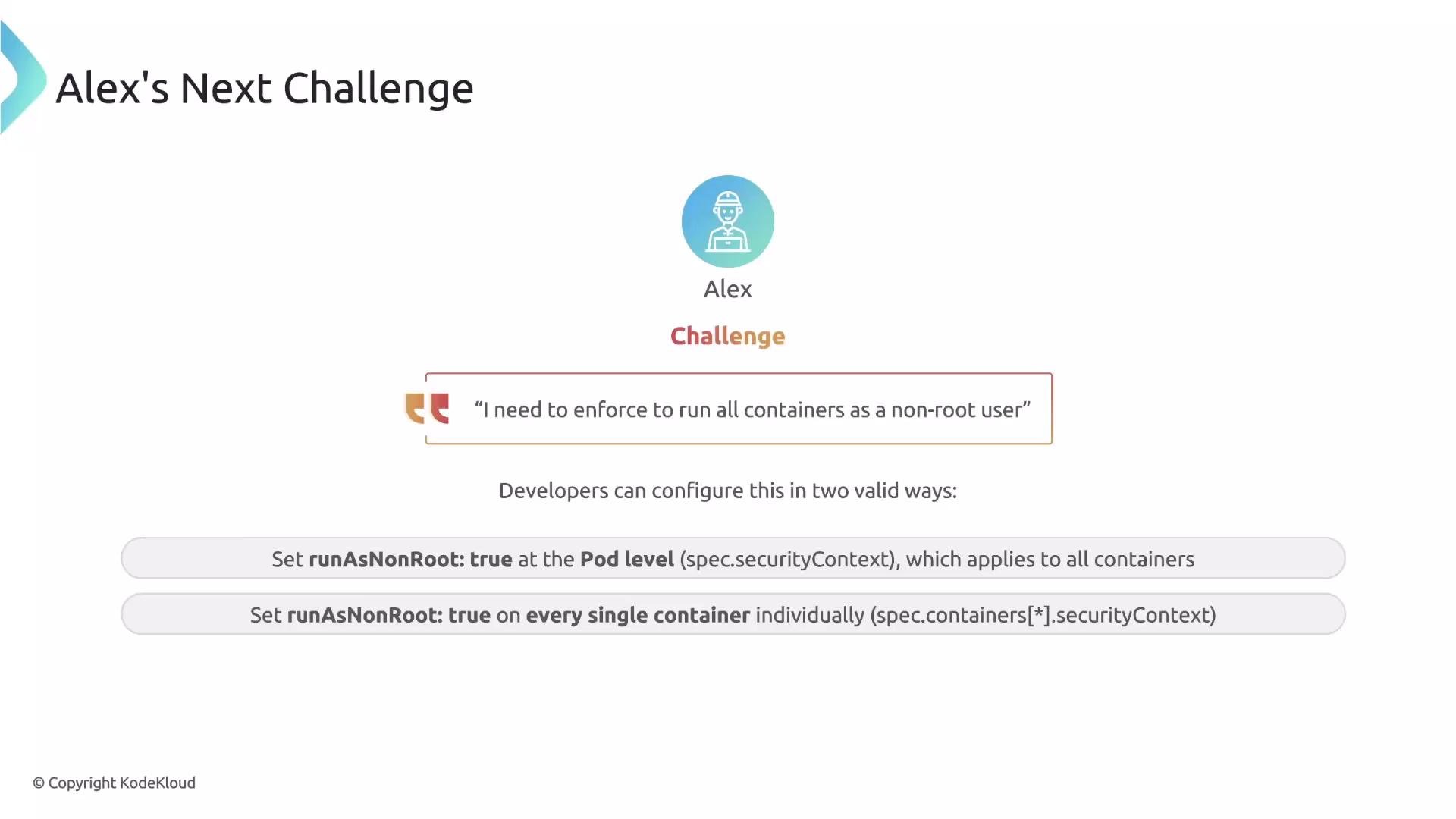
Scenario: enforce non-root containers
* Requirement: All containers must run as a non-root user.
* Two valid developer models:
* Set `runAsNonRoot: true` at the Pod-level `securityContext` (pod default).
* Or set `runAsNonRoot: true` on every container (container-level).
 Both approaches are valid, but a single Kyverno `pattern` typically describes one structural variant. Combining both structures into one `pattern` is either impossible or results in a very complex pattern. `anyPattern` solves this cleanly by providing multiple alternative patterns; Kyverno passes validation if any pattern matches.
Why this policy must handle two cases
* Problem 1 — override risk:
* A Pod-level default (`spec.securityContext.runAsNonRoot: true`) can be overridden by a container setting `securityContext.runAsNonRoot: false`. The policy must prevent containers from disabling a safe pod default.
Example container override:
```yaml theme={null}
spec:
securityContext:
runAsNonRoot: true
containers:
- name: bad-container
securityContext:
runAsNonRoot: false
```
* Problem 2 — missing default:
* If there is no pod-level `runAsNonRoot` default, every container (and initContainer) must explicitly set `runAsNonRoot: true`. The policy must validate per-container declarations.
Example without pod default:
```yaml theme={null}
spec:
containers:
- name: good-container
securityContext:
runAsNonRoot: true
- name: bad-container
securityContext:
runAsNonRoot: false
```
Policy intent
* Accept the Pod if either:
1. The Pod has `spec.securityContext.runAsNonRoot: true` and no container (or initContainer) sets `runAsNonRoot: false`, or
2. Every container and initContainer explicitly sets `securityContext.runAsNonRoot: true`.
This either-or logic is exactly why `anyPattern` exists.
How `anyPattern` works
* Place `anyPattern` inside a rule's `validate` block.
* `anyPattern` accepts a YAML list of alternative patterns.
* Kyverno evaluates patterns sequentially; validation succeeds on the first matching pattern. The resource is rejected only if it fails to match every pattern in the list.
Both approaches are valid, but a single Kyverno `pattern` typically describes one structural variant. Combining both structures into one `pattern` is either impossible or results in a very complex pattern. `anyPattern` solves this cleanly by providing multiple alternative patterns; Kyverno passes validation if any pattern matches.
Why this policy must handle two cases
* Problem 1 — override risk:
* A Pod-level default (`spec.securityContext.runAsNonRoot: true`) can be overridden by a container setting `securityContext.runAsNonRoot: false`. The policy must prevent containers from disabling a safe pod default.
Example container override:
```yaml theme={null}
spec:
securityContext:
runAsNonRoot: true
containers:
- name: bad-container
securityContext:
runAsNonRoot: false
```
* Problem 2 — missing default:
* If there is no pod-level `runAsNonRoot` default, every container (and initContainer) must explicitly set `runAsNonRoot: true`. The policy must validate per-container declarations.
Example without pod default:
```yaml theme={null}
spec:
containers:
- name: good-container
securityContext:
runAsNonRoot: true
- name: bad-container
securityContext:
runAsNonRoot: false
```
Policy intent
* Accept the Pod if either:
1. The Pod has `spec.securityContext.runAsNonRoot: true` and no container (or initContainer) sets `runAsNonRoot: false`, or
2. Every container and initContainer explicitly sets `securityContext.runAsNonRoot: true`.
This either-or logic is exactly why `anyPattern` exists.
How `anyPattern` works
* Place `anyPattern` inside a rule's `validate` block.
* `anyPattern` accepts a YAML list of alternative patterns.
* Kyverno evaluates patterns sequentially; validation succeeds on the first matching pattern. The resource is rejected only if it fails to match every pattern in the list.
 A Kyverno rule must use either a single `pattern` or `anyPattern`. Do not combine `pattern` and `anyPattern` in the same rule.
Policy fragment (solution)
* The example below shows two alternative patterns inside `anyPattern`:
* Pattern A: Enforce a pod-level default and prevent container overrides.
* Pattern B: Require per-container `runAsNonRoot: true` when no pod default exists.
```yaml theme={null}
validate:
failureAction: Enforce
message: "All containers and initContainers must run as non-root. Either set pod-level securityContext.runAsNonRoot: true (and do not override it in containers), or ensure every container/initContainer defines securityContext.runAsNonRoot: true."
anyPattern:
# Pattern A: Pod-level default must be set to runAsNonRoot: true,
# and if a container defines a securityContext it must also set runAsNonRoot: true.
- spec:
securityContext:
runAsNonRoot: true
containers:
- =(securityContext):
=(runAsNonRoot): true
=(initContainers):
- =(securityContext):
=(runAsNonRoot): true
# Pattern B: No pod-level default; every container and initContainer
# must define securityContext.runAsNonRoot: true.
- spec:
containers:
- securityContext:
runAsNonRoot: true
=(initContainers):
- securityContext:
runAsNonRoot: true
```
Pattern breakdown
| Pattern | When it applies | What it enforces |
| ---------------------------------------- | ------------------------------------------------------ | -------------------------------------------------------------------------------------------------------------------------------------------------------------------------------------------- |
| Pattern A (pod-level default) | When Pod has `spec.securityContext.runAsNonRoot: true` | Ensures pod-level default exists and any container `securityContext` (if present) also has `runAsNonRoot: true`, preventing container overrides. Applies the same check to `initContainers`. |
| Pattern B (container-level declarations) | When Pod lacks a pod-level default | Requires every `spec.containers` entry to include `securityContext.runAsNonRoot: true`. Applies the same check to `initContainers`. |
Notes and tips
* Use the optional presence marker (`=`) when you need to express conditional requirements for keys that may or may not exist (e.g., `=(initContainers)`).
* Keep `message` descriptive so users know how to fix failures (pod-level default vs. per-container settings).
* `anyPattern` is especially useful when the same valid configuration can be expressed in multiple Kubernetes locations (e.g., pod vs container).
References
* Kyverno docs: [https://kyverno.io/docs/](https://kyverno.io/docs/)
* Kubernetes securityContext: [https://kubernetes.io/docs/tasks/configure-pod-container/security-context/](https://kubernetes.io/docs/tasks/configure-pod-container/security-context/)
That's it—using `anyPattern` keeps your validation rules concise while allowing multiple valid configuration models for the same requirement.
A Kyverno rule must use either a single `pattern` or `anyPattern`. Do not combine `pattern` and `anyPattern` in the same rule.
Policy fragment (solution)
* The example below shows two alternative patterns inside `anyPattern`:
* Pattern A: Enforce a pod-level default and prevent container overrides.
* Pattern B: Require per-container `runAsNonRoot: true` when no pod default exists.
```yaml theme={null}
validate:
failureAction: Enforce
message: "All containers and initContainers must run as non-root. Either set pod-level securityContext.runAsNonRoot: true (and do not override it in containers), or ensure every container/initContainer defines securityContext.runAsNonRoot: true."
anyPattern:
# Pattern A: Pod-level default must be set to runAsNonRoot: true,
# and if a container defines a securityContext it must also set runAsNonRoot: true.
- spec:
securityContext:
runAsNonRoot: true
containers:
- =(securityContext):
=(runAsNonRoot): true
=(initContainers):
- =(securityContext):
=(runAsNonRoot): true
# Pattern B: No pod-level default; every container and initContainer
# must define securityContext.runAsNonRoot: true.
- spec:
containers:
- securityContext:
runAsNonRoot: true
=(initContainers):
- securityContext:
runAsNonRoot: true
```
Pattern breakdown
| Pattern | When it applies | What it enforces |
| ---------------------------------------- | ------------------------------------------------------ | -------------------------------------------------------------------------------------------------------------------------------------------------------------------------------------------- |
| Pattern A (pod-level default) | When Pod has `spec.securityContext.runAsNonRoot: true` | Ensures pod-level default exists and any container `securityContext` (if present) also has `runAsNonRoot: true`, preventing container overrides. Applies the same check to `initContainers`. |
| Pattern B (container-level declarations) | When Pod lacks a pod-level default | Requires every `spec.containers` entry to include `securityContext.runAsNonRoot: true`. Applies the same check to `initContainers`. |
Notes and tips
* Use the optional presence marker (`=`) when you need to express conditional requirements for keys that may or may not exist (e.g., `=(initContainers)`).
* Keep `message` descriptive so users know how to fix failures (pod-level default vs. per-container settings).
* `anyPattern` is especially useful when the same valid configuration can be expressed in multiple Kubernetes locations (e.g., pod vs container).
References
* Kyverno docs: [https://kyverno.io/docs/](https://kyverno.io/docs/)
* Kubernetes securityContext: [https://kubernetes.io/docs/tasks/configure-pod-container/security-context/](https://kubernetes.io/docs/tasks/configure-pod-container/security-context/)
That's it—using `anyPattern` keeps your validation rules concise while allowing multiple valid configuration models for the same requirement.