> ## Documentation Index
> Fetch the complete documentation index at: https://notes.kodekloud.com/llms.txt
> Use this file to discover all available pages before exploring further.
# OTel Col Load Balancing Exporter
> Explains the OpenTelemetry Collector load balancing exporter, its use cases, routing key options, resolver types, and configuration patterns for sticky, reliable routing of telemetry to downstream collectors.
This article explains the OpenTelemetry Collector load-balancing exporter: what it does, common use cases, routing key options, resolver types, and practical configuration patterns for reliable, sticky routing of telemetry to downstream collectors.
What the load-balancing exporter does
* Distributes telemetry (traces, metrics, logs) across a pool of downstream collectors (backends).
* Ensures related telemetry stays "sticky" to the same backend using a routing key so downstream processors (e.g., tail-based samplers) can operate on complete data.
* Creates an OTLP sub-exporter per backend so each backend gets independent queuing, retries, and resilience behavior.
Common uses
* Tail-based sampling: keep all spans of a trace together so downstream samplers can decide with full trace context.
* Sharding hot services: route high-volume services to a dedicated collector group.
* Metric scaling: shard metric streams across backends to balance ingestion.
Routing keys overview
Choose a routing key that preserves the consistency required by your downstream processing. The following table summarizes the most common routing key choices and when to use them.
| Routing key | Applies to | Purpose / When to use |
| ------------ | -------------------------------------- | ------------------------------------------------------------------------------------------------------- |
| `traceID` | Traces | Default for traces. Keeps all spans of a trace on the same backend — essential for tail-based sampling. |
| `service` | Traces & Metrics (default for metrics) | Routes by `service.name`. Useful for grouping telemetry at the service level. |
| `resource` | Traces & Metrics | Routes by resource attributes (e.g., host, deployment). Use to group telemetry by resource identity. |
| `metric` | Metrics only | Routes by metric name. Good for coarse metric sharding. |
| `streamID` | Metrics only | Routes by metric stream ID (hash of attributes). Most granular for metrics. |
| `attributes` | Traces & Metrics | Custom attribute routing. Requires a `routing_attributes` list to define keys to hash on. |
Choose the routing key that preserves the data consistency you need. For tail-based sampling, prefer `traceID`. For metric sharding, prefer `metric` or `streamID`.
Example: routing\_key variants
```yaml theme={null}
# Example routing_key choices (pick one)
# 1) traceID - traces (default for traces)
exporters:
loadbalancing:
routing_key: "traceID" # Keep all spans of a trace together
# 2) service - traces/metrics (default for metrics)
exporters:
loadbalancing:
routing_key: "service" # Group by service.name
# 3) resource - traces/metrics
exporters:
loadbalancing:
routing_key: "resource" # Group by resource attributes
# 4) metric - metrics only
exporters:
loadbalancing:
routing_key: "metric" # Group by metric name
# 5) streamID - metrics only (most granular)
exporters:
loadbalancing:
routing_key: "streamID"
# 6) attributes - custom attribute routing
exporters:
loadbalancing:
routing_key: "attributes"
routing_attributes:
- "span.kind"
- "http.method"
```
Resolvers — how the exporter discovers backend collectors
Resolvers determine how the load-balancing exporter discovers its backend pool. Select a resolver that matches your infrastructure and operational model.
| Resolver | Typical use case | Notes |
| -----------------------------: | ------------------------------------------- | --------------------------------------------------------------------------------------- |
| `static` | Small or fixed deployments | Use when backend hostnames are known and stable. |
| `dns` | Cloud load-balancers or DNS-based discovery | Resolve a DNS name to multiple IPs; the exporter can poll DNS at a configured interval. |
| `k8s` | Kubernetes headless services | Discover pods from a headless K8s service by name and port(s). |
| Other cloud-specific resolvers | Vendor/cloud integrations | Some Collector builds include additional resolvers (check your distribution docs). |
Example: resolver types
```yaml theme={null}
# Static resolver - fixed backends
exporters:
loadbalancing:
routing_key: "traceID"
resolver:
static:
hostnames:
- backend-1.example.com:4317
- backend-2.example.com:4317
- backend-3.example.com:4317
# DNS resolver - dynamic discovery
exporters:
loadbalancing:
routing_key: "service"
resolver:
dns:
hostname: collectors.svc.cluster.local
port: 4317
interval: 5s # poll interval for DNS updates
timeout: 1s
# Kubernetes resolver - K8s service discovery
exporters:
loadbalancing:
routing_key: "traceID"
resolver:
k8s:
service: otel-collector-headless
ports:
- 4317
- 4318
```
How the exporter maintains consistency and reliability
* Per-backend sub-exporters: the load-balancing exporter instantiates an OTLP sub-exporter per backend so each backend maintains independent queues and retry behavior.
* Consistent mapping: the exporter hashes the selected routing key to consistently route items with the same key to the same backend.
* Resilience: combined with exporter-level queues and retry\_on\_failure settings, this delivers robust forwarding even during transient backend issues.
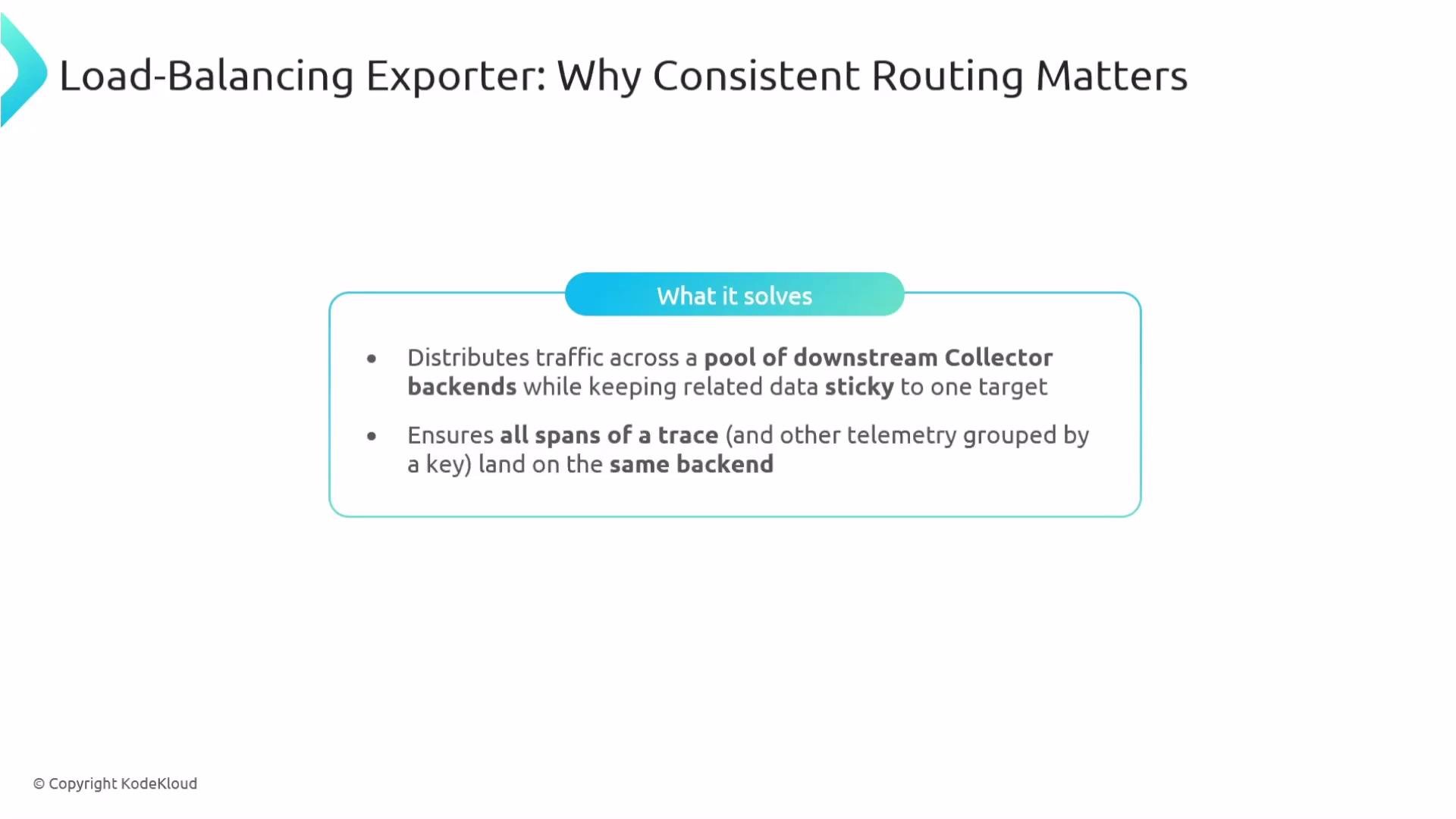 The load-balancing exporter guarantees stickiness using the selected routing key (for example, trace ID or service name). Choose a resolver type that matches your environment to discover the backend pool either statically or dynamically.
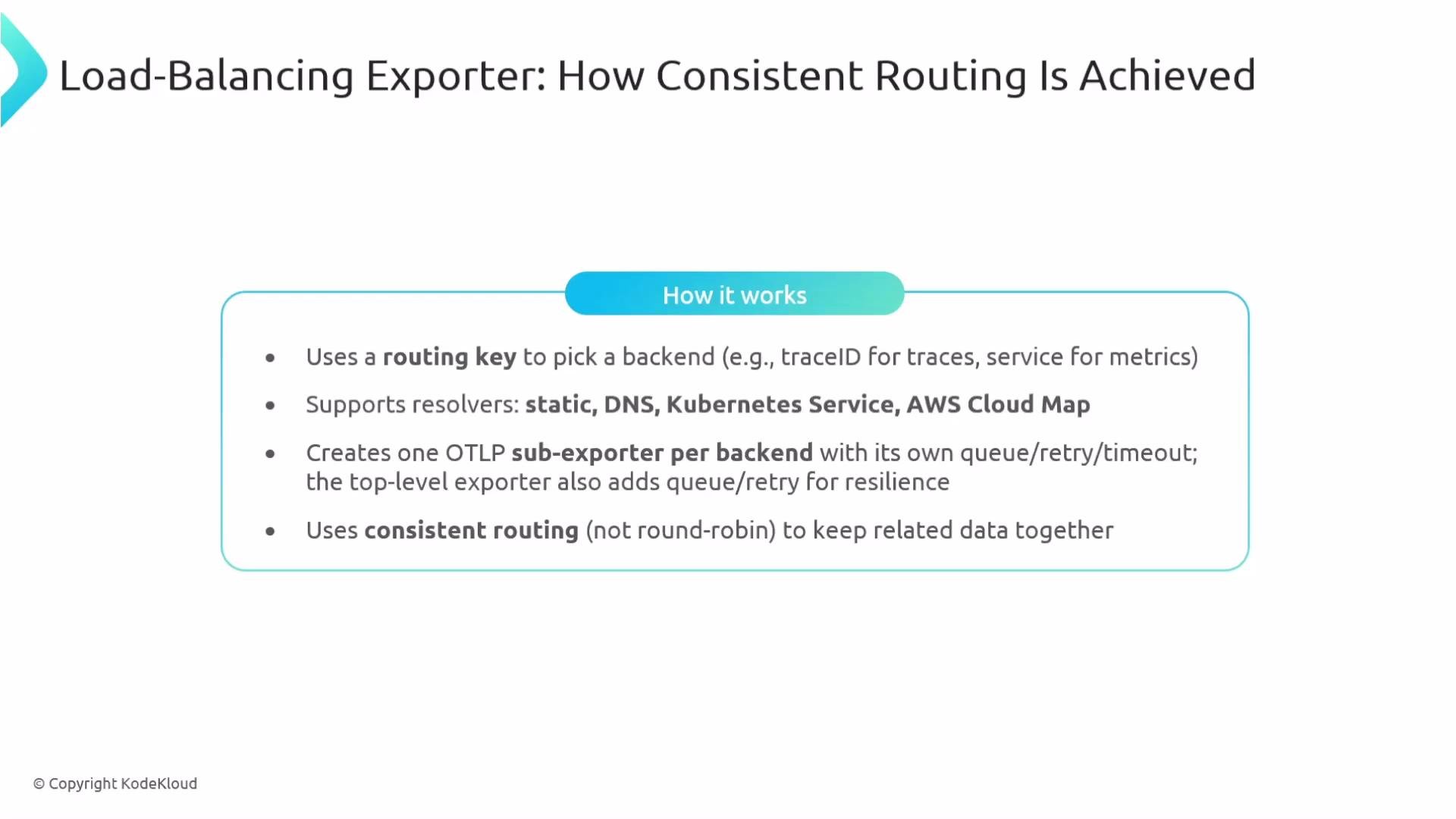 Tail-based sampling with a load-balancing exporter
Tail-based sampling often runs on downstream collectors. If the load-balancing exporter keeps all spans of a trace on the same backend, downstream tail samplers can see the entire trace without cross-node coordination, enabling accurate sampling decisions.
Tail-based sampling with a load-balancing exporter
Tail-based sampling often runs on downstream collectors. If the load-balancing exporter keeps all spans of a trace on the same backend, downstream tail samplers can see the entire trace without cross-node coordination, enabling accurate sampling decisions.
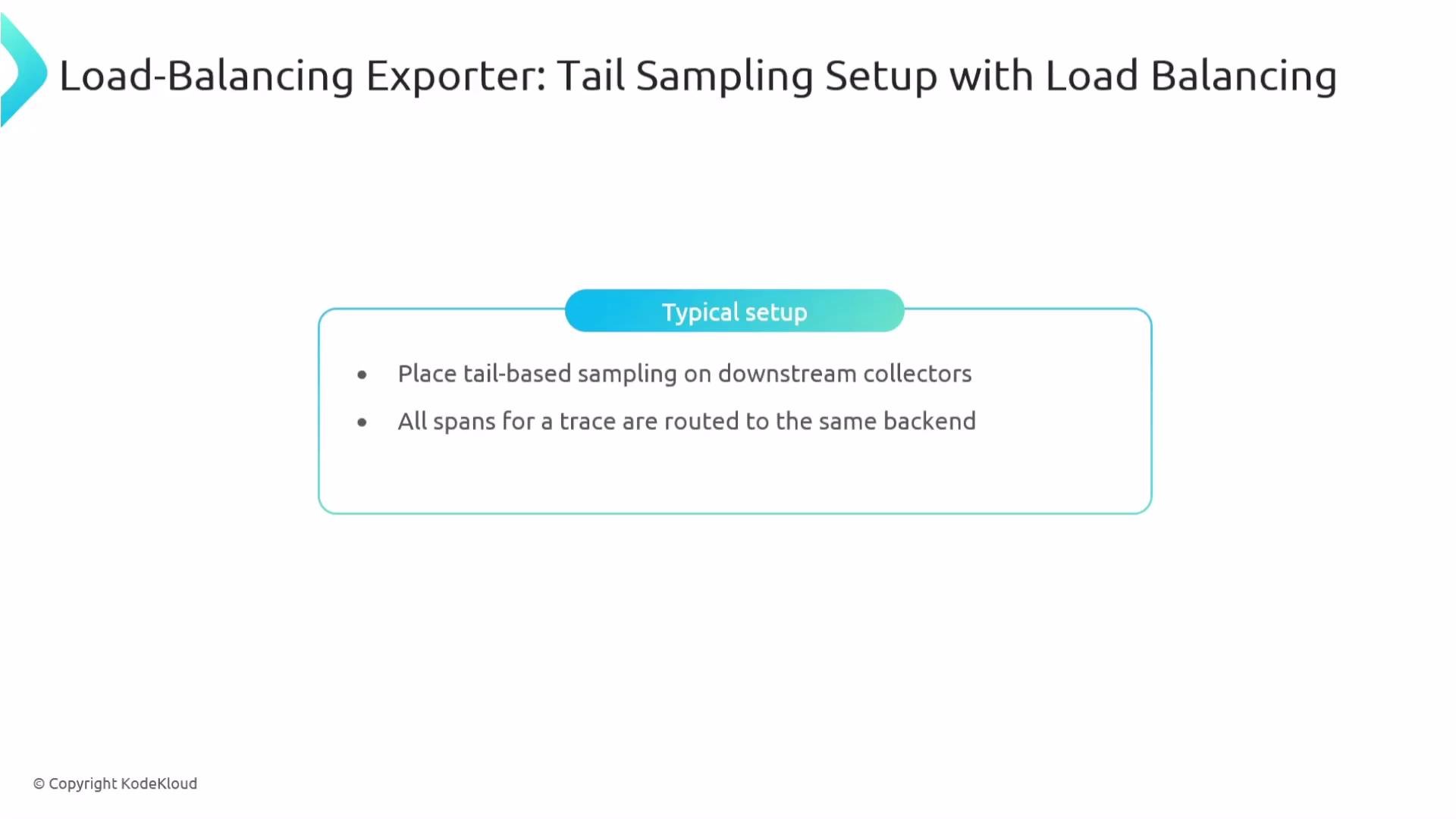 Illustration of consistent routing
Within the load-balancing collector, spans (or metric streams) that share the same routing key are hashed or consistently mapped to the same backend so each backend receives all data for that key.
Illustration of consistent routing
Within the load-balancing collector, spans (or metric streams) that share the same routing key are hashed or consistently mapped to the same backend so each backend receives all data for that key.
 Typical exporter configuration (production-minded)
The example below shows a production-oriented configuration using OTLP transport, a `static` resolver, exporter-level queuing, and retry settings. Adjust `routing_key`, resolver type, and timeouts to fit your deployment.
```yaml theme={null}
exporters:
loadbalancing:
routing_key: "traceID" # pick routing key appropriate for your use case
protocol:
otlp:
timeout: 1s
tls:
insecure: false
resolver:
static:
hostnames:
- backend-1.example.com:4317
- backend-2.example.com:4317
- backend-3.example.com:4317
# Exporter-level resilience
sending_queue:
enabled: true
queue_size: 20000
retry_on_failure:
enabled: true
max_elapsed_time: 5m
service:
pipelines:
traces:
receivers: [otlp]
processors: [batch]
exporters: [loadbalancing]
```
Notes and caveats
* `metric` and `streamID` routing keys are valid only for metrics; they are not applicable to traces or logs.
* Select `static` for fixed backend pools, `dns` for DNS-based discovery in cloud deployments, and `k8s` for Kubernetes headless services.
* Downstream backends must be able to handle the grouped load and any tail-sampling processors you plan to run.
* Monitor and tune per-backend queue sizes, retry settings, and OTLP timeouts to avoid dropped telemetry during spikes.
Links and references
* [OpenTelemetry Collector Documentation](https://opentelemetry.io/docs/collector/)
* [OTLP Protocol Overview](https://github.com/open-telemetry/opentelemetry-proto)
* [Kubernetes Services (headless)](https://kubernetes.io/docs/concepts/services-networking/service/#headless-services)
Typical exporter configuration (production-minded)
The example below shows a production-oriented configuration using OTLP transport, a `static` resolver, exporter-level queuing, and retry settings. Adjust `routing_key`, resolver type, and timeouts to fit your deployment.
```yaml theme={null}
exporters:
loadbalancing:
routing_key: "traceID" # pick routing key appropriate for your use case
protocol:
otlp:
timeout: 1s
tls:
insecure: false
resolver:
static:
hostnames:
- backend-1.example.com:4317
- backend-2.example.com:4317
- backend-3.example.com:4317
# Exporter-level resilience
sending_queue:
enabled: true
queue_size: 20000
retry_on_failure:
enabled: true
max_elapsed_time: 5m
service:
pipelines:
traces:
receivers: [otlp]
processors: [batch]
exporters: [loadbalancing]
```
Notes and caveats
* `metric` and `streamID` routing keys are valid only for metrics; they are not applicable to traces or logs.
* Select `static` for fixed backend pools, `dns` for DNS-based discovery in cloud deployments, and `k8s` for Kubernetes headless services.
* Downstream backends must be able to handle the grouped load and any tail-sampling processors you plan to run.
* Monitor and tune per-backend queue sizes, retry settings, and OTLP timeouts to avoid dropped telemetry during spikes.
Links and references
* [OpenTelemetry Collector Documentation](https://opentelemetry.io/docs/collector/)
* [OTLP Protocol Overview](https://github.com/open-telemetry/opentelemetry-proto)
* [Kubernetes Services (headless)](https://kubernetes.io/docs/concepts/services-networking/service/#headless-services)