> ## Documentation Index
> Fetch the complete documentation index at: https://notes.kodekloud.com/llms.txt
> Use this file to discover all available pages before exploring further.
# OpenTelemetry Goals Mission Vision and Values
> Overview of OpenTelemetry’s goals, mission, vision, and values for unified, portable, low-overhead application telemetry
In this lesson we explain OpenTelemetry’s goals, mission, vision, and engineering values so you can understand the project’s direction and how it fits into a modern observability strategy. Knowing these fundamentals makes it easier to adopt OpenTelemetry consistently across teams and platforms and helps you decide where and how to integrate telemetry into your architecture.
Why this matters: unifying telemetry reduces duplicated effort, improves interoperability across languages and tools, and enables faster incident detection and resolution.
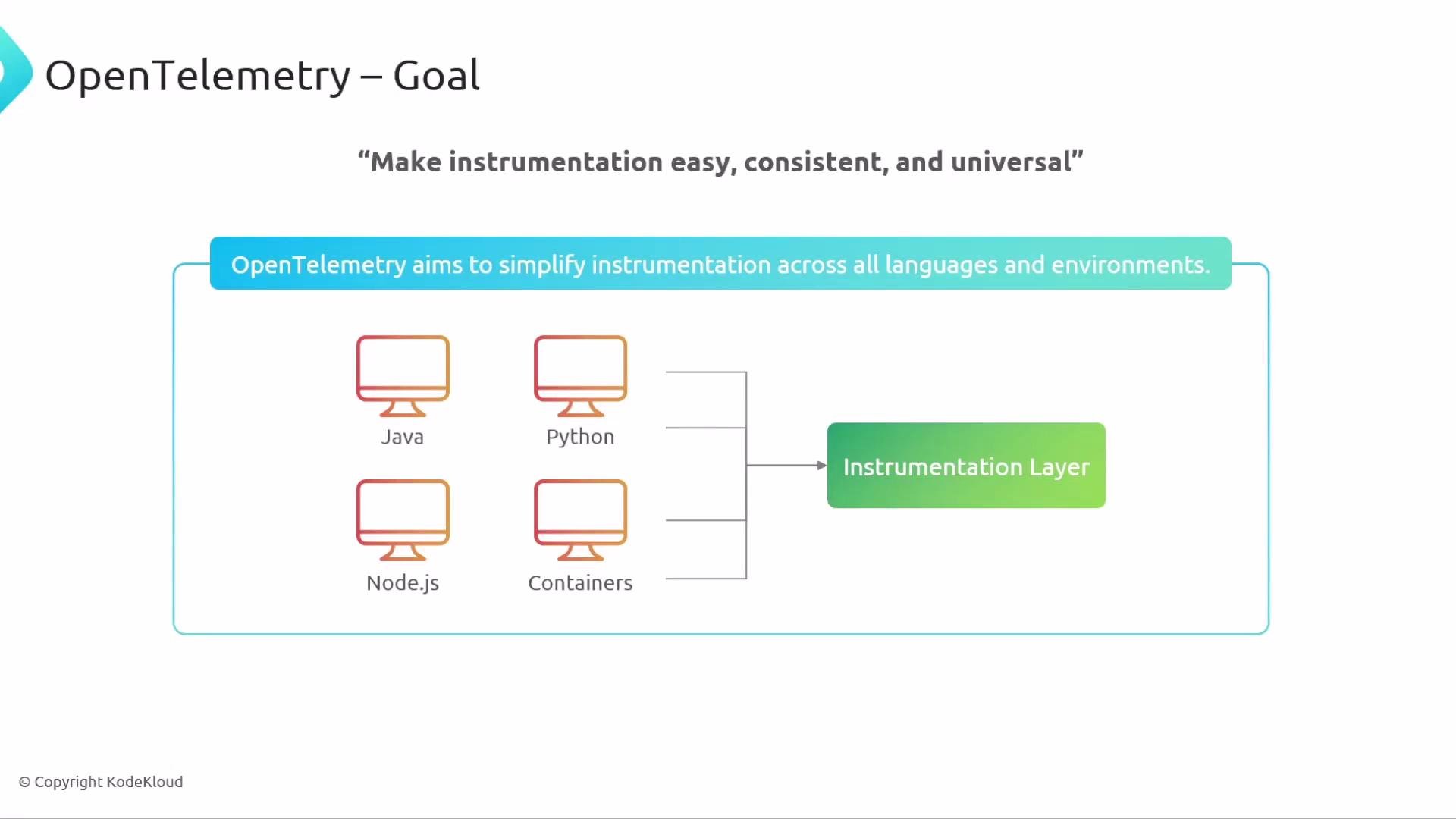
## Goal: Make instrumentation easy, consistent, and universal
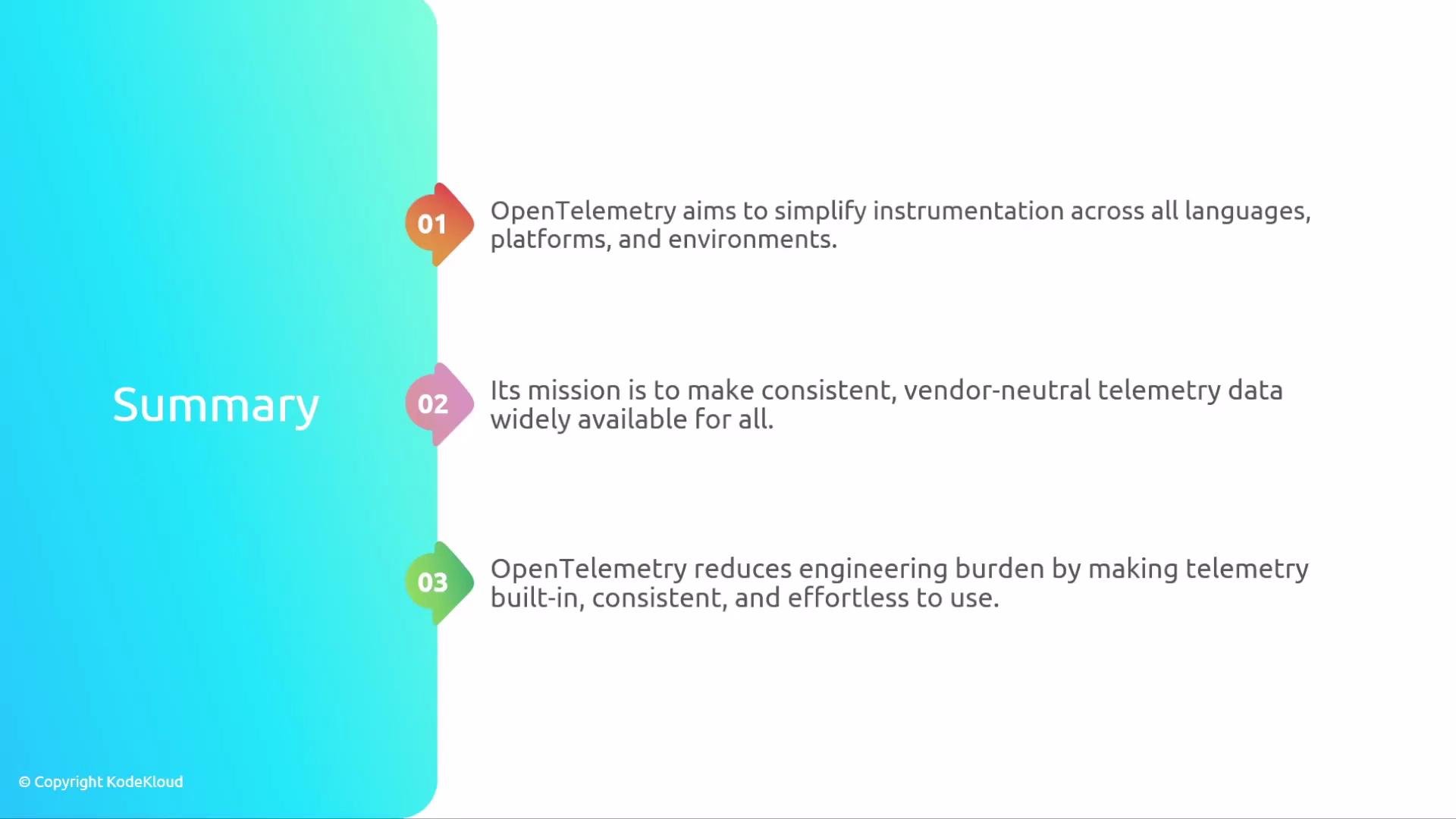
OpenTelemetry’s primary goal is to simplify application instrumentation across languages and environments (Java, Python, Node.js, containers, serverless, etc.). The project provides APIs, SDKs, and auto-instrumentation libraries so developers don’t have to build bespoke instrumentation for each platform.
 OpenTelemetry focuses on generating telemetry—traces, metrics, and logs—and exporting it to the backend of your choice. It is not a storage or visualization layer; those responsibilities belong to the observability backend you select (for example, commercial APMs or open-source platforms).
OpenTelemetry provides APIs, SDKs, auto-instrumentation libraries, and the Collector for generating and exporting telemetry. Storage and visualizations are handled by your chosen observability backend.
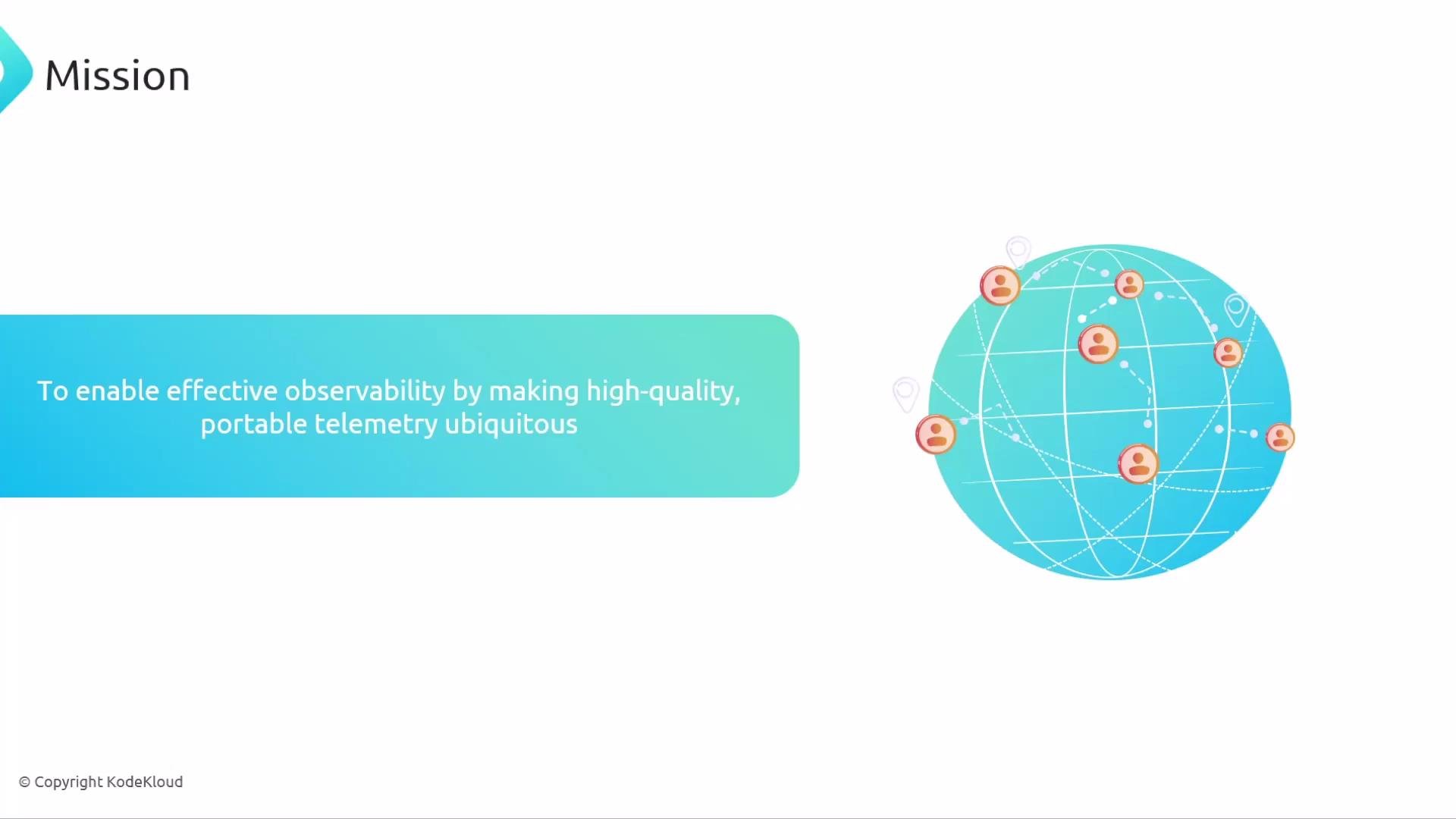
## Mission: Enable effective observability with high-quality, portable telemetry
The mission is to make high-quality, portable telemetry ubiquitous so teams can achieve effective observability. Portable telemetry means data is consistent and usable across tools and vendors—so you can change backends without losing signal fidelity.
OpenTelemetry focuses on generating telemetry—traces, metrics, and logs—and exporting it to the backend of your choice. It is not a storage or visualization layer; those responsibilities belong to the observability backend you select (for example, commercial APMs or open-source platforms).
OpenTelemetry provides APIs, SDKs, auto-instrumentation libraries, and the Collector for generating and exporting telemetry. Storage and visualizations are handled by your chosen observability backend.
## Mission: Enable effective observability with high-quality, portable telemetry
The mission is to make high-quality, portable telemetry ubiquitous so teams can achieve effective observability. Portable telemetry means data is consistent and usable across tools and vendors—so you can change backends without losing signal fidelity.
 Focus areas for the mission:
* Consistent semantic conventions and signal formats.
* Portable instrumentation that works across languages and platforms.
* High signal quality so telemetry is actionable for debugging, SLOs, and capacity planning.
## Vision: How telemetry should work in practice
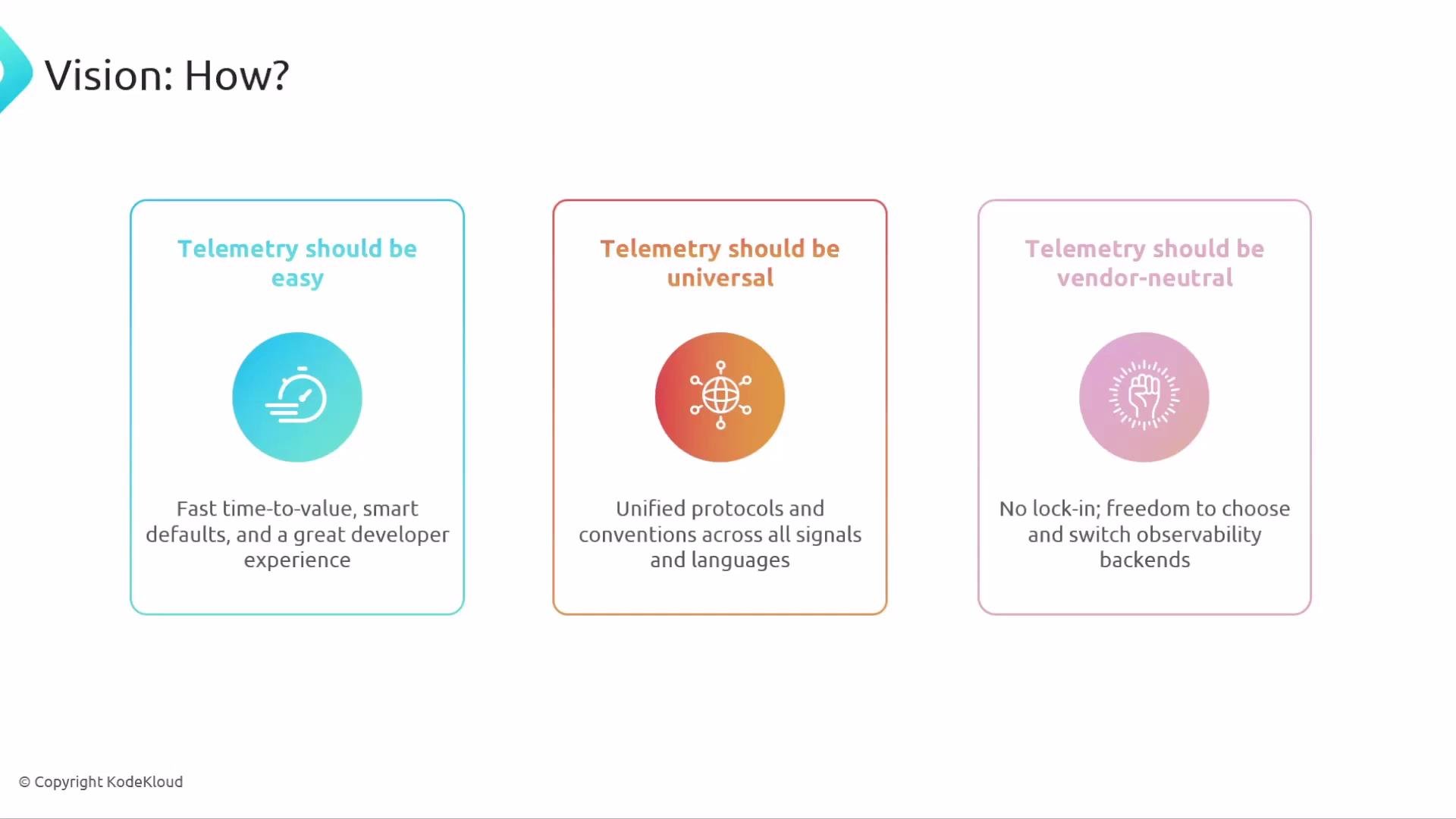
OpenTelemetry’s vision is about the practical experience for developers and operators:
* Easy to adopt with fast time to value and sensible defaults.
* Universal: unified protocols and conventions across signals and languages.
* Vendor-neutral: freedom to choose or switch observability backends.
* Composable: use only the components you need—the in-app SDKs, auto-instrumentation, and/or the Collector.
Focus areas for the mission:
* Consistent semantic conventions and signal formats.
* Portable instrumentation that works across languages and platforms.
* High signal quality so telemetry is actionable for debugging, SLOs, and capacity planning.
## Vision: How telemetry should work in practice
OpenTelemetry’s vision is about the practical experience for developers and operators:
* Easy to adopt with fast time to value and sensible defaults.
* Universal: unified protocols and conventions across signals and languages.
* Vendor-neutral: freedom to choose or switch observability backends.
* Composable: use only the components you need—the in-app SDKs, auto-instrumentation, and/or the Collector.
 Practical note: you can mix and match components. For simple setups, use SDKs that export directly to your backend. For advanced routing, enrichment, sampling, or protocol translation, route telemetry through the OpenTelemetry Collector.
## Why built-in telemetry matters
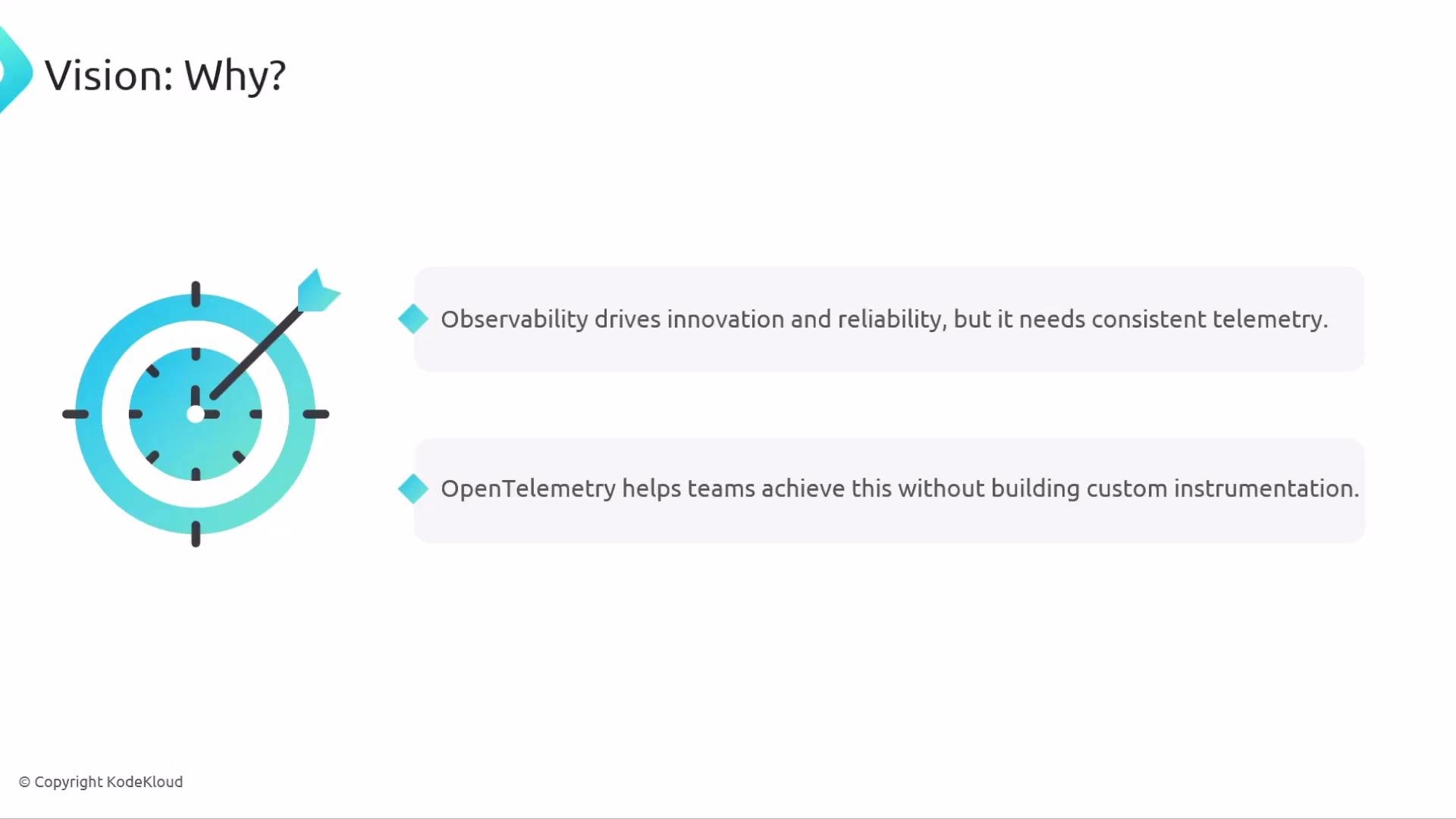
Telemetry should be a first-class engineering concern: available early, native to the application lifecycle, and consistent across services. Treating telemetry as a foundational part of development reduces fragmentation, accelerates troubleshooting, and prevents costly rework.
Practical note: you can mix and match components. For simple setups, use SDKs that export directly to your backend. For advanced routing, enrichment, sampling, or protocol translation, route telemetry through the OpenTelemetry Collector.
## Why built-in telemetry matters
Telemetry should be a first-class engineering concern: available early, native to the application lifecycle, and consistent across services. Treating telemetry as a foundational part of development reduces fragmentation, accelerates troubleshooting, and prevents costly rework.
 Benefits of built-in telemetry:
* Faster incident detection and root-cause analysis
* Consistent metrics and trace context across services
* Easier onboarding for new teams and tools
## Engineering values that guide OpenTelemetry
OpenTelemetry is guided by several engineering principles that shape design and implementation choices:
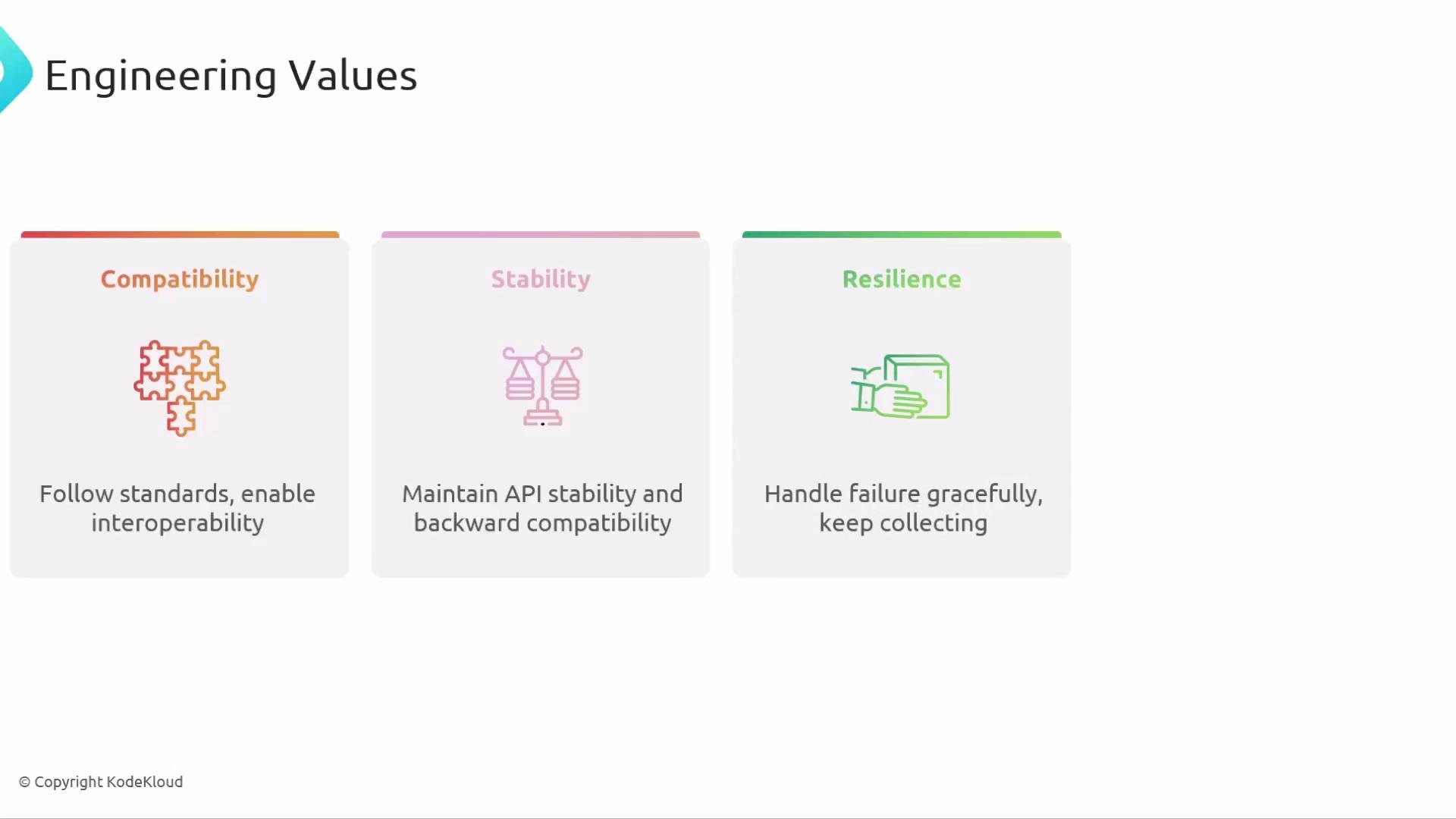
* Compatibility: follow open standards and ensure interoperability with multiple backends and protocols.
* Stability: maintain stable APIs and backward compatibility to protect integrations.
* Resilience: minimize data loss and ensure instrumentation does not cause application failures.
* Performance: keep telemetry overhead very low so instrumentation does not degrade application performance.
Benefits of built-in telemetry:
* Faster incident detection and root-cause analysis
* Consistent metrics and trace context across services
* Easier onboarding for new teams and tools
## Engineering values that guide OpenTelemetry
OpenTelemetry is guided by several engineering principles that shape design and implementation choices:
* Compatibility: follow open standards and ensure interoperability with multiple backends and protocols.
* Stability: maintain stable APIs and backward compatibility to protect integrations.
* Resilience: minimize data loss and ensure instrumentation does not cause application failures.
* Performance: keep telemetry overhead very low so instrumentation does not degrade application performance.
 When adding telemetry to production systems, prioritize safe defaults and low overhead. Instrumentation must not cause application instability or unacceptable performance regressions.
## Recap: Goals, Mission, Vision, and Values (Quick Reference)
| Area | Purpose | Key takeaway |
| ------------------ | -------------------------------------------------------------------- | -------------------------------------------------------- |
| Goal | Simplify and unify instrumentation across languages and platforms | Make telemetry easy, consistent, and universal |
| Mission | Produce high-quality, portable telemetry for effective observability | Telemetry should be useful across tools and environments |
| Vision | How telemetry should feel and be composed in practice | Easy adoption, vendor-neutral, and composable components |
| Engineering values | Design principles for implementation | Compatibility, stability, resilience, and performance |
When adding telemetry to production systems, prioritize safe defaults and low overhead. Instrumentation must not cause application instability or unacceptable performance regressions.
## Recap: Goals, Mission, Vision, and Values (Quick Reference)
| Area | Purpose | Key takeaway |
| ------------------ | -------------------------------------------------------------------- | -------------------------------------------------------- |
| Goal | Simplify and unify instrumentation across languages and platforms | Make telemetry easy, consistent, and universal |
| Mission | Produce high-quality, portable telemetry for effective observability | Telemetry should be useful across tools and environments |
| Vision | How telemetry should feel and be composed in practice | Easy adoption, vendor-neutral, and composable components |
| Engineering values | Design principles for implementation | Compatibility, stability, resilience, and performance |
 In practice, many popular libraries and frameworks (for example, web frameworks and common HTTP client libraries) already provide OpenTelemetry instrumentation integrations. Often you can start collecting telemetry by enabling or adding these libraries and configuring an exporter or Collector.
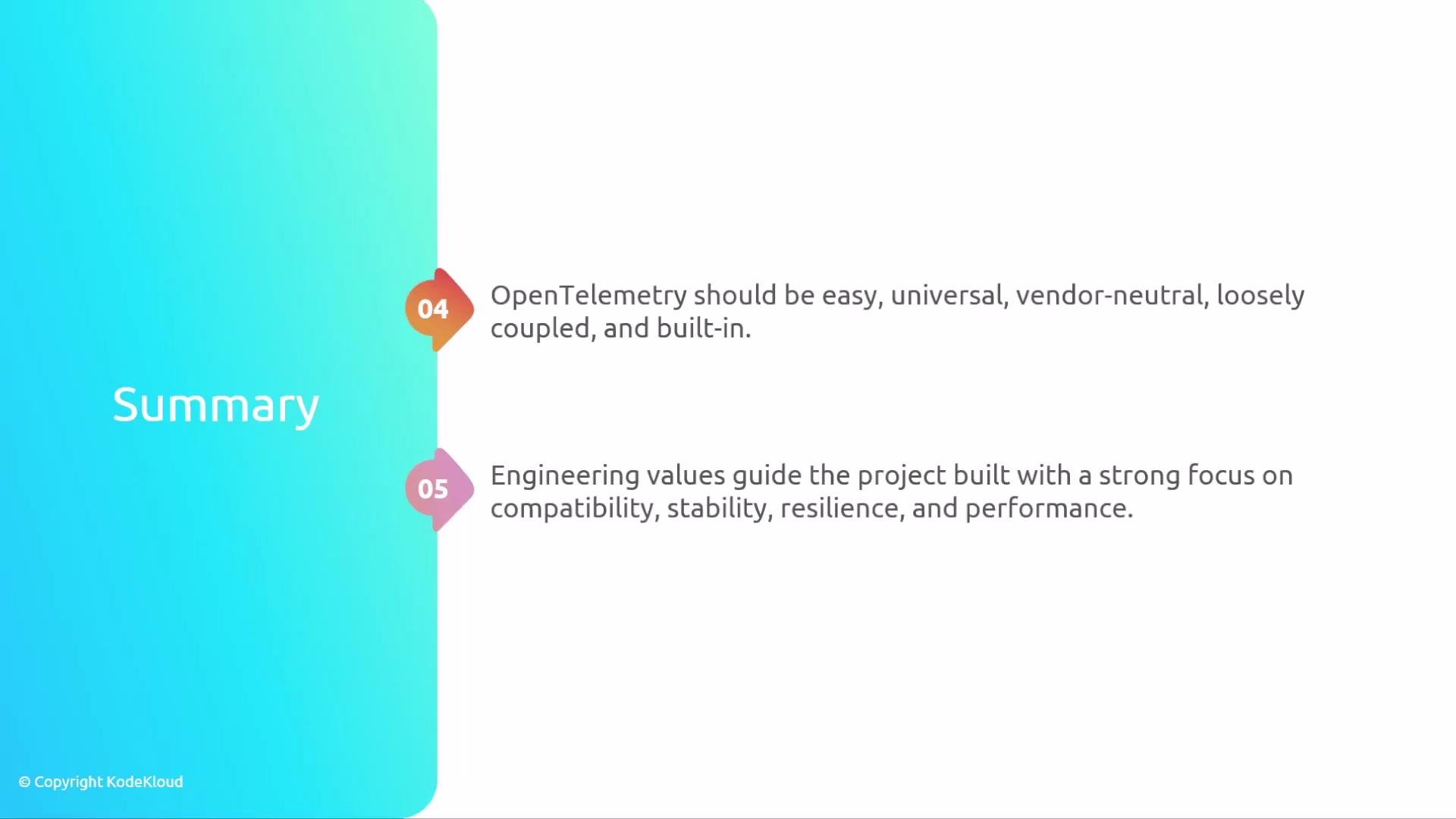 OpenTelemetry aims to make telemetry built-in, consistent, and effortless so teams can achieve observability without the burden of custom, platform-specific instrumentation.
## Links and References
* OpenTelemetry official site: [https://opentelemetry.io/](https://opentelemetry.io/)
* OpenTelemetry GitHub: [https://github.com/open-telemetry](https://github.com/open-telemetry)
* OpenTelemetry Collector: [https://opentelemetry.io/docs/collector/](https://opentelemetry.io/docs/collector/)
* Instrumentation libraries and language guides: [https://opentelemetry.io/docs/instrumentation/](https://opentelemetry.io/docs/instrumentation/)
Thank you for reading.
OpenTelemetry aims to make telemetry built-in, consistent, and effortless so teams can achieve observability without the burden of custom, platform-specific instrumentation.
## Links and References
* OpenTelemetry official site: [https://opentelemetry.io/](https://opentelemetry.io/)
* OpenTelemetry GitHub: [https://github.com/open-telemetry](https://github.com/open-telemetry)
* OpenTelemetry Collector: [https://opentelemetry.io/docs/collector/](https://opentelemetry.io/docs/collector/)
* Instrumentation libraries and language guides: [https://opentelemetry.io/docs/instrumentation/](https://opentelemetry.io/docs/instrumentation/)
Thank you for reading.