> ## Documentation Index
> Fetch the complete documentation index at: https://notes.kodekloud.com/llms.txt
> Use this file to discover all available pages before exploring further.
# Span Kind
> Explains span kinds in OpenTelemetry and how to classify spans (CLIENT, SERVER, INTERNAL, PRODUCER, CONSUMER) to ensure correct tracing and dependency visualization
This lesson explains Span Kind — the semantic classification that tells tracing systems what role a span plays in a distributed trace (is it making a request, handling one, or processing a message?). Correct span kinds give observability tools the context they need to link spans, build dependency graphs, and surface meaningful service relationships.
 Why span kind matters
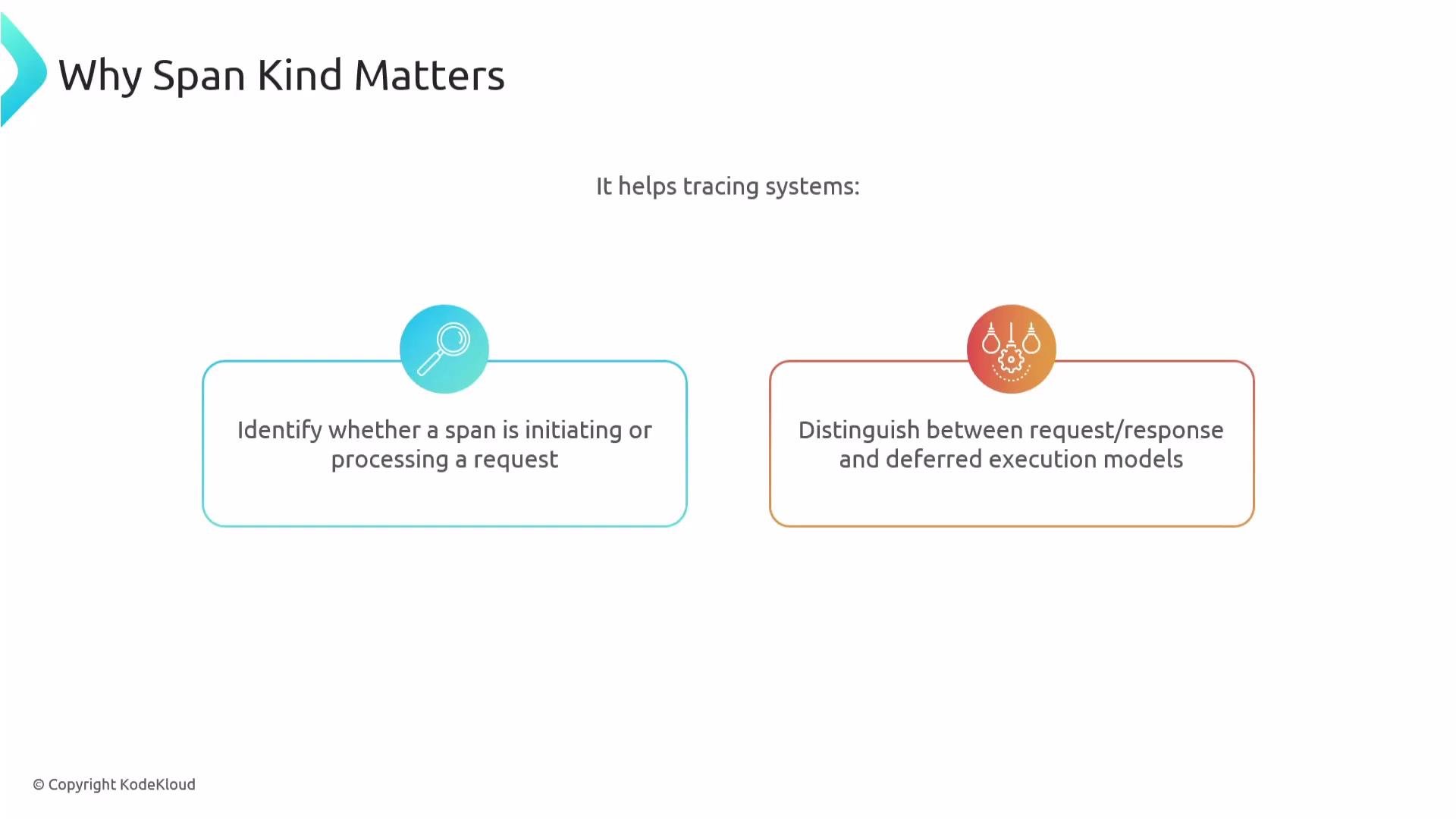
* It provides semantic information that tracing backends use to interpret relationships between spans (for example, to connect outgoing requests to the service that received them).
* It indicates whether an interaction is synchronous (request/response) or asynchronous (message-based), which affects how traces are visualized and analyzed.
* It helps maintain correct parent-child relationships across process or service boundaries when context is propagated.
Why span kind matters
* It provides semantic information that tracing backends use to interpret relationships between spans (for example, to connect outgoing requests to the service that received them).
* It indicates whether an interaction is synchronous (request/response) or asynchronous (message-based), which affects how traces are visualized and analyzed.
* It helps maintain correct parent-child relationships across process or service boundaries when context is propagated.
 OpenTelemetry span kinds
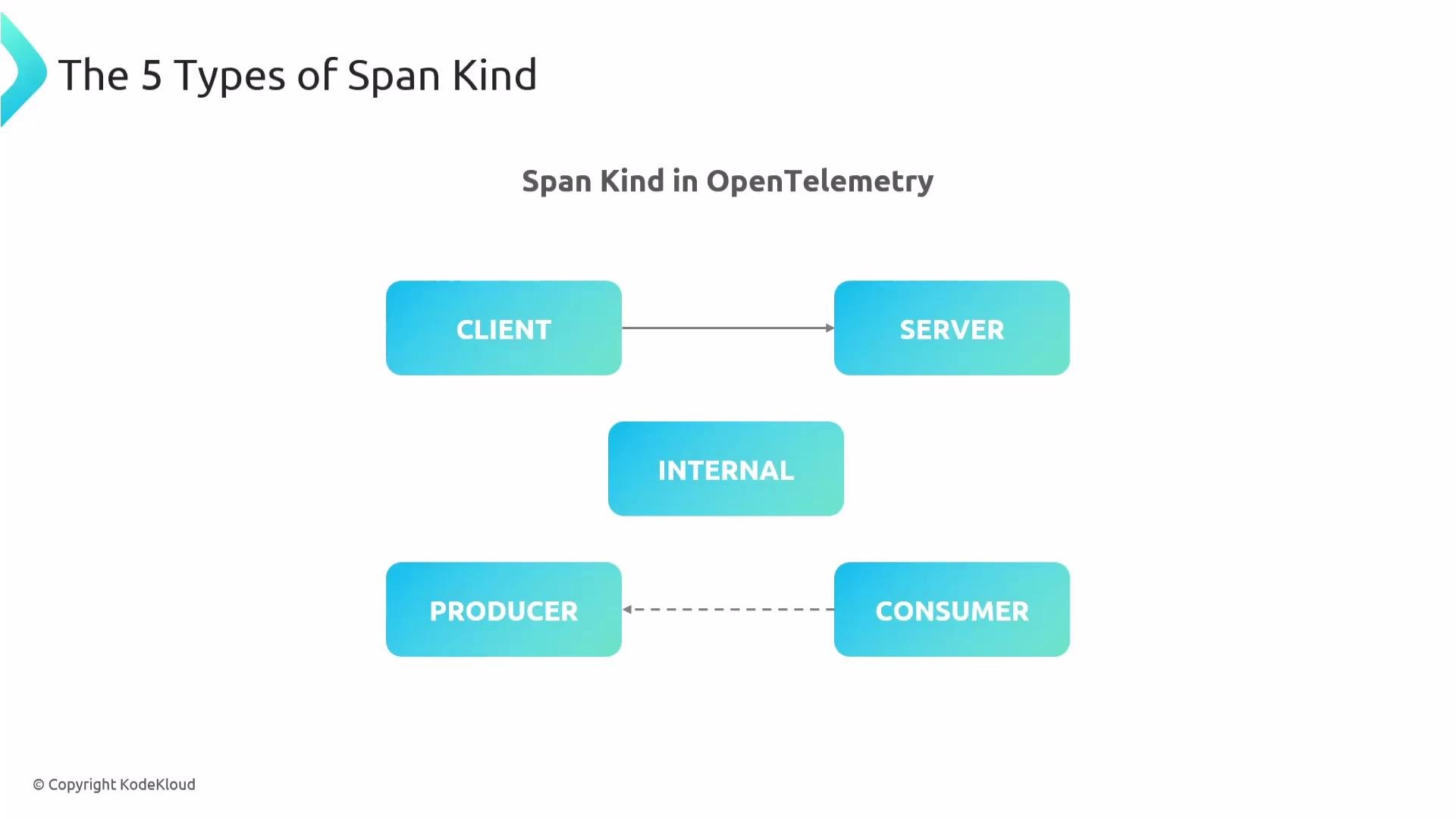
OpenTelemetry defines five span kinds to cover common interaction models: `CLIENT`, `SERVER`, `INTERNAL`, `PRODUCER`, and `CONSUMER`. Use the kind that best represents the role of the span so tracing tools can correctly link and display causal relationships.
OpenTelemetry span kinds
OpenTelemetry defines five span kinds to cover common interaction models: `CLIENT`, `SERVER`, `INTERNAL`, `PRODUCER`, and `CONSUMER`. Use the kind that best represents the role of the span so tracing tools can correctly link and display causal relationships.
 Summary table of span kinds
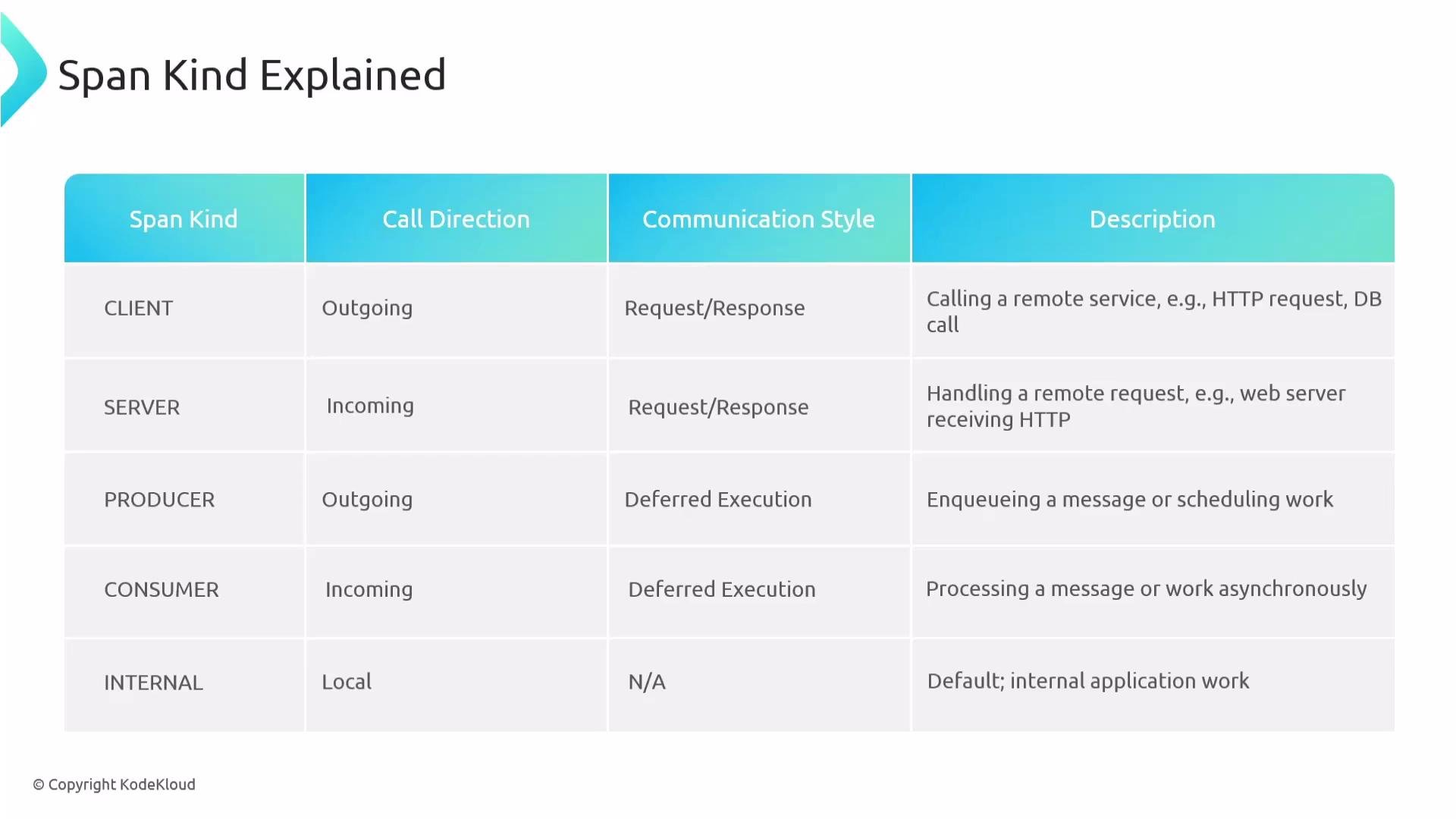
| Span Kind | Direction | Communication style | Typical use case |
| ---------- | -----------------: | -------------------------------------- | -------------------------------------------------- |
| `CLIENT` | Outgoing | Synchronous request/response | HTTP requests, RPC calls, DB queries |
| `SERVER` | Incoming | Synchronous request/response | Web server handling an HTTP request |
| `INTERNAL` | Local | In-process work (no boundary crossing) | Computations, helper functions, local processing |
| `PRODUCER` | Outgoing (message) | Asynchronous/message-based | Publishing to a Kafka topic or message queue |
| `CONSUMER` | Incoming (message) | Asynchronous/message-based | Processing messages consumed from a queue or topic |
Why use span kinds correctly?
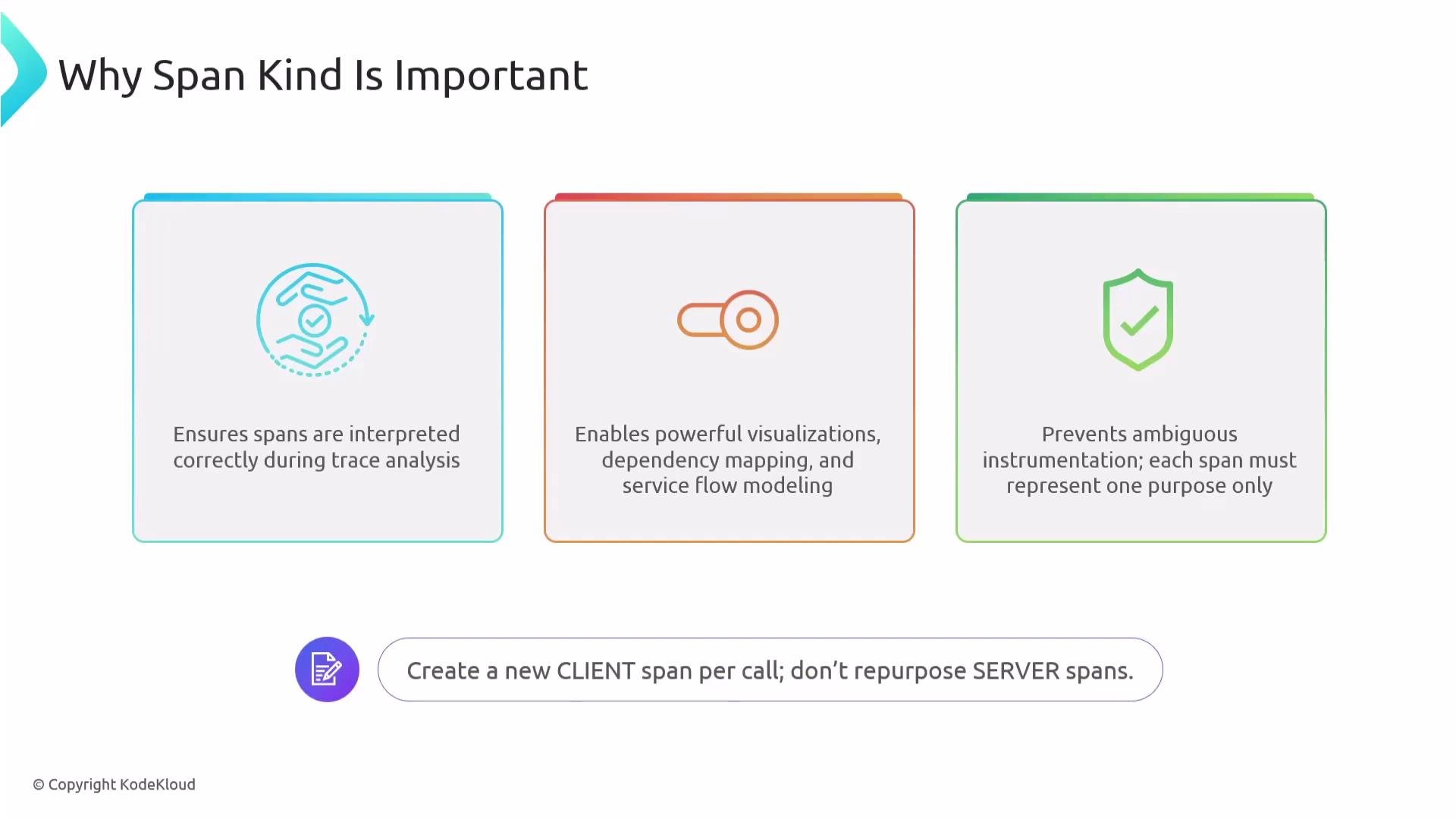
* Correct kinds enable accurate trace analysis and visualization (dependency maps, service flow graphs).
* They reduce ambiguity: each span should represent a single, clear purpose.
* They ensure propagation and linking work as intended across service boundaries.
Summary table of span kinds
| Span Kind | Direction | Communication style | Typical use case |
| ---------- | -----------------: | -------------------------------------- | -------------------------------------------------- |
| `CLIENT` | Outgoing | Synchronous request/response | HTTP requests, RPC calls, DB queries |
| `SERVER` | Incoming | Synchronous request/response | Web server handling an HTTP request |
| `INTERNAL` | Local | In-process work (no boundary crossing) | Computations, helper functions, local processing |
| `PRODUCER` | Outgoing (message) | Asynchronous/message-based | Publishing to a Kafka topic or message queue |
| `CONSUMER` | Incoming (message) | Asynchronous/message-based | Processing messages consumed from a queue or topic |
Why use span kinds correctly?
* Correct kinds enable accurate trace analysis and visualization (dependency maps, service flow graphs).
* They reduce ambiguity: each span should represent a single, clear purpose.
* They ensure propagation and linking work as intended across service boundaries.
 Concrete examples
* `CLIENT`: Outgoing calls (HTTP requests, RPC, DB queries). Create a new `CLIENT` span for each external call so each request is represented individually.
* `SERVER`: Incoming requests handled by a service. When context is propagated, the `SERVER` span becomes a child of the originating `CLIENT` span.
* `PRODUCER`: Enqueuing or publishing a message (e.g., writing to a Kafka topic).
* `CONSUMER`: Receiving and processing a message from a broker or queue.
* `INTERNAL`: Local in-process operations that do not cross service boundaries (default kind when none is set).
Concrete examples
* `CLIENT`: Outgoing calls (HTTP requests, RPC, DB queries). Create a new `CLIENT` span for each external call so each request is represented individually.
* `SERVER`: Incoming requests handled by a service. When context is propagated, the `SERVER` span becomes a child of the originating `CLIENT` span.
* `PRODUCER`: Enqueuing or publishing a message (e.g., writing to a Kafka topic).
* `CONSUMER`: Receiving and processing a message from a broker or queue.
* `INTERNAL`: Local in-process operations that do not cross service boundaries (default kind when none is set).
 HTTP example
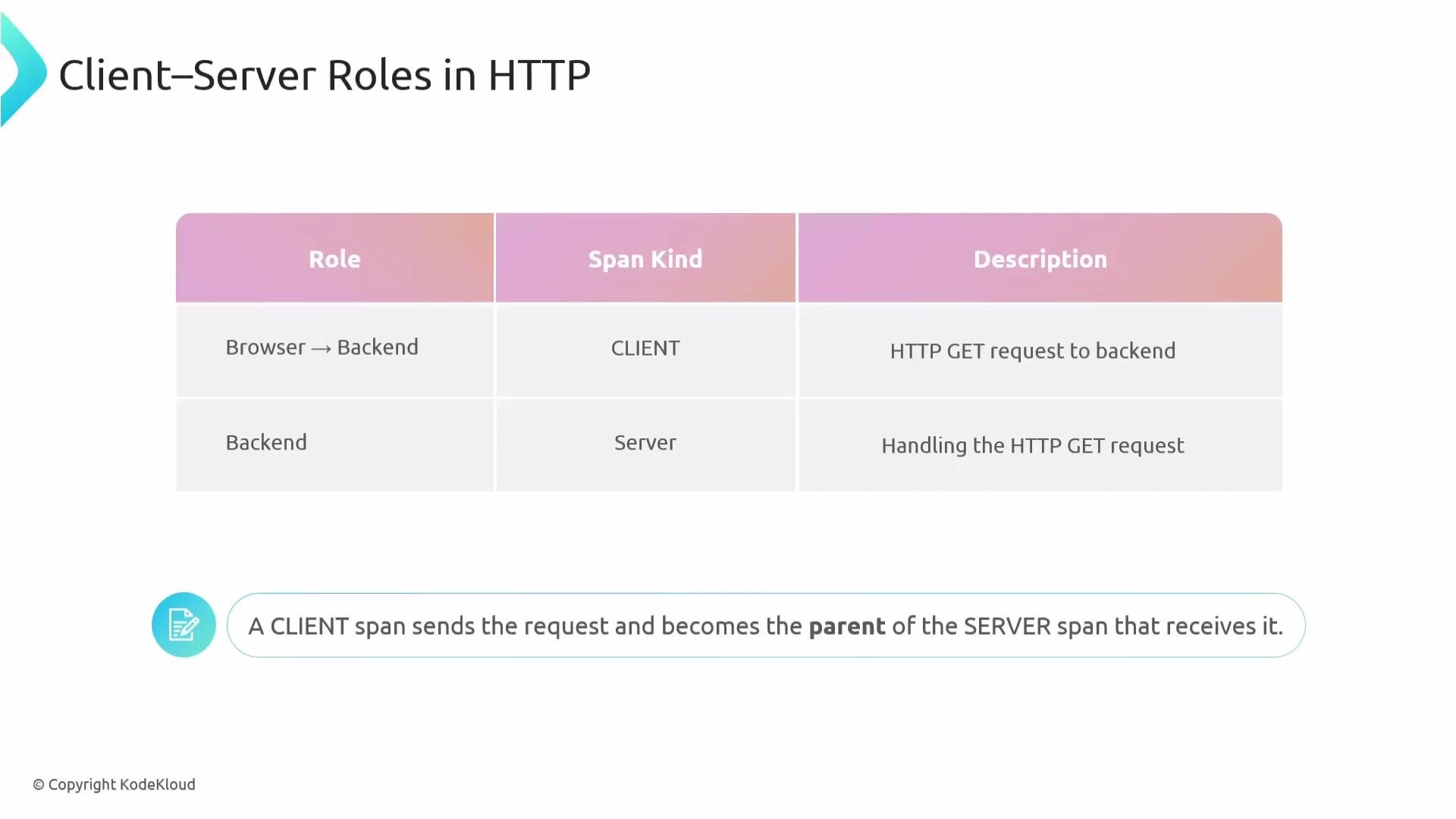
* Client side: creating an outgoing HTTP request should produce a `CLIENT` span.
* Server side: receiving that request produces a `SERVER` span.
* When headers (or another propagation mechanism) carry trace context, the server span becomes a child of the client span, forming a clear client→server causal link in the trace.
HTTP example
* Client side: creating an outgoing HTTP request should produce a `CLIENT` span.
* Server side: receiving that request produces a `SERVER` span.
* When headers (or another propagation mechanism) carry trace context, the server span becomes a child of the client span, forming a clear client→server causal link in the trace.
 Messaging example
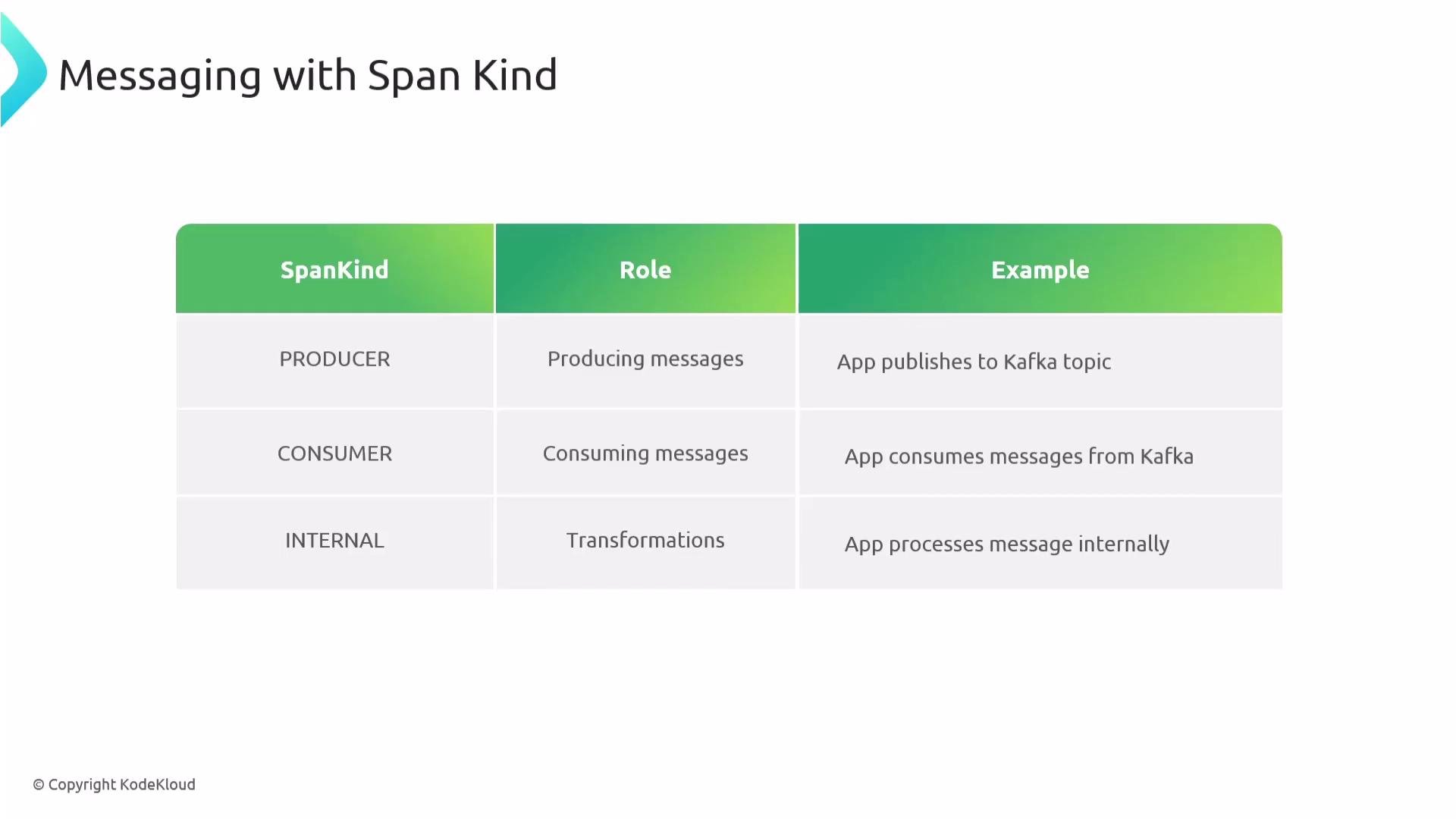
* `PRODUCER` spans represent the act of publishing or enqueueing a message.
* `CONSUMER` spans represent the processing of that message by consumers.
* Any additional local work done while processing a message (parsing, business logic) should use `INTERNAL` spans to reflect in-process operations.
Messaging example
* `PRODUCER` spans represent the act of publishing or enqueueing a message.
* `CONSUMER` spans represent the processing of that message by consumers.
* Any additional local work done while processing a message (parsing, business logic) should use `INTERNAL` spans to reflect in-process operations.
 Best practices
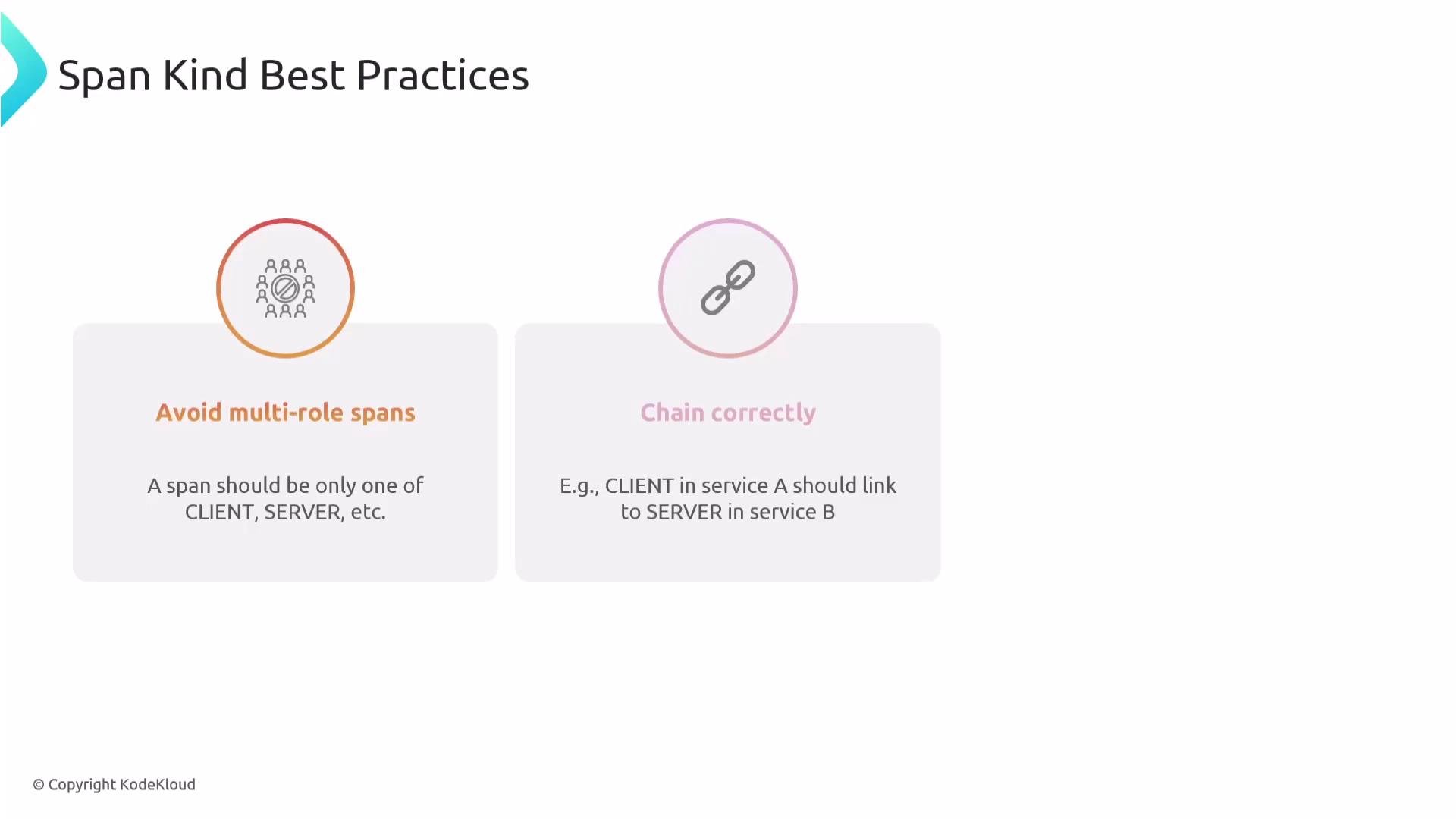
* Give each span one clear role — do not mix `CLIENT` and `SERVER` responsibilities in a single span.
* When a call crosses a process or service boundary, set the appropriate span kind to help tracing backends visualize relationships.
* Create separate `CLIENT` spans for each outgoing operation (e.g., multiple DB calls should each have their own `CLIENT` span).
* For async flows, use `PRODUCER` and `CONSUMER` and preserve causal links via context propagation or explicit span links.
Best practices
* Give each span one clear role — do not mix `CLIENT` and `SERVER` responsibilities in a single span.
* When a call crosses a process or service boundary, set the appropriate span kind to help tracing backends visualize relationships.
* Create separate `CLIENT` spans for each outgoing operation (e.g., multiple DB calls should each have their own `CLIENT` span).
* For async flows, use `PRODUCER` and `CONSUMER` and preserve causal links via context propagation or explicit span links.
 Key takeaways
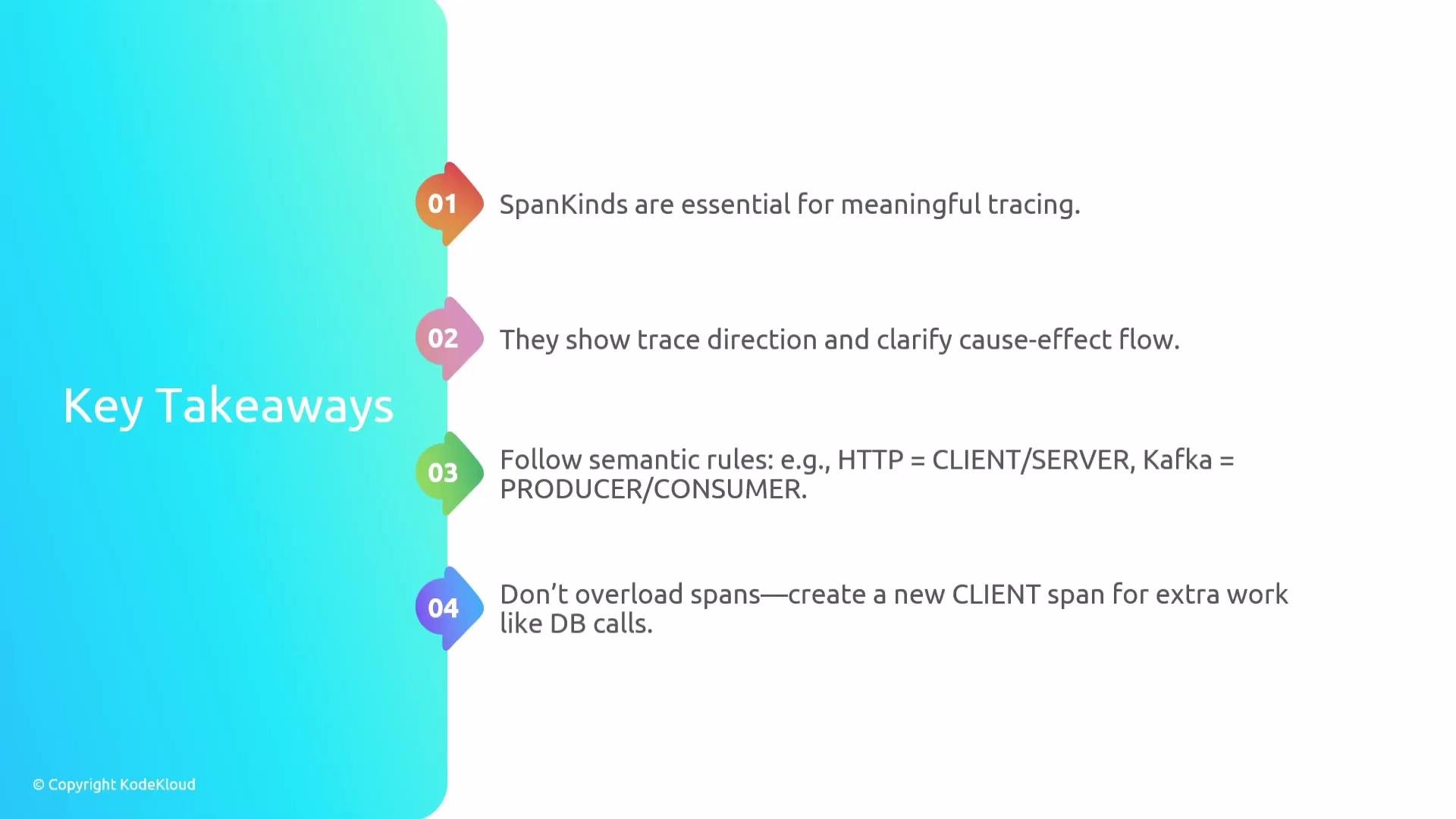
* Span kinds are essential for meaningful tracing: they indicate direction, communication style, and clarify cause-effect relationships.
* Use `CLIENT`/`SERVER` for synchronous request/response; use `PRODUCER`/`CONSUMER` for messaging; default to `INTERNAL` for local operations.
* Avoid overloading spans with multiple roles; create distinct spans for separate outgoing operations to keep traces clear and accurate.
Key takeaways
* Span kinds are essential for meaningful tracing: they indicate direction, communication style, and clarify cause-effect relationships.
* Use `CLIENT`/`SERVER` for synchronous request/response; use `PRODUCER`/`CONSUMER` for messaging; default to `INTERNAL` for local operations.
* Avoid overloading spans with multiple roles; create distinct spans for separate outgoing operations to keep traces clear and accurate.
 Most spans you create locally will be `INTERNAL`. Reserve `CLIENT`, `SERVER`, `PRODUCER`, and `CONSUMER` for interactions that cross process or service boundaries.
Further reading and references
* OpenTelemetry Spec — Span Kind semantic conventions: [https://opentelemetry.io/docs/reference/specification/trace/semantic\_conventions/span-kind/](https://opentelemetry.io/docs/reference/specification/trace/semantic_conventions/span-kind/)
* Kafka documentation (example messaging system): [https://kafka.apache.org/documentation/](https://kafka.apache.org/documentation/)
That's it for this lesson.
Most spans you create locally will be `INTERNAL`. Reserve `CLIENT`, `SERVER`, `PRODUCER`, and `CONSUMER` for interactions that cross process or service boundaries.
Further reading and references
* OpenTelemetry Spec — Span Kind semantic conventions: [https://opentelemetry.io/docs/reference/specification/trace/semantic\_conventions/span-kind/](https://opentelemetry.io/docs/reference/specification/trace/semantic_conventions/span-kind/)
* Kafka documentation (example messaging system): [https://kafka.apache.org/documentation/](https://kafka.apache.org/documentation/)
That's it for this lesson.