> ## Documentation Index
> Fetch the complete documentation index at: https://notes.kodekloud.com/llms.txt
> Use this file to discover all available pages before exploring further.
# Schema Fundamentals
> Explains OpenTelemetry telemetry schemas, schema_url usage, semantic versioning, and how schema-aware transforms in collectors and backends translate attributes to maintain compatibility.
A telemetry schema is a versioned changelog that documents semantic-convention changes (renames, additions, deprecations) for telemetry signals. Each schema file records what changed and is stored under a predictable path such as `/schema/version`. Backends, processors, and collectors use the `schema_url` embedded in telemetry to interpret and transform incoming data correctly over time.
Example schema file (YAML):
```yaml theme={null}
file_format: 1.1.0
schema_url: https://opentelemetry.io/schemas/1.1.0
versions:
- version: 1.1.0
changes:
- rename_attributes:
- from: http.status_code
to: http.response.status_code
```
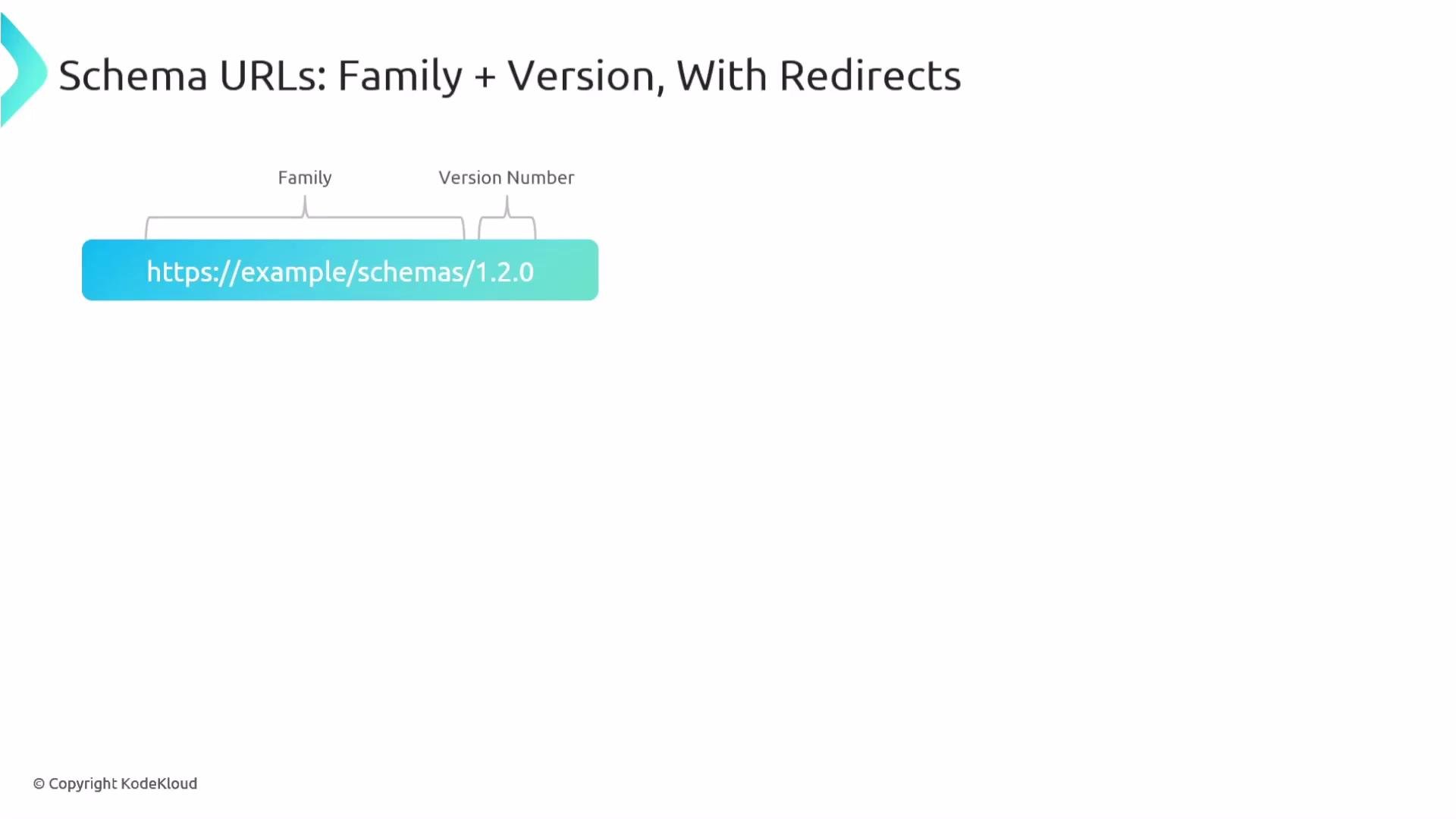
The `schema_url` within telemetry has two important parts:
* family name (groups the logical set of schema versions)
* semantic version (MAJOR.MINOR.PATCH)
If a schema host changes, the URL may redirect to a new location, allowing consumers to discover the rules for the referenced schema version.
 Embedding `schema_url` makes telemetry self-describing. Example telemetry JSON:
```json theme={null}
{
"schema_url": "https://opentelemetry.io/schemas/1.1.0",
"resource": {
"service.name": "payment.service"
}
}
```
Typical schema files list changes in order and can target scopes: `all`, `spans`, `metrics`, etc. Example schema with scoped changes:
```yaml theme={null}
schema_url: https://opentelemetry.io/schemas/1.1.0
versions:
- version: 1.1.0
all:
rename_attributes:
- from: http.status_code
to: http.response.status_code
spans:
add_attributes:
- key: telemetry.source
value: "payment-service"
metrics:
remove_attributes:
- key: deprecated.metric.id
```
Table: Schema scope mappings
| Scope | Purpose | Example change |
| --------- | ---------------------------------------------- | ---------------------------------------------------------------------------- |
| `all` | Applies to every signal (spans, metrics, logs) | `rename_attributes: {from: http.status_code, to: http.response.status_code}` |
| `spans` | Only affects span attributes | `add_attributes: [{key: telemetry.source, value: "payment-service"}]` |
| `metrics` | Only affects metric attributes | `remove_attributes: [{key: deprecated.metric.id}]` |
Semantic versioning determines compatibility and consumer behavior. Follow [SemVer](https://semver.org) rules: patch releases are ignorable structural fixes, minor versions add backward-compatible rules, and major versions introduce potentially breaking changes. Tools should read schema files up to the minor version they support; newer minors or different majors may contain rules they don't understand.
Embedding `schema_url` makes telemetry self-describing. Example telemetry JSON:
```json theme={null}
{
"schema_url": "https://opentelemetry.io/schemas/1.1.0",
"resource": {
"service.name": "payment.service"
}
}
```
Typical schema files list changes in order and can target scopes: `all`, `spans`, `metrics`, etc. Example schema with scoped changes:
```yaml theme={null}
schema_url: https://opentelemetry.io/schemas/1.1.0
versions:
- version: 1.1.0
all:
rename_attributes:
- from: http.status_code
to: http.response.status_code
spans:
add_attributes:
- key: telemetry.source
value: "payment-service"
metrics:
remove_attributes:
- key: deprecated.metric.id
```
Table: Schema scope mappings
| Scope | Purpose | Example change |
| --------- | ---------------------------------------------- | ---------------------------------------------------------------------------- |
| `all` | Applies to every signal (spans, metrics, logs) | `rename_attributes: {from: http.status_code, to: http.response.status_code}` |
| `spans` | Only affects span attributes | `add_attributes: [{key: telemetry.source, value: "payment-service"}]` |
| `metrics` | Only affects metric attributes | `remove_attributes: [{key: deprecated.metric.id}]` |
Semantic versioning determines compatibility and consumer behavior. Follow [SemVer](https://semver.org) rules: patch releases are ignorable structural fixes, minor versions add backward-compatible rules, and major versions introduce potentially breaking changes. Tools should read schema files up to the minor version they support; newer minors or different majors may contain rules they don't understand.
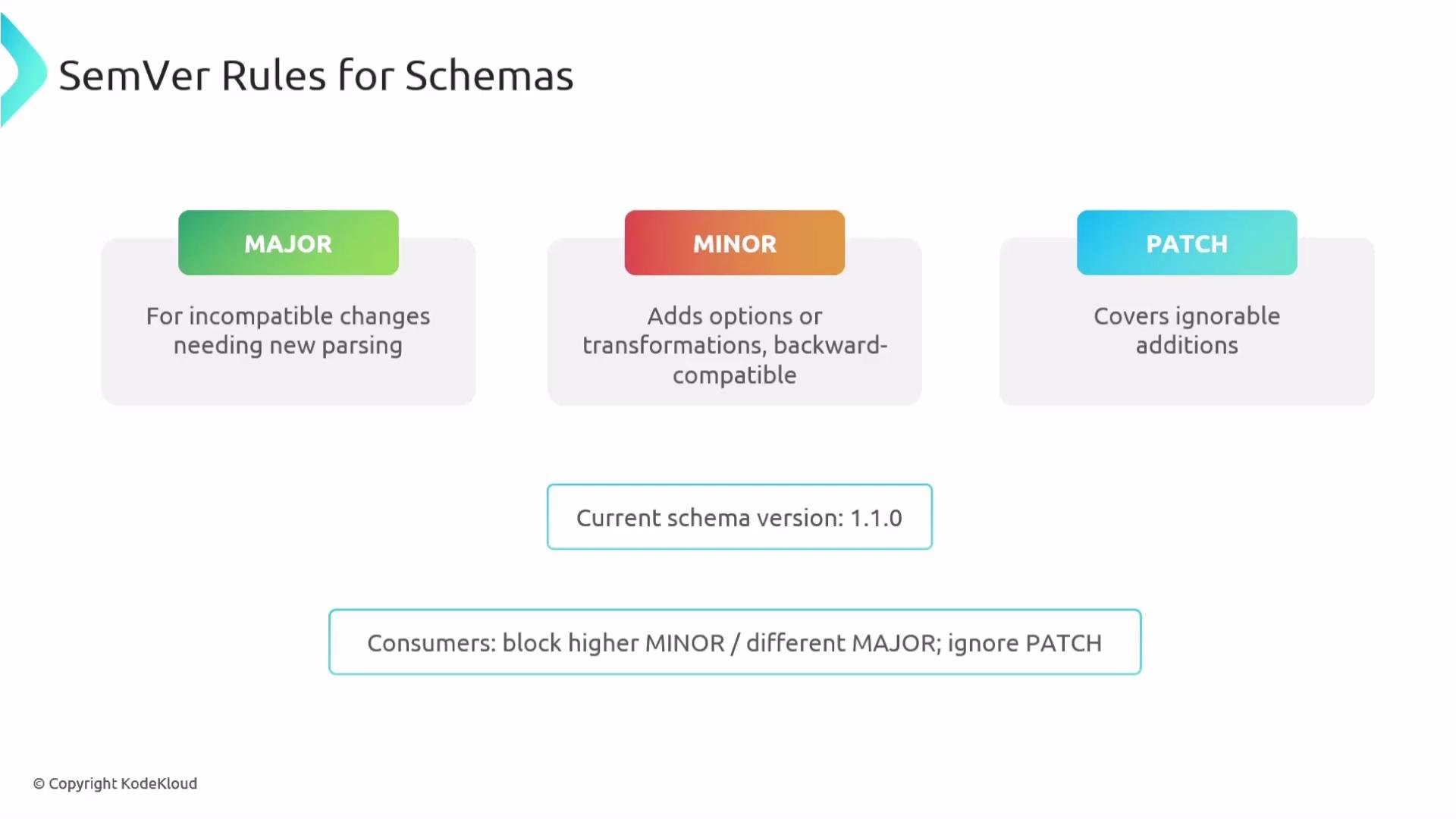 Consumers can safely read schema files with the same major version and a minor version less than or equal to the minor they support. Patch differences are always safe.
Compatibility examples (quick reference):
| File version | Consumer version | Compatible? | Notes |
| -------------------------------- | ---------------- | ----------: | --------------------------------------------------- |
| `1.1.0` vs `1.1.0` | `1.1.0` | Yes | Exact match |
| `1.0.1` vs `1.0.9` | `1.0.x` | Yes | Patch-only differences are compatible |
| file `1.1.x` vs consumer `1.3.x` | `1.x` | Yes | Newer consumer can read an older minor |
| file `1.3.x` vs consumer `1.1.x` | `1.x` | No | File minor newer than consumer — consumer is behind |
| file `2.0.0` vs consumer `1.x.y` | major differs | No | Breaking changes possible |
Concrete example
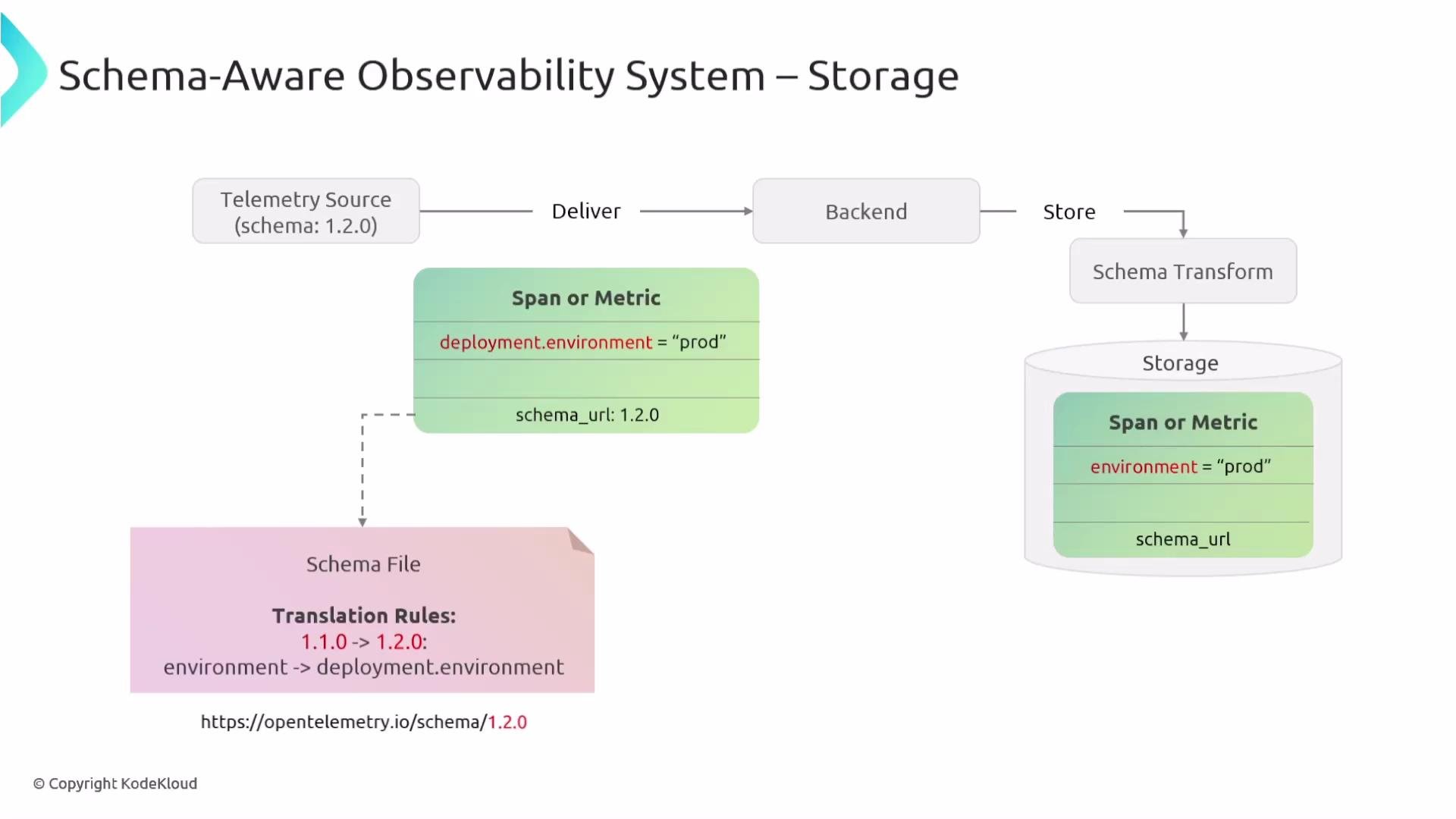
* An SDK emits spans and metrics with `schema_url = https://opentelemetry.io/schemas/1.2.0`. Each span contains `deployment.environment = "prod"`.
* In schema `1.1.0` the same attribute was named `environment`.
* If the backend stores data using `1.1.0`, incoming `1.2.0` telemetry must be transformed before storage so the backend remains consistent.
Consumers can safely read schema files with the same major version and a minor version less than or equal to the minor they support. Patch differences are always safe.
Compatibility examples (quick reference):
| File version | Consumer version | Compatible? | Notes |
| -------------------------------- | ---------------- | ----------: | --------------------------------------------------- |
| `1.1.0` vs `1.1.0` | `1.1.0` | Yes | Exact match |
| `1.0.1` vs `1.0.9` | `1.0.x` | Yes | Patch-only differences are compatible |
| file `1.1.x` vs consumer `1.3.x` | `1.x` | Yes | Newer consumer can read an older minor |
| file `1.3.x` vs consumer `1.1.x` | `1.x` | No | File minor newer than consumer — consumer is behind |
| file `2.0.0` vs consumer `1.x.y` | major differs | No | Breaking changes possible |
Concrete example
* An SDK emits spans and metrics with `schema_url = https://opentelemetry.io/schemas/1.2.0`. Each span contains `deployment.environment = "prod"`.
* In schema `1.1.0` the same attribute was named `environment`.
* If the backend stores data using `1.1.0`, incoming `1.2.0` telemetry must be transformed before storage so the backend remains consistent.
 How translation preserves user experience
* SDK emits telemetry using the new schema (`1.2.0`) and queries or dashboards are written against `deployment.environment`.
* Storage uses `environment` with `schema_url = 'https://opentelemetry.io/schemas/1.1.0'`.
* A schema-aware query layer rewrites user-facing queries to match storage semantics.
Example user query (written against `1.2.0`):
```sql theme={null}
SELECT * FROM Spans WHERE deployment.environment = 'prod';
```
Translated storage query (rewritten to backend schema):
```sql theme={null}
SELECT * FROM Spans WHERE environment = 'prod' AND schema_url = 'https://opentelemetry.io/schemas/1.1.0';
```
Collector example (schema translation at the edge)
1. Developers configure their SDKs normally and emit spans/metrics under `1.2.0` (e.g., `deployment.environment = "prod"`).
2. Telemetry is sent to an OpenTelemetry Collector instead of directly to the backend.
3. The Collector runs a schema-transform processor configured with a target `schema_url` (for example, `https://opentelemetry.io/schemas/1.1.0`).
4. The processor consults both the incoming `1.2.0` rules and the target `1.1.0` rules to determine renames and rewrites.
5. The Collector outputs telemetry where attribute names and the `schema_url` match the target `1.1.0` format, then forwards it to the backend.
Because the Collector performs translation before storage, the backend receives consistent, target-schema-compliant payloads and does not need to perform per-item rewrites.
Summary
* Schema files are versioned declarations of semantic changes (renames, additions, deprecations).
* The telemetry `schema_url` makes data self-describing and enables correct interpretation across the pipeline.
* Follow semantic versioning: patches are safe, minors are backward-compatible additions, majors may break.
* Schema transforms (in the Collector or backend) map attributes between versions so storage and queries remain consistent across schema evolution.
Links and references
* [OpenTelemetry Collector documentation](https://opentelemetry.io/docs/collector/)
* [Semantic Versioning (SemVer)](https://semver.org)
* [OpenTelemetry Schemas (reference)](https://opentelemetry.io/schemas/)
How translation preserves user experience
* SDK emits telemetry using the new schema (`1.2.0`) and queries or dashboards are written against `deployment.environment`.
* Storage uses `environment` with `schema_url = 'https://opentelemetry.io/schemas/1.1.0'`.
* A schema-aware query layer rewrites user-facing queries to match storage semantics.
Example user query (written against `1.2.0`):
```sql theme={null}
SELECT * FROM Spans WHERE deployment.environment = 'prod';
```
Translated storage query (rewritten to backend schema):
```sql theme={null}
SELECT * FROM Spans WHERE environment = 'prod' AND schema_url = 'https://opentelemetry.io/schemas/1.1.0';
```
Collector example (schema translation at the edge)
1. Developers configure their SDKs normally and emit spans/metrics under `1.2.0` (e.g., `deployment.environment = "prod"`).
2. Telemetry is sent to an OpenTelemetry Collector instead of directly to the backend.
3. The Collector runs a schema-transform processor configured with a target `schema_url` (for example, `https://opentelemetry.io/schemas/1.1.0`).
4. The processor consults both the incoming `1.2.0` rules and the target `1.1.0` rules to determine renames and rewrites.
5. The Collector outputs telemetry where attribute names and the `schema_url` match the target `1.1.0` format, then forwards it to the backend.
Because the Collector performs translation before storage, the backend receives consistent, target-schema-compliant payloads and does not need to perform per-item rewrites.
Summary
* Schema files are versioned declarations of semantic changes (renames, additions, deprecations).
* The telemetry `schema_url` makes data self-describing and enables correct interpretation across the pipeline.
* Follow semantic versioning: patches are safe, minors are backward-compatible additions, majors may break.
* Schema transforms (in the Collector or backend) map attributes between versions so storage and queries remain consistent across schema evolution.
Links and references
* [OpenTelemetry Collector documentation](https://opentelemetry.io/docs/collector/)
* [Semantic Versioning (SemVer)](https://semver.org)
* [OpenTelemetry Schemas (reference)](https://opentelemetry.io/schemas/)