> ## Documentation Index
> Fetch the complete documentation index at: https://notes.kodekloud.com/llms.txt
> Use this file to discover all available pages before exploring further.
# Vector Matching
> Describes PromQL vector matching and modifiers like on ignoring group_left and group_right to control label based pairing and many-to-one or one-to-many arithmetic
In this lesson we cover vector matching in PromQL—how Prometheus pairs elements from two instant vectors when performing element-wise arithmetic and how to control that matching using label selectors and grouping modifiers.
## Element-wise operations between vectors
PromQL can operate on two instant vectors element-wise. For example, to compute the percentage of free space per filesystem, divide available bytes by total size and multiply by 100:
```text theme={null}
node_filesystem_avail_bytes{instance="node1", job="node", mountpoint="/home"} 512
node_filesystem_avail_bytes{instance="node1", job="node", mountpoint="/var"} 484
node_filesystem_size_bytes{instance="node1", job="node", mountpoint="/home"} 1024
node_filesystem_size_bytes{instance="node1", job="node", mountpoint="/var"} 2048
```
Query:
```promql theme={null}
node_filesystem_avail_bytes / node_filesystem_size_bytes * 100
```
This divides each left-hand sample by the corresponding right-hand sample and multiplies by 100 to yield a percentage.
### Label-matching rule (exact by default)
By default, PromQL only pairs two samples when their complete set of labels and values are identical. The matching process checks every label on the left sample and tries to find a sample on the right with the exact same label names and values.
All labels on the two vectors must match exactly unless you use `on(...)` or `ignoring(...)` to control which labels are used for matching.
If labels differ (or one sample has an extra label), they will not match:
```text theme={null}
node_filesystem_avail_bytes{instance="node1", job="node", mountpoint="/home"} 512
node_filesystem_size_bytes{instance="node2", job="node", mountpoint="/home"} 1024
```
Because `instance` differs, these samples will not pair.
## Controlling which labels are used for matching
Use `on(...)` to list the label names to match on, or `ignoring(...)` to exclude certain labels from the matching. This is vital when one metric has additional label dimensions that should not prevent matching.
Example: compute the percentage of `500` errors per HTTP method when error metrics include a `code` label, but request metrics do not.
Input metrics:
```text theme={null}
http_errors{method="get", code="500"} 40
http_errors{method="get", code="404"} 77
http_errors{method="put", code="501"} 23
http_errors{method="post", code="500"} 61
http_errors{method="post", code="404"} 42
http_requests{method="get"} 421
http_requests{method="del"} 288
http_requests{method="post"} 372
```
Options to match by `method`:
* Ignore the `code` label on the errors side:
```promql theme={null}
http_errors{code="500"} / ignoring(code) http_requests
```
* Or explicitly match on `method`:
```promql theme={null}
http_errors{code="500"} / on(method) http_requests
```
Only methods present on both sides will appear. In this dataset, `put` (only in `http_errors`) and `del` (only in `http_requests`) will be dropped from the output.
You can list multiple labels in `on(...)`:
```promql theme={null}
http_errors / on(method, instance) http_requests
```
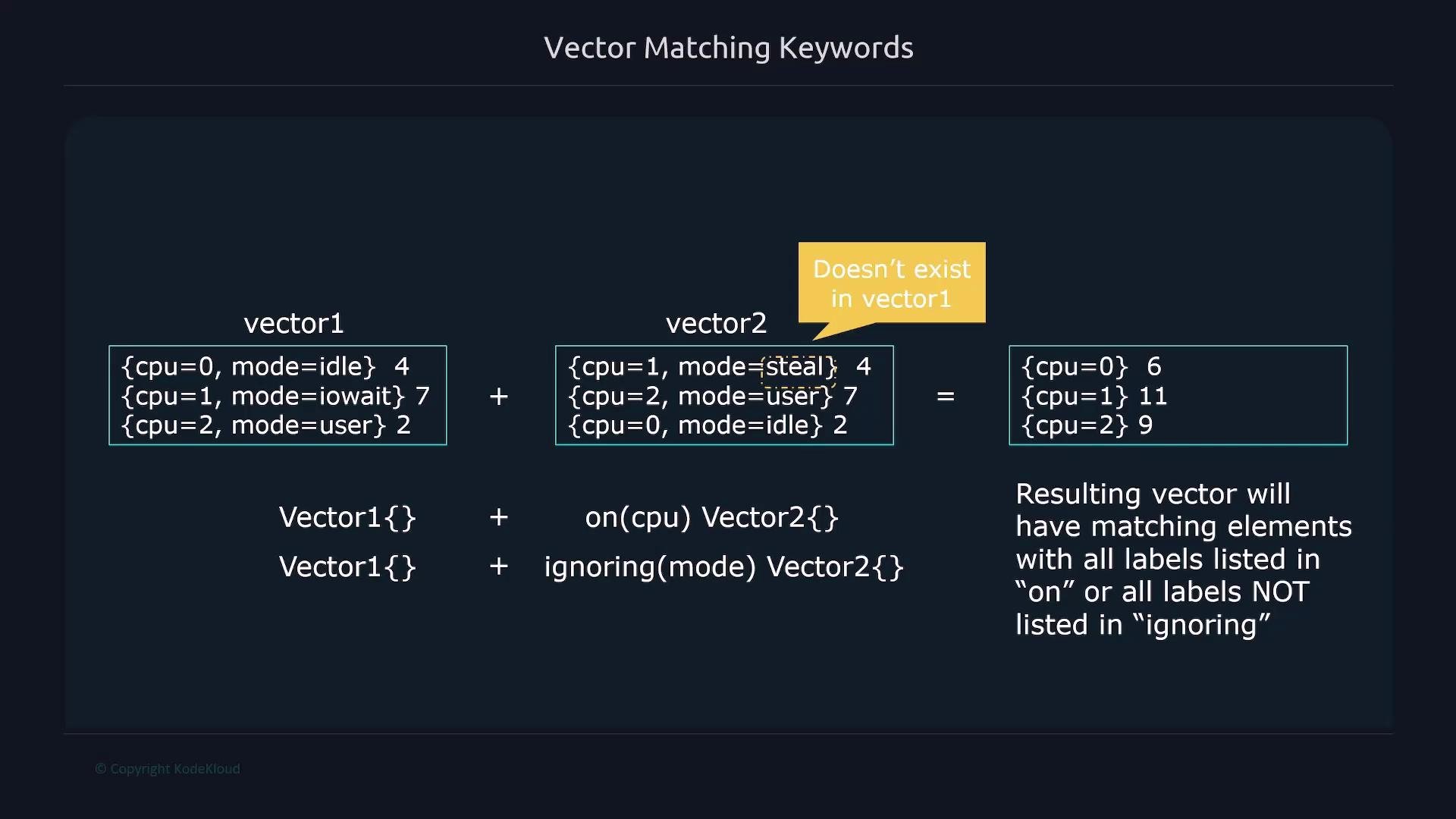
## Example: match on CPU but ignore mode
When metrics include different operational modes but you only want to match by CPU:
vector1:
```text theme={null}
{cpu="0", mode="idle"} 4
{cpu="1", mode="iowait"} 7
{cpu="2", mode="user"} 2
```
vector2:
```text theme={null}
{cpu="1", mode="steal"} 4
{cpu="2", mode="user"} 7
{cpu="0", mode="idle"} 2
```
Use `on(cpu)` or `ignoring(mode)` to match samples by `cpu` only.
 ## Matching modes: one-to-one, many-to-one, one-to-many
* One-to-one (default): each element on the left matches at most one element on the right.
* Many-to-one / one-to-many: when multiple samples on one side match a single sample on the other side, you must explicitly allow this with `group_left()` or `group_right()`.
When PromQL detects multiple matches for a single sample without an explicit grouping modifier, it returns an error: "multiple matches for labels".
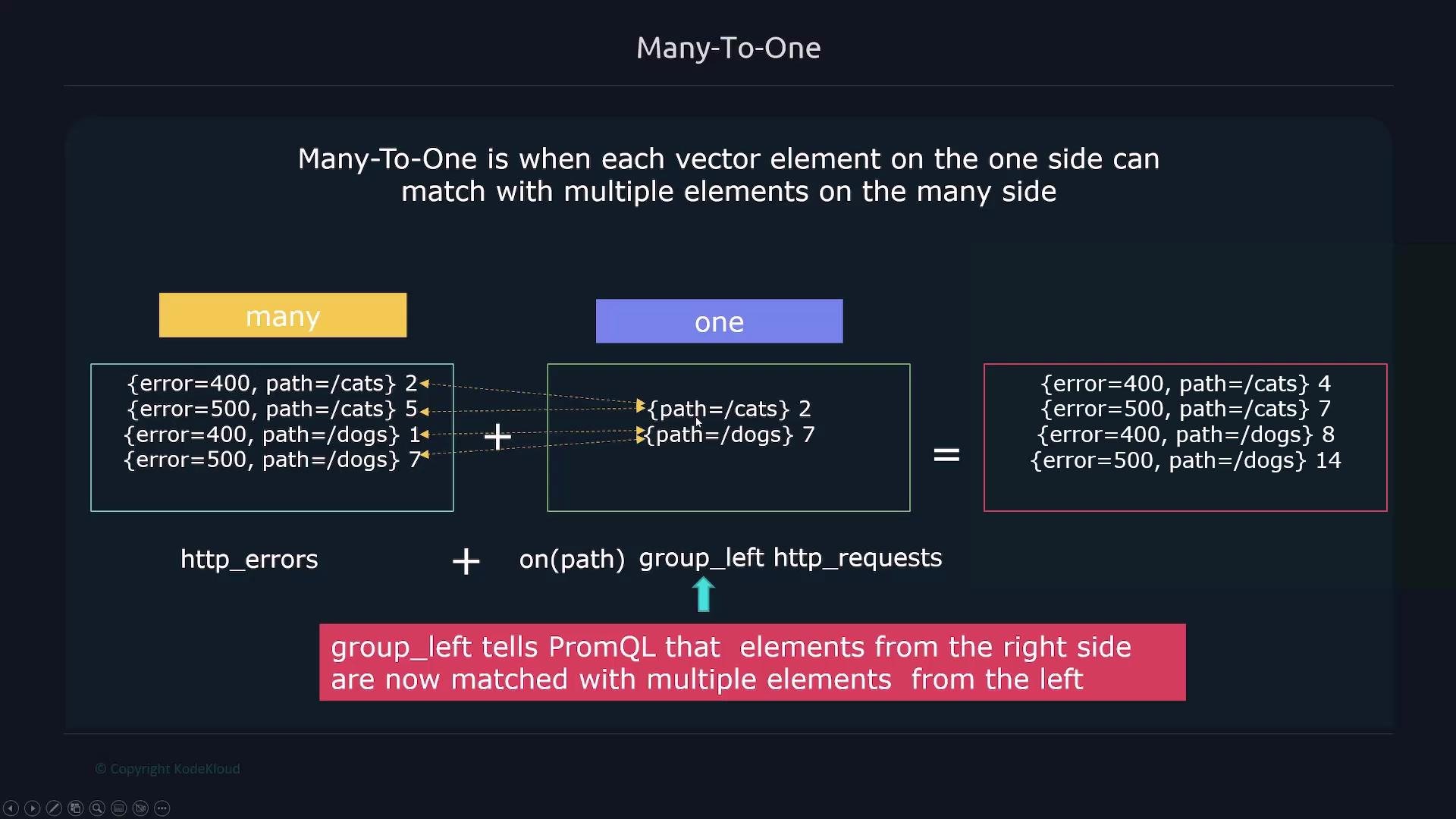
Example (many-to-one): error counts per `path` and `error` vs. total requests per `path`.
Input:
```text theme={null}
http_errors:
{error="400", path="/cats"} 2
{error="500", path="/cats"} 5
{error="400", path="/dogs"} 1
{error="500", path="/dogs"} 7
http_requests:
{path="/cats"} 14
{path="/dogs"} 20
```
A naive query:
```promql theme={null}
http_errors / on(path) http_requests
```
returns an error due to multiple `http_errors` entries for each `path`. Tell PromQL that the left-hand side may have multiple entries matching a single right-hand entry with `group_left()`:
```promql theme={null}
http_errors / on(path) group_left() http_requests
```
`group_left()` preserves the extra labels from the left-hand side (for example `error`) in the output.
## Matching modes: one-to-one, many-to-one, one-to-many
* One-to-one (default): each element on the left matches at most one element on the right.
* Many-to-one / one-to-many: when multiple samples on one side match a single sample on the other side, you must explicitly allow this with `group_left()` or `group_right()`.
When PromQL detects multiple matches for a single sample without an explicit grouping modifier, it returns an error: "multiple matches for labels".
Example (many-to-one): error counts per `path` and `error` vs. total requests per `path`.
Input:
```text theme={null}
http_errors:
{error="400", path="/cats"} 2
{error="500", path="/cats"} 5
{error="400", path="/dogs"} 1
{error="500", path="/dogs"} 7
http_requests:
{path="/cats"} 14
{path="/dogs"} 20
```
A naive query:
```promql theme={null}
http_errors / on(path) http_requests
```
returns an error due to multiple `http_errors` entries for each `path`. Tell PromQL that the left-hand side may have multiple entries matching a single right-hand entry with `group_left()`:
```promql theme={null}
http_errors / on(path) group_left() http_requests
```
`group_left()` preserves the extra labels from the left-hand side (for example `error`) in the output.
 Use `group_right()` when the right-hand side may have multiple matching samples per single left-hand sample (one-to-many in the opposite direction). The `group_*()` modifier may be used with or without a label list; providing a label list preserves those labels from the many side in the result.
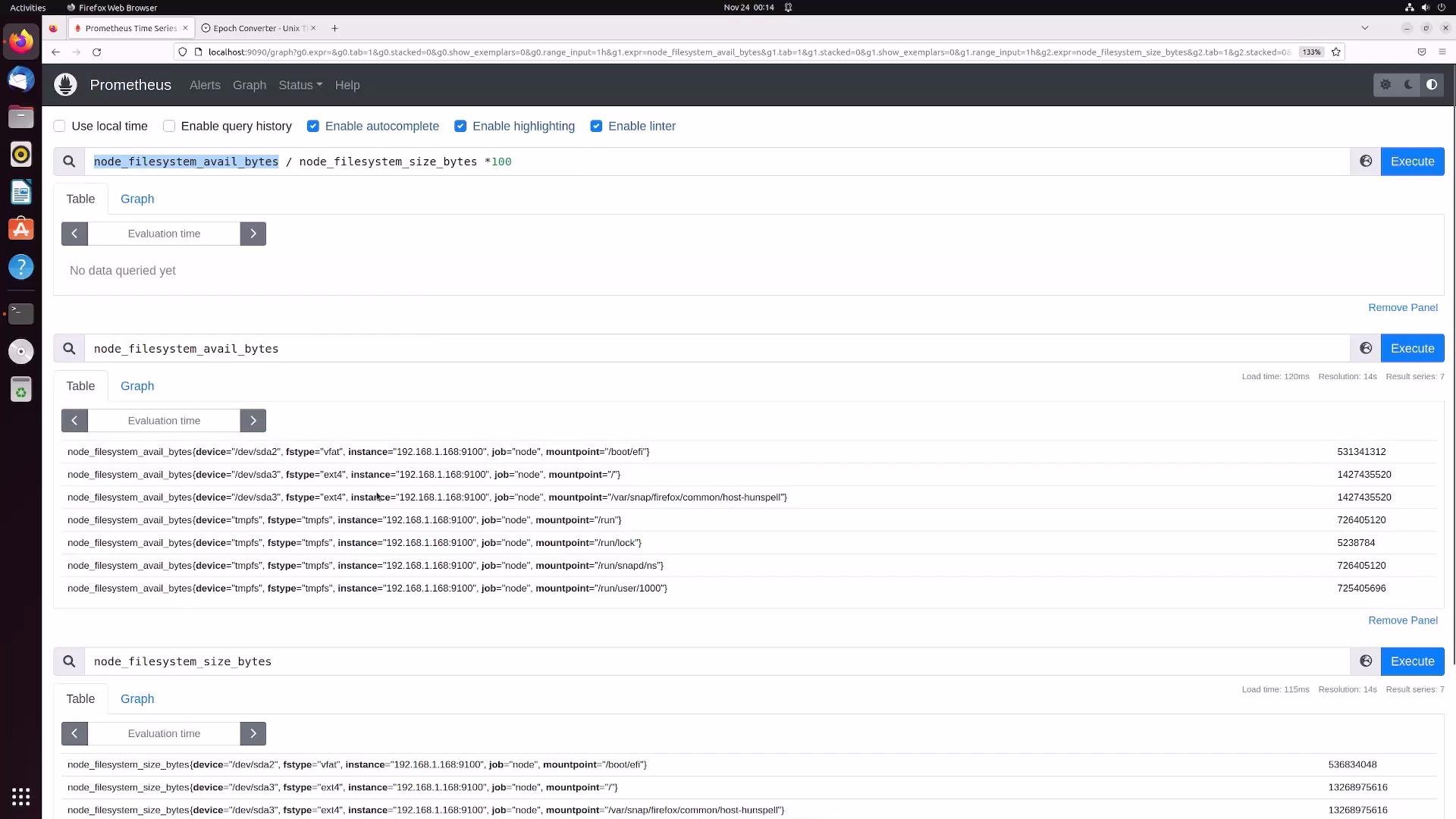
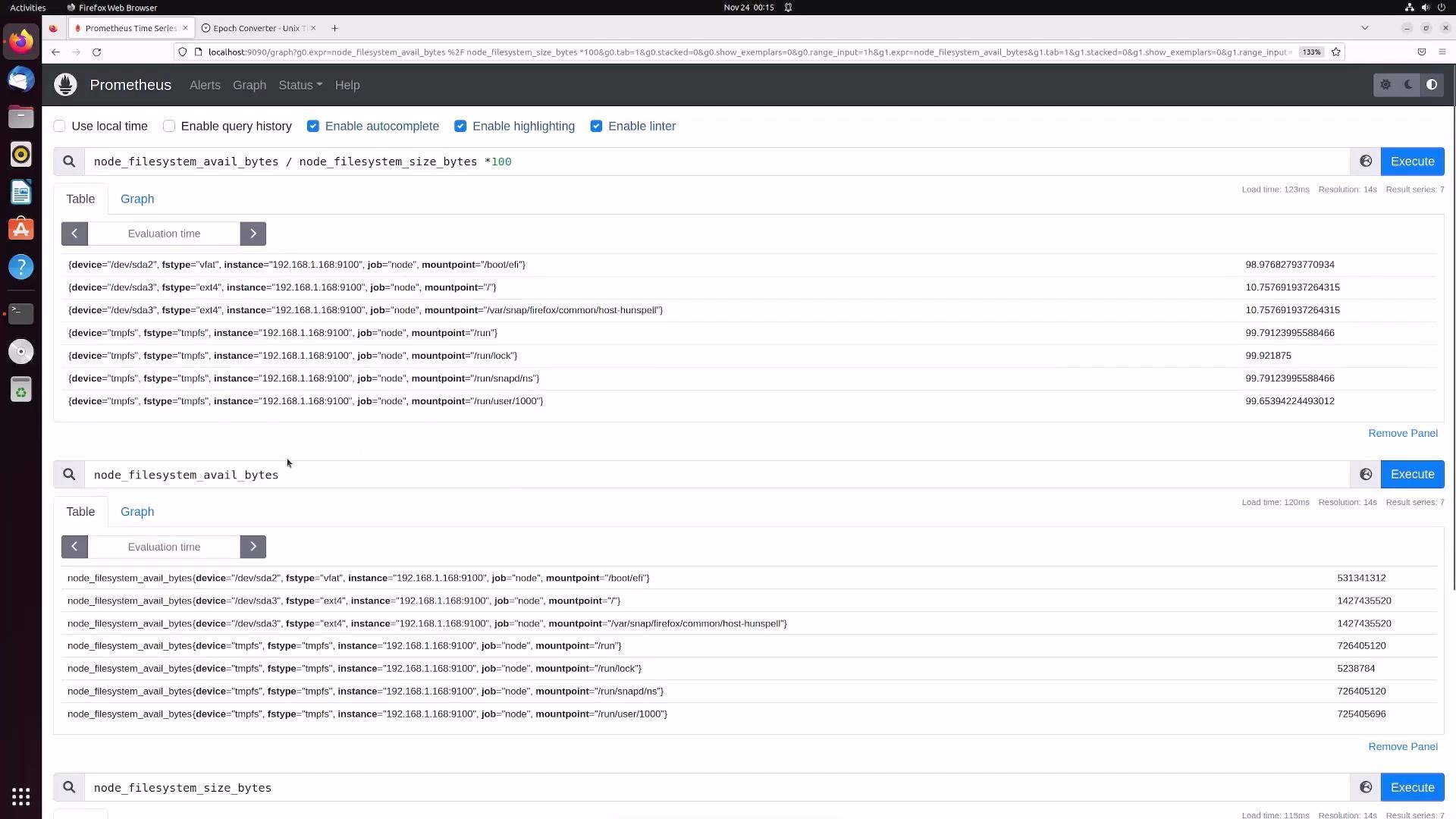
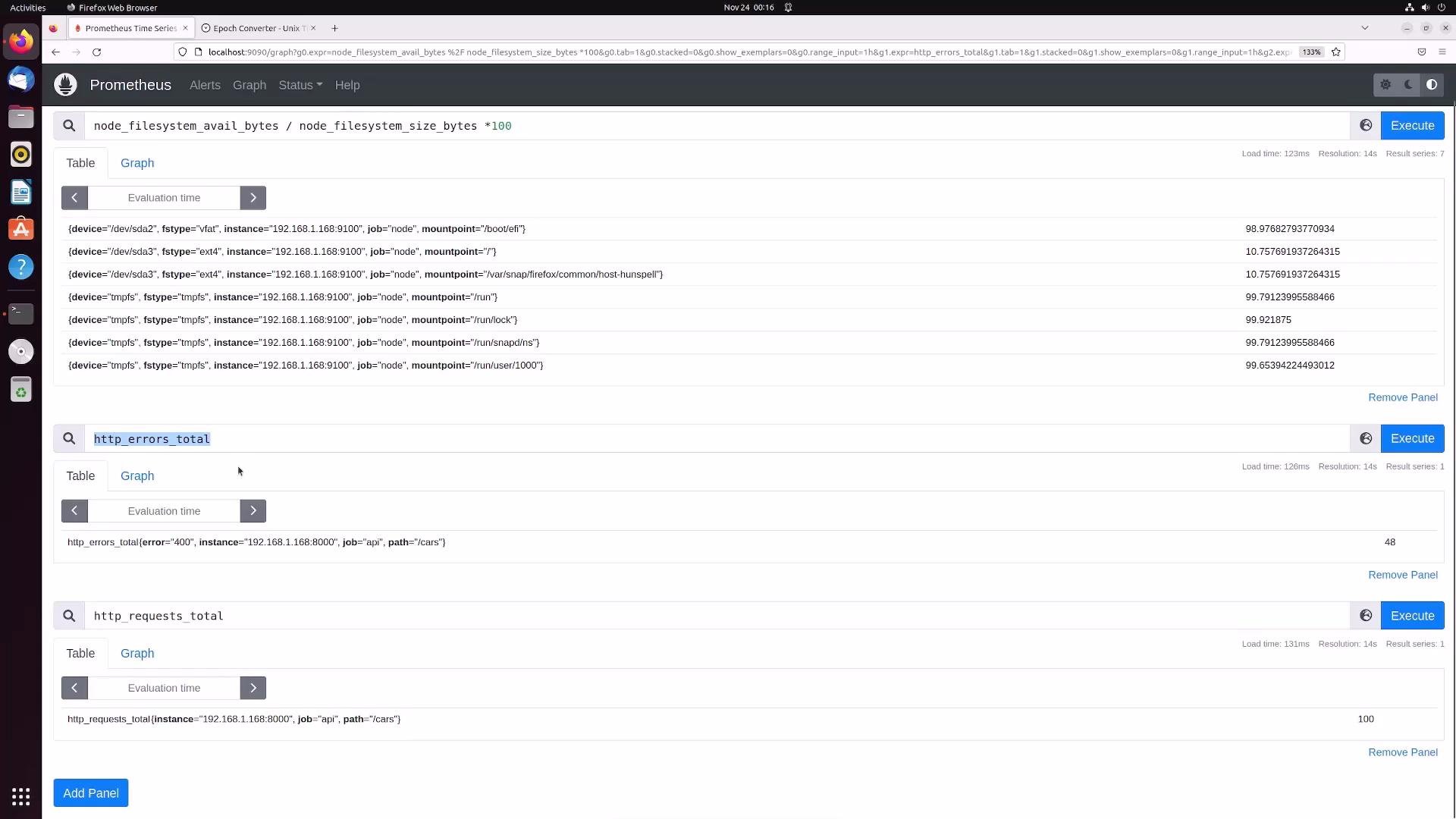
## Prometheus UI example: filesystem availability percentage
Each filesystem time series commonly includes labels like `device`, `fstype`, `instance`, `job`, and `mountpoint`. When the label sets align exactly between `node_filesystem_avail_bytes` and `node_filesystem_size_bytes`, dividing them yields the percentage available for that timeseries:
```text theme={null}
node_filesystem_avail_bytes{device="/dev/sda2", fstype="vfat", instance="192.168.1.168:9100", job="node", mountpoint="/boot/efi"} 531341312
node_filesystem_size_bytes{device="/dev/sda2", fstype="vfat", instance="192.168.1.168:9100", job="node", mountpoint="/boot/efi"} 536834048
...
```
If labels match perfectly, this query will return the expected percentage per filesystem.
Use `group_right()` when the right-hand side may have multiple matching samples per single left-hand sample (one-to-many in the opposite direction). The `group_*()` modifier may be used with or without a label list; providing a label list preserves those labels from the many side in the result.
## Prometheus UI example: filesystem availability percentage
Each filesystem time series commonly includes labels like `device`, `fstype`, `instance`, `job`, and `mountpoint`. When the label sets align exactly between `node_filesystem_avail_bytes` and `node_filesystem_size_bytes`, dividing them yields the percentage available for that timeseries:
```text theme={null}
node_filesystem_avail_bytes{device="/dev/sda2", fstype="vfat", instance="192.168.1.168:9100", job="node", mountpoint="/boot/efi"} 531341312
node_filesystem_size_bytes{device="/dev/sda2", fstype="vfat", instance="192.168.1.168:9100", job="node", mountpoint="/boot/efi"} 536834048
...
```
If labels match perfectly, this query will return the expected percentage per filesystem.
 If labels do not match (for example one metric has an extra `error` label), the division returns no results unless you control matching with `on(...)`, `ignoring(...)`, and—if multiple matches occur—`group_left()` or `group_right()`.
 ### Example: HTTP errors vs. HTTP requests totals
When `http_errors_total` includes an `error` label and `http_requests_total` does not:
```text theme={null}
http_errors_total{error="400", instance="192.168.1.168:8000", job="api", path="/cars"} 13
http_errors_total{error="500", instance="192.168.1.168:8000", job="api", path="/cars"} 32
http_requests_total{instance="192.168.1.168:8000", job="api", path="/cars"} 100
```
A direct division will yield nothing because label sets differ. Exclude `error` from matching:
```promql theme={null}
http_errors_total / ignoring(error) http_requests_total
```
If multiple `http_errors_total` samples (different `error` values) match a single `http_requests_total` sample, use `group_left()` to explicitly allow many-to-one matching and retain the `error` label in results:
```promql theme={null}
http_errors_total / ignoring(error) group_left() http_requests_total
```
### Example: HTTP errors vs. HTTP requests totals
When `http_errors_total` includes an `error` label and `http_requests_total` does not:
```text theme={null}
http_errors_total{error="400", instance="192.168.1.168:8000", job="api", path="/cars"} 13
http_errors_total{error="500", instance="192.168.1.168:8000", job="api", path="/cars"} 32
http_requests_total{instance="192.168.1.168:8000", job="api", path="/cars"} 100
```
A direct division will yield nothing because label sets differ. Exclude `error` from matching:
```promql theme={null}
http_errors_total / ignoring(error) http_requests_total
```
If multiple `http_errors_total` samples (different `error` values) match a single `http_requests_total` sample, use `group_left()` to explicitly allow many-to-one matching and retain the `error` label in results:
```promql theme={null}
http_errors_total / ignoring(error) group_left() http_requests_total
```
 ## Matching modes at a glance
| Matching mode | Description | Example |
| -------------------- | --------------------------------------------------------------------------------------------------- | ------------------------------ |
| One-to-one (default) | Each sample on the left matches at most one on the right. Requires identical label sets and values. | `A / B` |
| Many-to-one | Multiple samples on the left match a single sample on the right. Must use `group_left()`. | `A / on(path) group_left() B` |
| One-to-many | Multiple samples on the right match a single sample on the left. Must use `group_right()`. | `A / on(path) group_right() B` |
Note: In the table, `A` and `B` represent vectors; any label selectors like `{path="/cats"}` should be written as PromQL expressions in queries.
## Practical tips and links
* Always inspect the label sets of the two vectors (`label_join`, `label_replace`, or the Prometheus UI) before combining them to avoid silent drops or errors.
* Use `on(...)` to restrict matching to specific key labels, and `ignoring(...)` to exclude irrelevant labels.
* When allowing multiple matches, choose `group_left()` or `group_right()` according to which side holds the extra label dimensions you want to preserve.
* To explicitly keep only select labels from the many side, supply them to `group_left()` or `group_right()`.
Further reading:
* [PromQL: Binary Operators and Vector Matching](https://prometheus.io/docs/prometheus/latest/querying/operators/#vector-matching)
* [Prometheus Documentation](https://prometheus.io/docs/)
Summary
* PromQL defaults to strict one-to-one label matching.
* Use `on(...)` / `ignoring(...)` to control which labels are considered for matching.
* Use `group_left()` / `group_right()` to explicitly allow many-to-one or one-to-many matches and to preserve labels from the many side when needed.
## Matching modes at a glance
| Matching mode | Description | Example |
| -------------------- | --------------------------------------------------------------------------------------------------- | ------------------------------ |
| One-to-one (default) | Each sample on the left matches at most one on the right. Requires identical label sets and values. | `A / B` |
| Many-to-one | Multiple samples on the left match a single sample on the right. Must use `group_left()`. | `A / on(path) group_left() B` |
| One-to-many | Multiple samples on the right match a single sample on the left. Must use `group_right()`. | `A / on(path) group_right() B` |
Note: In the table, `A` and `B` represent vectors; any label selectors like `{path="/cats"}` should be written as PromQL expressions in queries.
## Practical tips and links
* Always inspect the label sets of the two vectors (`label_join`, `label_replace`, or the Prometheus UI) before combining them to avoid silent drops or errors.
* Use `on(...)` to restrict matching to specific key labels, and `ignoring(...)` to exclude irrelevant labels.
* When allowing multiple matches, choose `group_left()` or `group_right()` according to which side holds the extra label dimensions you want to preserve.
* To explicitly keep only select labels from the many side, supply them to `group_left()` or `group_right()`.
Further reading:
* [PromQL: Binary Operators and Vector Matching](https://prometheus.io/docs/prometheus/latest/querying/operators/#vector-matching)
* [Prometheus Documentation](https://prometheus.io/docs/)
Summary
* PromQL defaults to strict one-to-one label matching.
* Use `on(...)` / `ignoring(...)` to control which labels are considered for matching.
* Use `group_left()` / `group_right()` to explicitly allow many-to-one or one-to-many matches and to preserve labels from the many side when needed.