> ## Documentation Index
> Fetch the complete documentation index at: https://notes.kodekloud.com/llms.txt
> Use this file to discover all available pages before exploring further.
# Mocking Dependencies in Rust
> This article explores mocking in Rust, demonstrating its importance for creating isolated, predictable, and repeatable tests using the mockall crate.
In this article, we explore the concept of mocking in Rust and demonstrate its importance for creating isolated, predictable, and repeatable tests. Using the [mockall crate](https://crates.io/crates/mockall), you'll learn how to simulate dependencies and verify interactions between components.
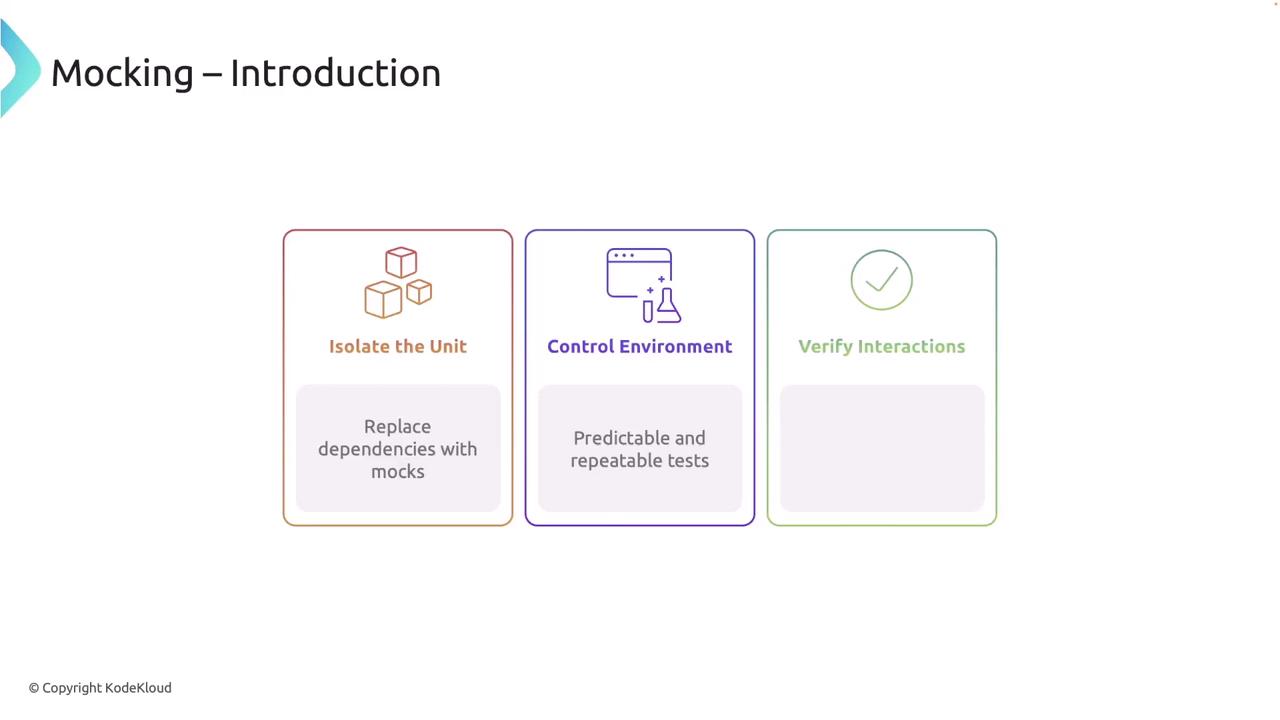
Mocking is the practice of creating simulated objects that mimic the behavior of real objects. Its main objectives include:
* Isolating the unit under test by replacing its dependencies with mocks.
* Controlling the test environment to ensure repeatability.
* Verifying interactions between components to confirm expected behaviors.
## When to Use Mocks
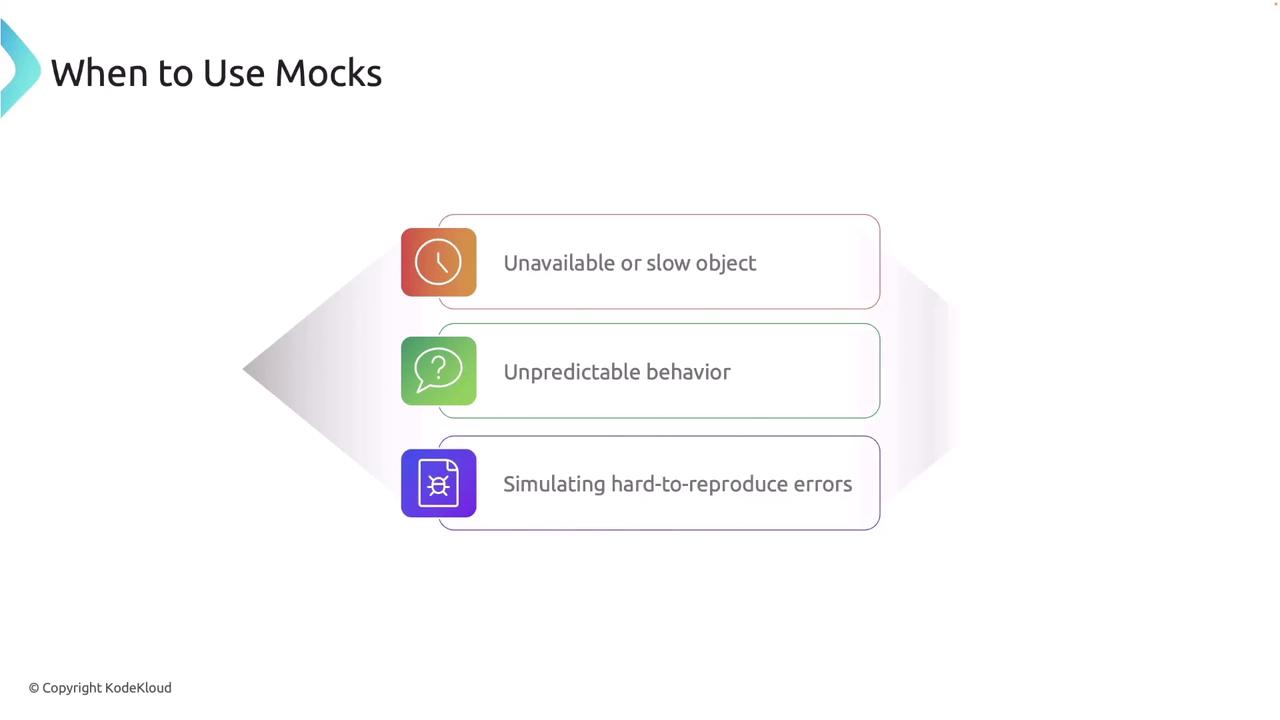
Mocks are ideal in scenarios where:
* The real object is unavailable or slow (e.g., a database or an external API).
* Unpredictable behavior of the real object could lead to flaky tests.
* You need to simulate error conditions that are difficult to reproduce with the actual dependency.
## Why Use mockall?
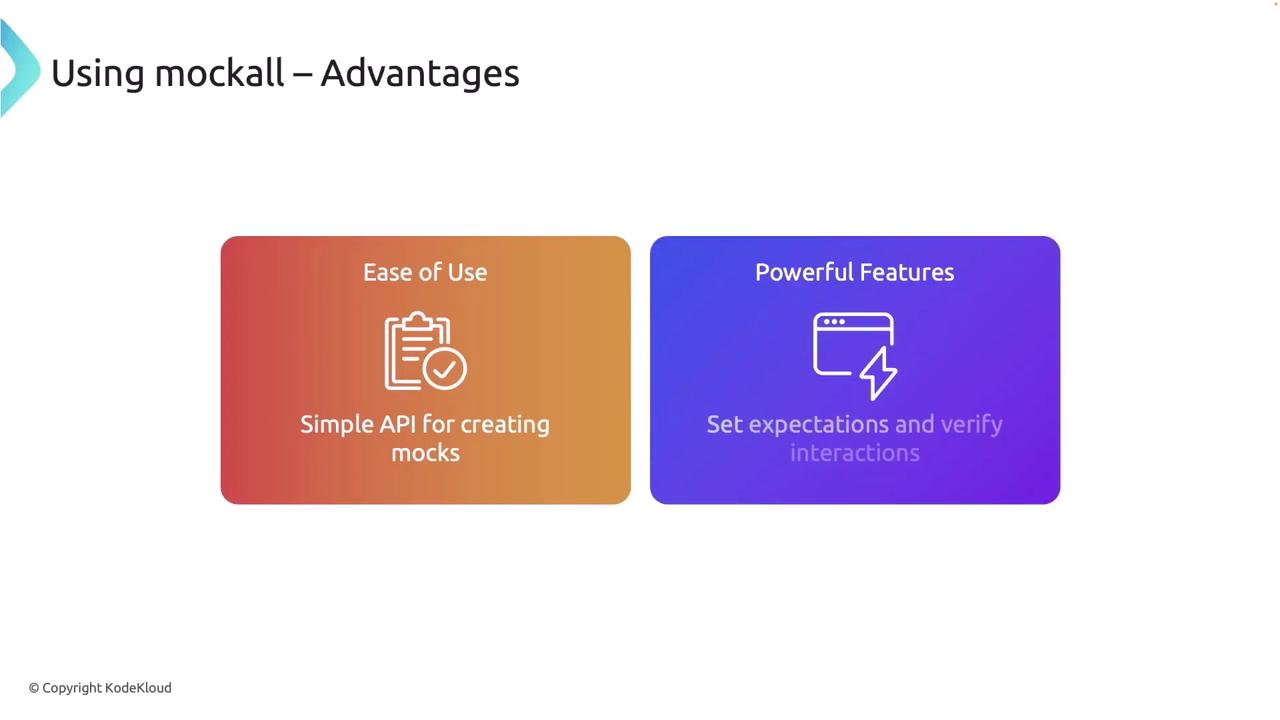
The `mockall` crate offers a simple yet powerful API for creating mocks, setting expectations, and verifying method calls. Its advantages include:
* A straightforward API that simplifies mock creation.
* Support for returning specific values and simulating errors.
* Robust interaction verification to ensure your components communicate as expected.
## Setting Up the Project
Begin by creating a library crate named `rust-mock` and opening it in VS Code. Suppose you are building a service that interacts with an external API, but during unit testing you want to avoid actual API calls. Instead, you'll implement a mock.
### Basic Function Example
Consider a simple function along with its test:
```rust theme={null}
pub fn add(left: u64, right: u64) -> u64 {
left + right
}
#[cfg(test)]
mod tests {
use super::*;
#[test]
fn it_works() {
let result: u64 = add(2, 2);
assert_eq!(result, 4);
}
}
```
### Defining the Trait and Real Implementation
Below is an example of the `ApiClient` trait. We provide both a real implementation and later a mock for testing:
```rust theme={null}
trait ApiClient {
fn fetch_data(&self) -> String;
}
// Real Implementation
struct RealApiClient;
impl ApiClient for RealApiClient {
fn fetch_data(&self) -> String {
// Simulate an API call
"Real data from API".to_string()
}
}
```
### Creating a Service that Uses the Trait
Next, define a generic `DataService` that depends on any type implementing the `ApiClient` trait. This service processes the data regardless of whether it comes from the real client or a mock instance:
```rust theme={null}
struct DataService {
api_client: T,
}
impl DataService {
fn new(api_client: T) -> Self {
Self { api_client }
}
fn get_processed_data(&self) -> String {
let data: String = self.api_client.fetch_data();
format!("Processed: {}", data)
}
}
```
### Adding a Basic Mock Implementation
For unit testing, create a simple mock implementation without external libraries:
```rust theme={null}
// Mock Implementation
struct MockApiClient;
impl ApiClient for MockApiClient {
fn fetch_data(&self) -> String {
"Mock data for testing".to_string()
}
}
#[cfg(test)]
mod tests {
use super::*;
#[test]
fn test_data_service_with_mock() {
let mock_client = MockApiClient;
let service: DataService = DataService::new(mock_client);
let result: String = service.get_processed_data();
assert_eq!(result, "Processed: Mock data for testing");
}
}
```
## Enhancing Mocks with mockall
For more advanced mocking capabilities, incorporate the `mockall` crate. Begin by adding it to your Cargo.toml:
```Rust theme={null}
cargo add mockall
```
Then, import the crate and utilize its macros to generate mocks for the `ApiClient` trait:
```rust theme={null}
use mockall::{mock, predicate::*};
// Define the ApiClient trait
trait ApiClient {
fn fetch_data(&self) -> String;
}
mock! {
// The mockall library automatically creates a mock type called MockApiClient.
pub ApiClient {}
impl ApiClient for ApiClient {
fn fetch_data(&self) -> String;
}
}
// Real implementation of the ApiClient
struct RealApiClient;
impl ApiClient for RealApiClient {
fn fetch_data(&self) -> String {
// Simulate an API call
"Real data from API".to_string()
}
}
// Code that uses the ApiClient trait
struct DataService {
api_client: T,
}
impl DataService {
fn new(api_client: T) -> Self {
Self { api_client }
}
fn get_processed_data(&self) -> String {
let data: String = self.api_client.fetch_data();
format!("Processed: {}", data)
}
}
```
### Using mockall in Tests
The following test demonstrates how to use the generated `MockApiClient` to simulate the behavior of the `ApiClient` trait. The expectation here is that calling `fetch_data` on the mock will return "Mocked data":
```rust theme={null}
#[cfg(test)]
mod tests {
use super::*;
#[test]
fn test_data_service_with_mockall() {
// Create a new mock client
let mut mock_client: MockApiClient = MockApiClient::new();
// Set up the expectation: when fetch_data is called, return "Mocked data"
mock_client
.expect_fetch_data()
.return_const("Mocked data".to_string());
// Use the mock client in DataService
let service: DataService = DataService::new(mock_client);
// Call the method and verify the result
let result: String = service.get_processed_data();
assert_eq!(result, "Processed: Mocked data");
}
}
```
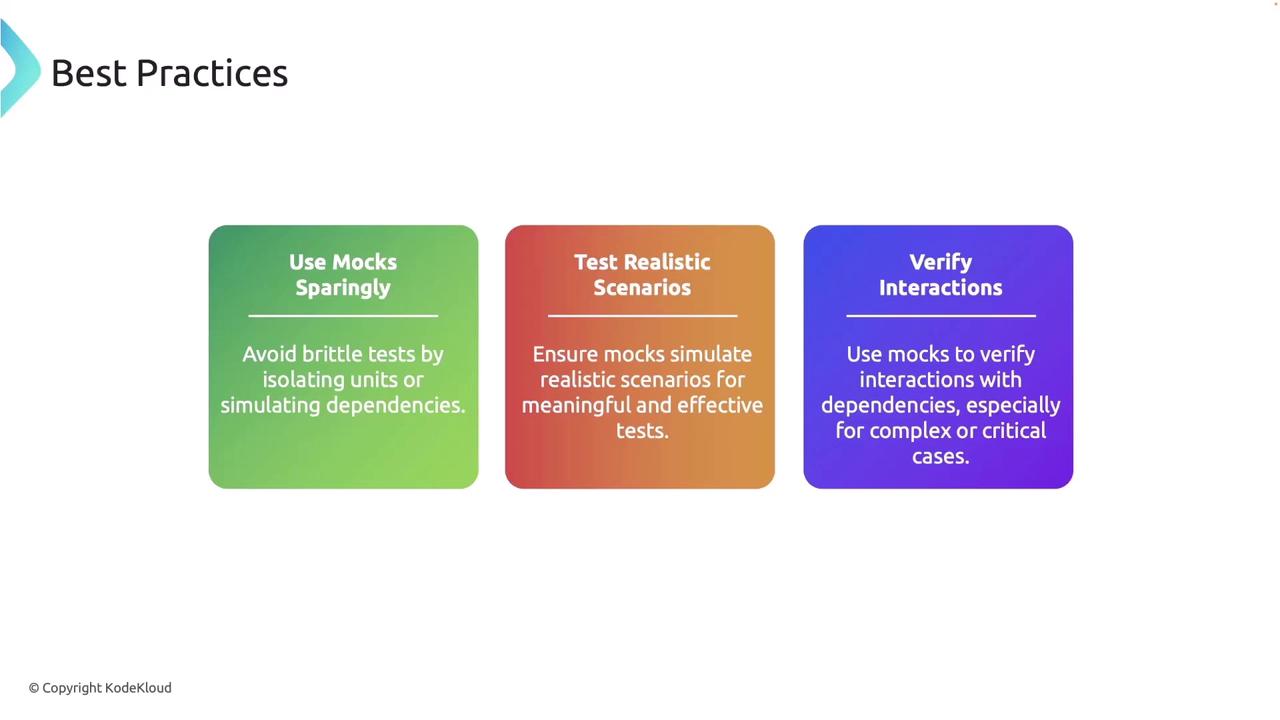
## Best Practices for Mocking
Mocking is a powerful tool for isolating units under test. Here are some best practices:
* Use mocks judiciously.
Use mocks judiciously to avoid creating tests that depend too heavily on implementation details.
* Simulate realistic scenarios to maintain meaningful tests.
* Utilize mocks to verify that your code interacts correctly with its dependencies, especially in complex interaction scenarios.
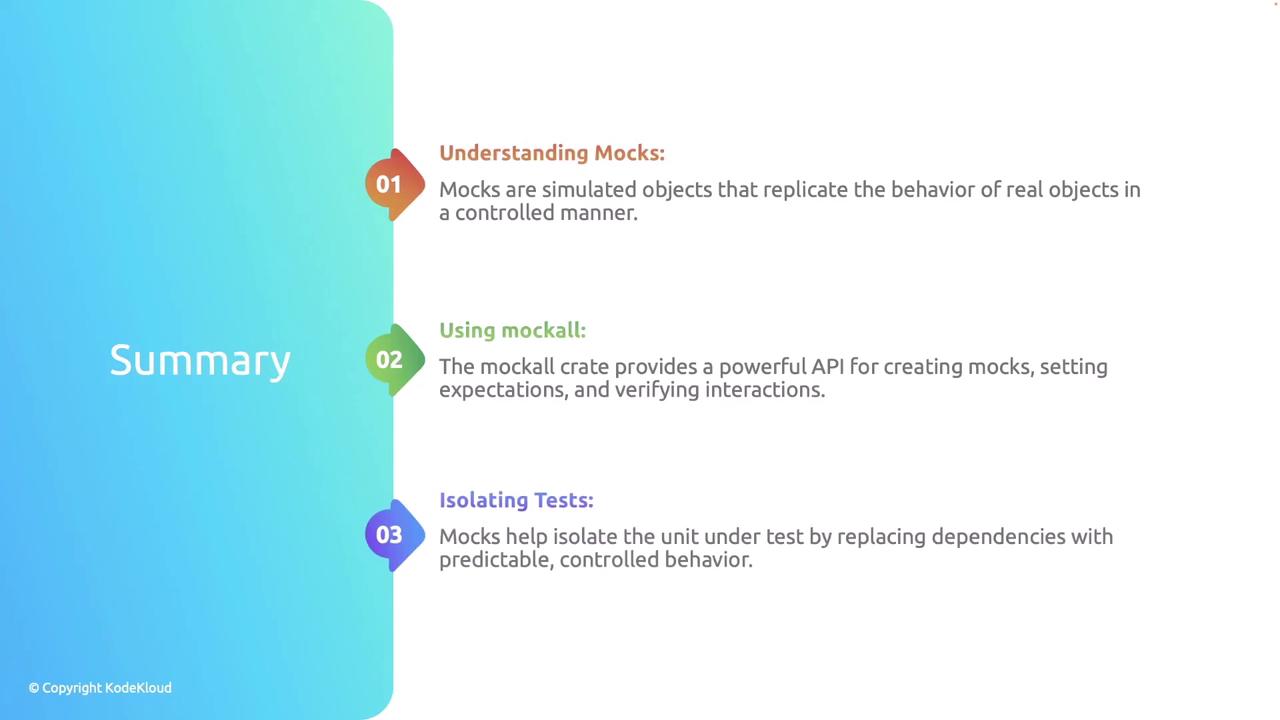
By understanding and applying these mocking techniques, you can write robust tests that ensure each component of your Rust application functions correctly. This approach not only improves code quality but also enhances test reliability, making your development process smoother and more efficient.