> ## Documentation Index
> Fetch the complete documentation index at: https://notes.kodekloud.com/llms.txt
> Use this file to discover all available pages before exploring further.
# Interview Byte Why Not Just Buy a Bigger Server
> Compares vertical and horizontal scaling, explaining trade-offs, operational impacts, and guidance on when to scale up or scale out for different application sizes and availability needs
A common interview warm-up question is: "Your app is slow — why not just buy a bigger server?" The interviewer wants to see you understand the trade-offs between vertical scaling (scaling up) and horizontal scaling (scaling out), when each is appropriate, and what operational and architectural changes each choice implies.
## Vertical scaling (scale up)
Vertical scaling means increasing the capacity of a single machine: more CPU, more RAM, faster disks, or a larger instance type. It’s often the simplest and quickest way to buy performance.
Pros:
* Minimal or zero code changes.
* Fast to implement (resize an instance, attach larger disks).
* Simpler operational model: single deployment target, fewer moving parts.
Cons:
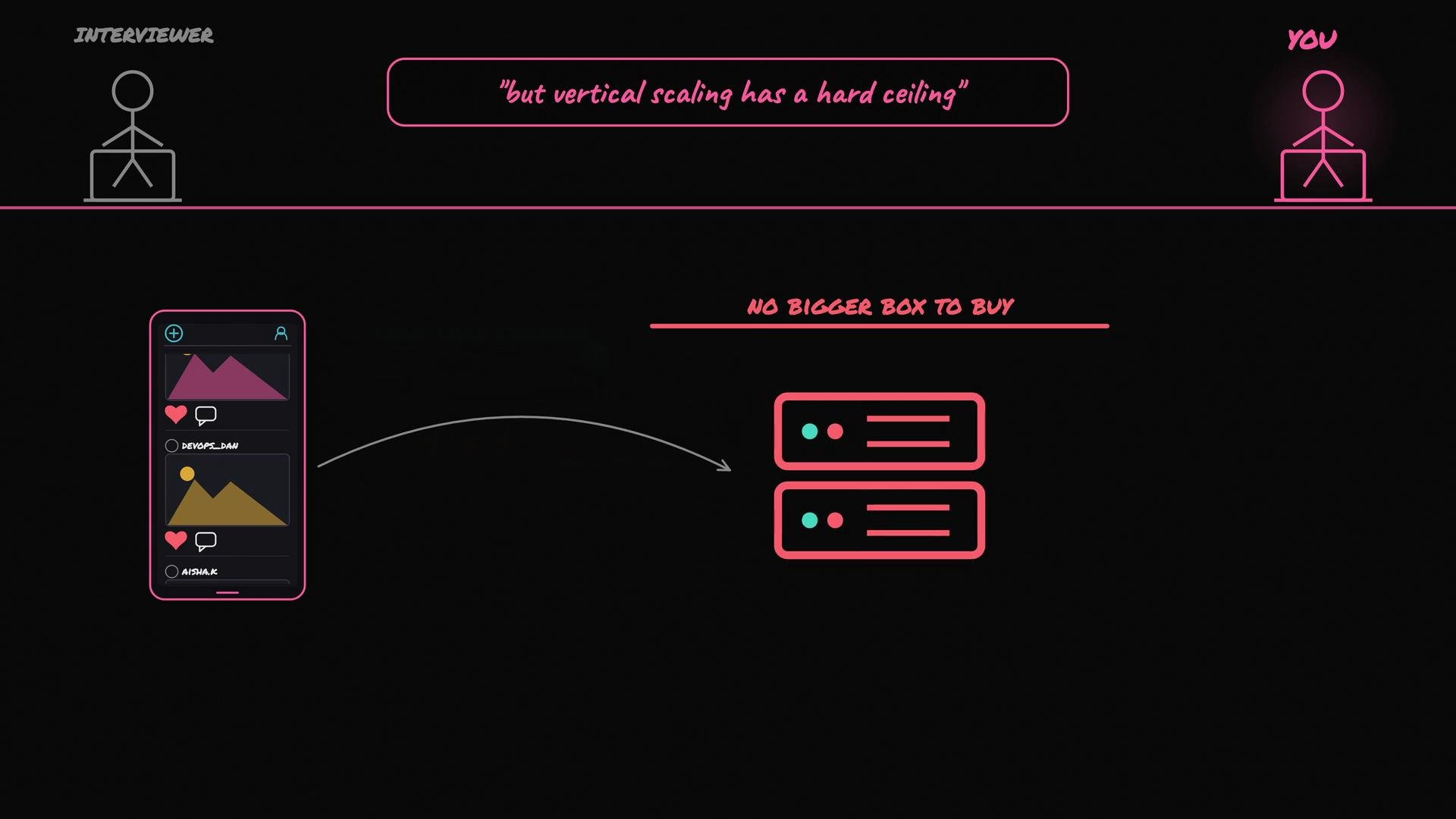
* Physical and practical limits: there’s a ceiling on how large a single machine can be.
* Costs can grow nonlinearly for very large instances.
* Single point of failure: if the machine fails, the whole service goes down.
 ## Horizontal scaling (scale out)
Horizontal scaling means adding more machines and distributing traffic across them, typically with a load balancer in front and multiple app servers behind it.
Benefits:
* Increases aggregate capacity beyond any single machine.
* Improves availability and fault tolerance (failures affect only part of the fleet).
* Enables elastic capacity (autoscaling) to match demand.
Costs and complexities:
* Requires stateless service design or centralized session/state stores (e.g., `Redis`, `memcached`) so requests can be handled by any server.
* Data becomes harder: you’ll need replication, read replicas, sharding/partitioning, and careful attention to consistency.
* Operational overhead: deployments, monitoring, health checks, orchestration, and troubleshooting across many nodes.
* Network overhead and partial failures mean you must design for retries, idempotency, and degraded operation modes.
Common horizontal stack elements:
* Load balancer (L4/L7)
* Multiple app servers (stateless or using centralized state)
* Shared caches and session stores
* Distributed database with replication or sharding
* Autoscaling and health monitoring
## Horizontal scaling (scale out)
Horizontal scaling means adding more machines and distributing traffic across them, typically with a load balancer in front and multiple app servers behind it.
Benefits:
* Increases aggregate capacity beyond any single machine.
* Improves availability and fault tolerance (failures affect only part of the fleet).
* Enables elastic capacity (autoscaling) to match demand.
Costs and complexities:
* Requires stateless service design or centralized session/state stores (e.g., `Redis`, `memcached`) so requests can be handled by any server.
* Data becomes harder: you’ll need replication, read replicas, sharding/partitioning, and careful attention to consistency.
* Operational overhead: deployments, monitoring, health checks, orchestration, and troubleshooting across many nodes.
* Network overhead and partial failures mean you must design for retries, idempotency, and degraded operation modes.
Common horizontal stack elements:
* Load balancer (L4/L7)
* Multiple app servers (stateless or using centralized state)
* Shared caches and session stores
* Distributed database with replication or sharding
* Autoscaling and health monitoring
 ## When to choose which — practical guidance
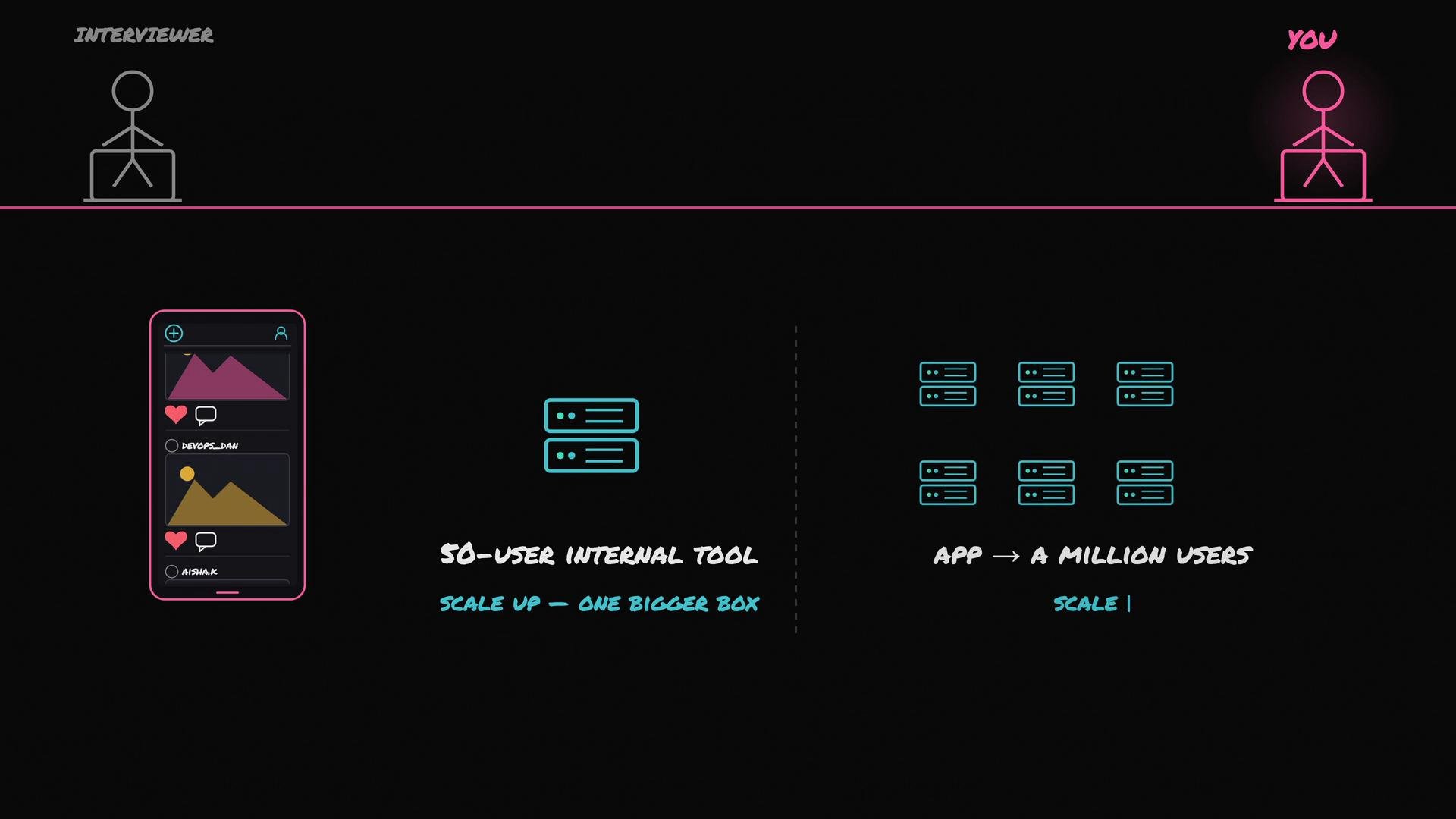
* Small, low-risk workloads (e.g., an internal tool with \~50 users): start with vertical scaling. It’s cheaper and faster to operate initially.
* High-scale, consumer-facing systems (e.g., targeting millions of users): design for horizontal scaling from the start to avoid hitting vertical limits and to ensure redundancy.
* If you need high availability and seamless upgrades, horizontal scaling is usually the better choice even at moderate scale.
| Scenario | Recommended approach | Why |
| -------------------------------------------- | ---------------------------------------------------------: | -------------------------------------------------------------------------------------- |
| Small internal tool (\~tens of users) | Vertical scaling | Simpler, lower operational cost, quick to implement |
| Growing web app with regional traffic spikes | Horizontal scaling + autoscaling | Handles bursty traffic and provides redundancy |
| Large consumer product (100k+ users) | Horizontal-first architecture | Avoids single-server ceiling, supports partitioning and replication |
| Latency-sensitive single-node bottleneck | Profile and optimize first; possibly vertical for hot path | Fixing hot code paths or moving to faster hardware can be cheaper than re-architecting |
## Key trade-offs (quick summary)
* Cost: small vertical upgrades can be cheap; extreme vertical instances are expensive. Horizontal systems can be cost-effective at scale but add operational cost.
* Complexity: vertical is simpler; horizontal requires distributed systems skills.
* Availability: vertical is a single point of failure; horizontal provides redundancy.
* Time-to-solution: vertical is usually faster to implement; horizontal requires design and testing.
Quick interview tip: describe both approaches (vertical and horizontal), explain their trade-offs (cost, complexity, availability), and give a short, concrete example (e.g., 50-user internal tool vs. million-user consumer app).
## References and further reading
* [Vertical scaling (Wikipedia)](https://en.wikipedia.org/wiki/Vertical_scaling)
* [Horizontal scaling (Wikipedia)](https://en.wikipedia.org/wiki/Horizontal_scaling)
* [Load balancing (Wikipedia)](https://en.wikipedia.org/wiki/Load_balancing_\(computing\))
* Redis — [https://redis.io/](https://redis.io/)
* memcached — [https://memcached.org/](https://memcached.org/)
* Database replication and sharding — search terms: “database replication”, “database sharding”, “partitioning”
## When to choose which — practical guidance
* Small, low-risk workloads (e.g., an internal tool with \~50 users): start with vertical scaling. It’s cheaper and faster to operate initially.
* High-scale, consumer-facing systems (e.g., targeting millions of users): design for horizontal scaling from the start to avoid hitting vertical limits and to ensure redundancy.
* If you need high availability and seamless upgrades, horizontal scaling is usually the better choice even at moderate scale.
| Scenario | Recommended approach | Why |
| -------------------------------------------- | ---------------------------------------------------------: | -------------------------------------------------------------------------------------- |
| Small internal tool (\~tens of users) | Vertical scaling | Simpler, lower operational cost, quick to implement |
| Growing web app with regional traffic spikes | Horizontal scaling + autoscaling | Handles bursty traffic and provides redundancy |
| Large consumer product (100k+ users) | Horizontal-first architecture | Avoids single-server ceiling, supports partitioning and replication |
| Latency-sensitive single-node bottleneck | Profile and optimize first; possibly vertical for hot path | Fixing hot code paths or moving to faster hardware can be cheaper than re-architecting |
## Key trade-offs (quick summary)
* Cost: small vertical upgrades can be cheap; extreme vertical instances are expensive. Horizontal systems can be cost-effective at scale but add operational cost.
* Complexity: vertical is simpler; horizontal requires distributed systems skills.
* Availability: vertical is a single point of failure; horizontal provides redundancy.
* Time-to-solution: vertical is usually faster to implement; horizontal requires design and testing.
Quick interview tip: describe both approaches (vertical and horizontal), explain their trade-offs (cost, complexity, availability), and give a short, concrete example (e.g., 50-user internal tool vs. million-user consumer app).
## References and further reading
* [Vertical scaling (Wikipedia)](https://en.wikipedia.org/wiki/Vertical_scaling)
* [Horizontal scaling (Wikipedia)](https://en.wikipedia.org/wiki/Horizontal_scaling)
* [Load balancing (Wikipedia)](https://en.wikipedia.org/wiki/Load_balancing_\(computing\))
* Redis — [https://redis.io/](https://redis.io/)
* memcached — [https://memcached.org/](https://memcached.org/)
* Database replication and sharding — search terms: “database replication”, “database sharding”, “partitioning”