> ## Documentation Index
> Fetch the complete documentation index at: https://notes.kodekloud.com/llms.txt
> Use this file to discover all available pages before exploring further.
# Message Queues
> Explains message queues and how they decouple producers and consumers to handle background tasks, buffer spikes, ensure reliability, and require idempotency for at-least-once delivery.
In this lesson we cover message queues: what they are, why they matter, and how they enable resilient, decoupled systems for handling background work and traffic spikes.
A concrete motivating example is a photo-upload flow in a typical photo app. We don't want to serve full-size images to users, so we generate smaller thumbnails. Thumbnail generation can be slow, so doing it synchronously would make users wait. Instead, we offload this work to a background system.
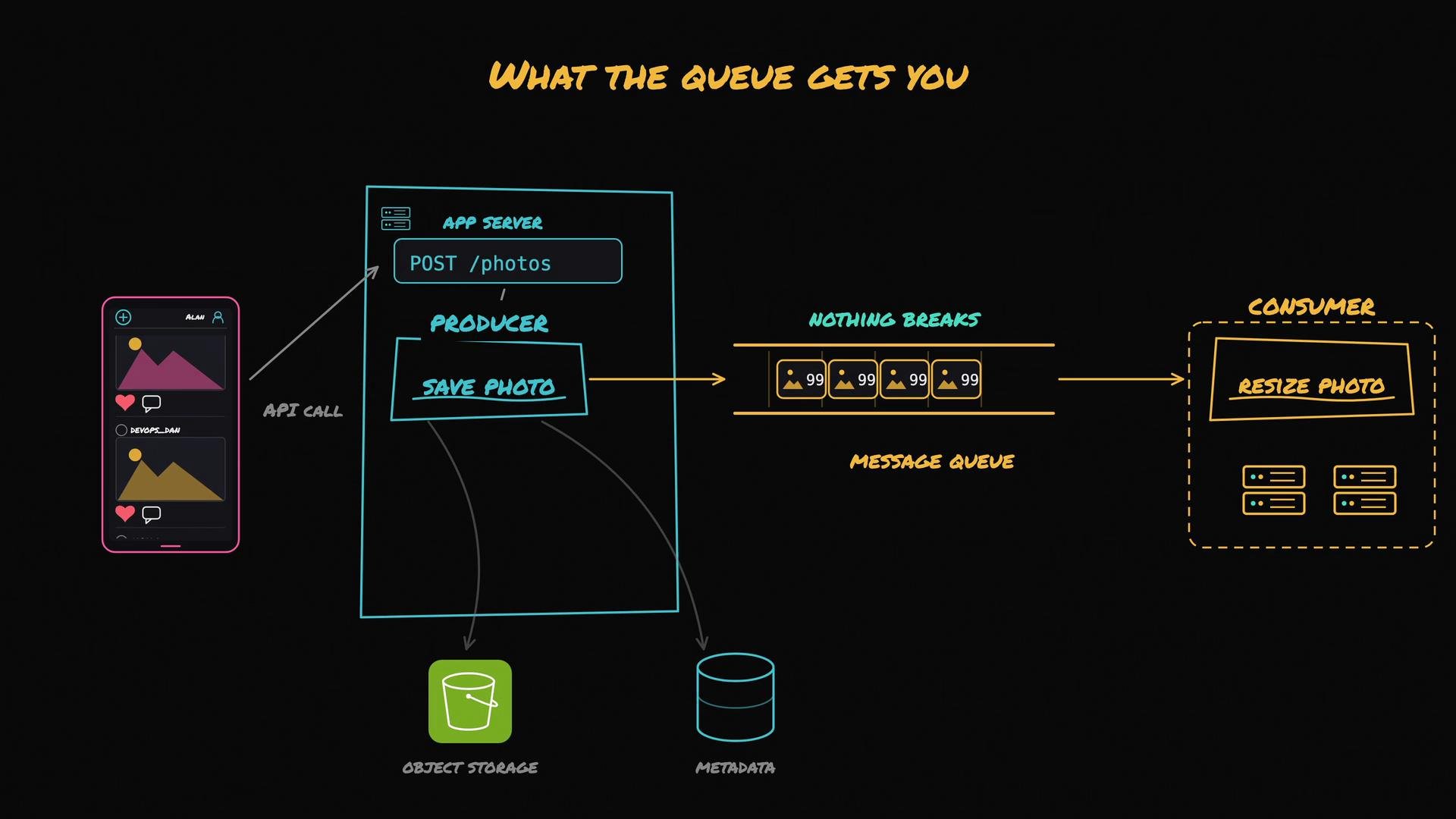
When a user uploads a photo, the client calls an API such as `POST /photos`. The server-side handler (for example, `savePhoto`) validates the image, stores the original file in object storage (e.g., [S3](https://aws.amazon.com/s3/)), writes metadata to the database, and triggers thumbnail creation.
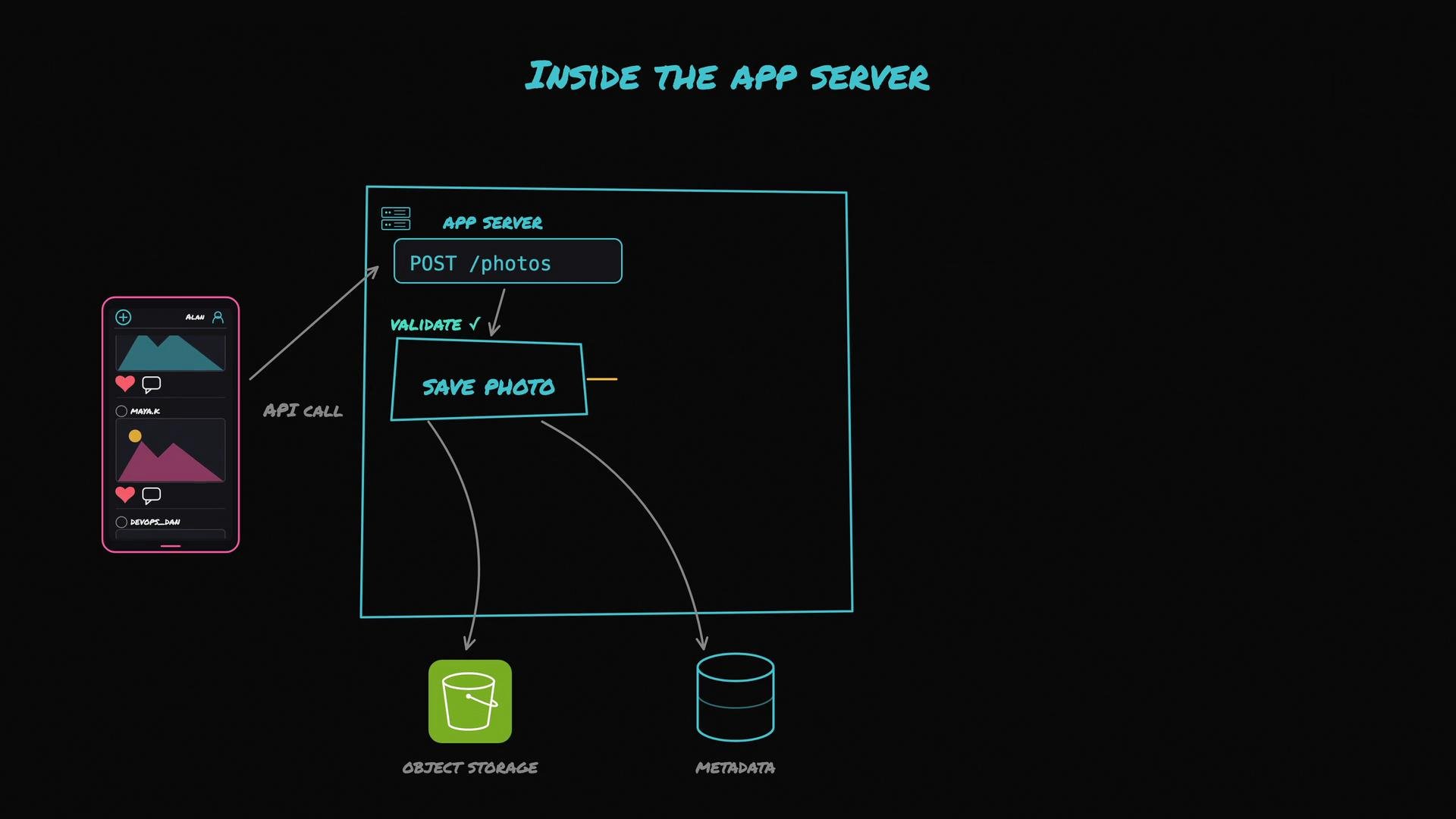 A naive (and inefficient) approach is to call the thumbnail generator (`resizePhoto`) synchronously from `savePhoto`. In this design, the upload handler performs the resize before returning success to the client. If the resize is slow or gets stuck, the user experiences long waits or timeouts.
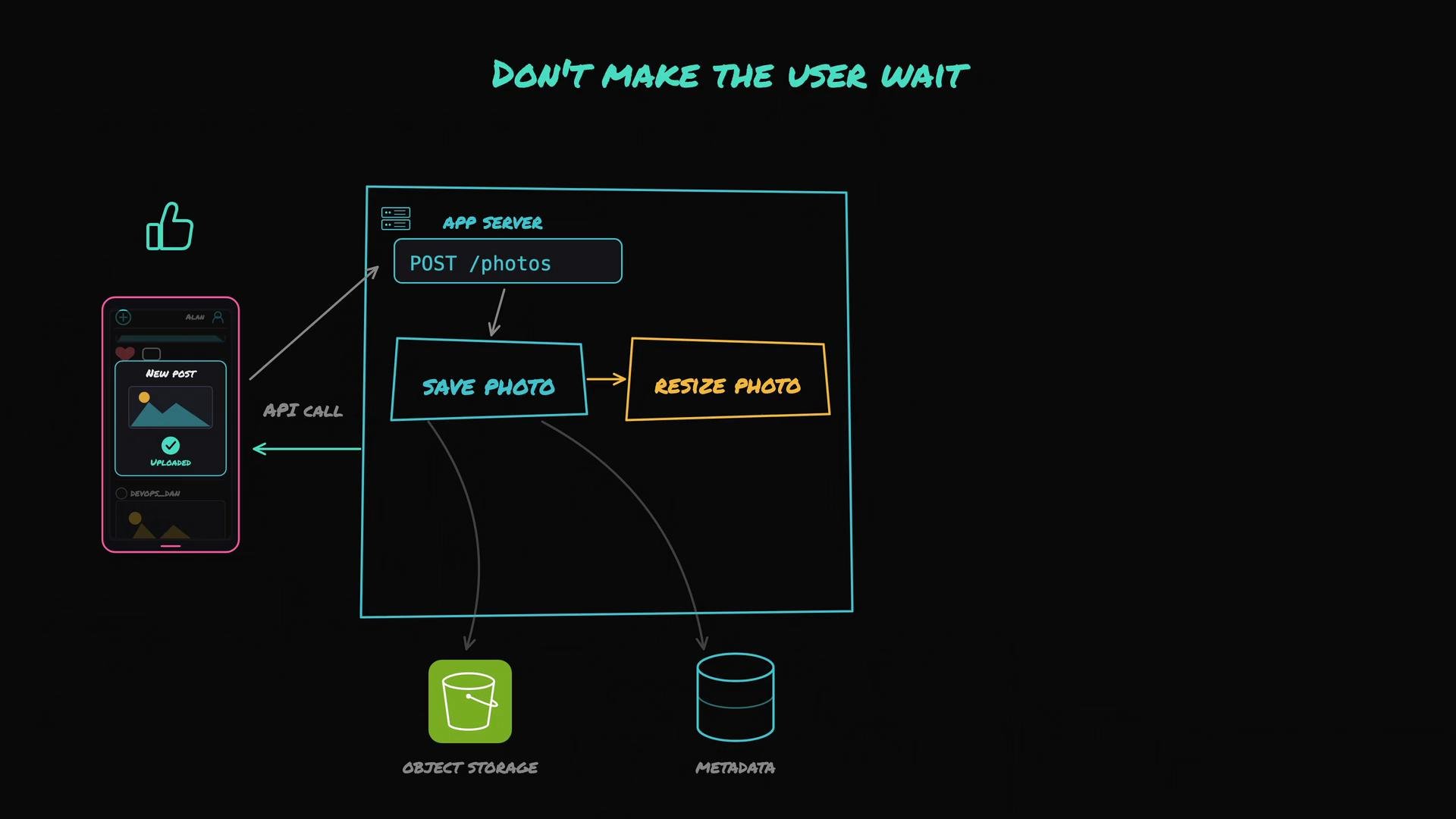 A better design is to make the resize task asynchronous. After saving the original photo and metadata, the server returns success to the user immediately and hands the slow work to a background system. The question becomes: how do we hand off the job safely so it won't be lost if the server crashes?
The safe solution is a message queue. Instead of calling `resizePhoto` directly, `savePhoto` writes a small message to a queue (for example, a `resize-photo` queue) describing the job. Then `savePhoto` returns success to the client.
A better design is to make the resize task asynchronous. After saving the original photo and metadata, the server returns success to the user immediately and hands the slow work to a background system. The question becomes: how do we hand off the job safely so it won't be lost if the server crashes?
The safe solution is a message queue. Instead of calling `resizePhoto` directly, `savePhoto` writes a small message to a queue (for example, a `resize-photo` queue) describing the job. Then `savePhoto` returns success to the client.
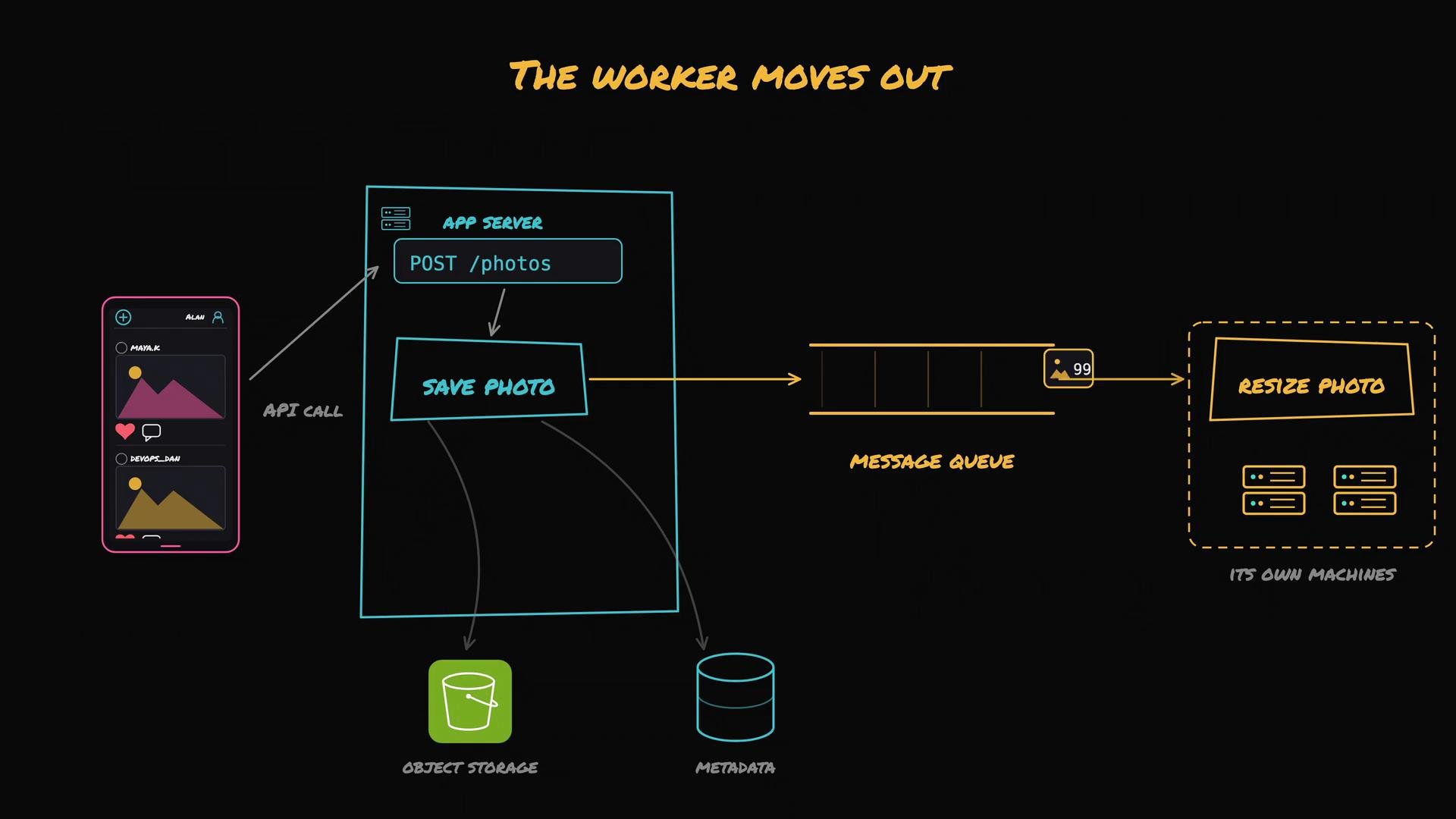
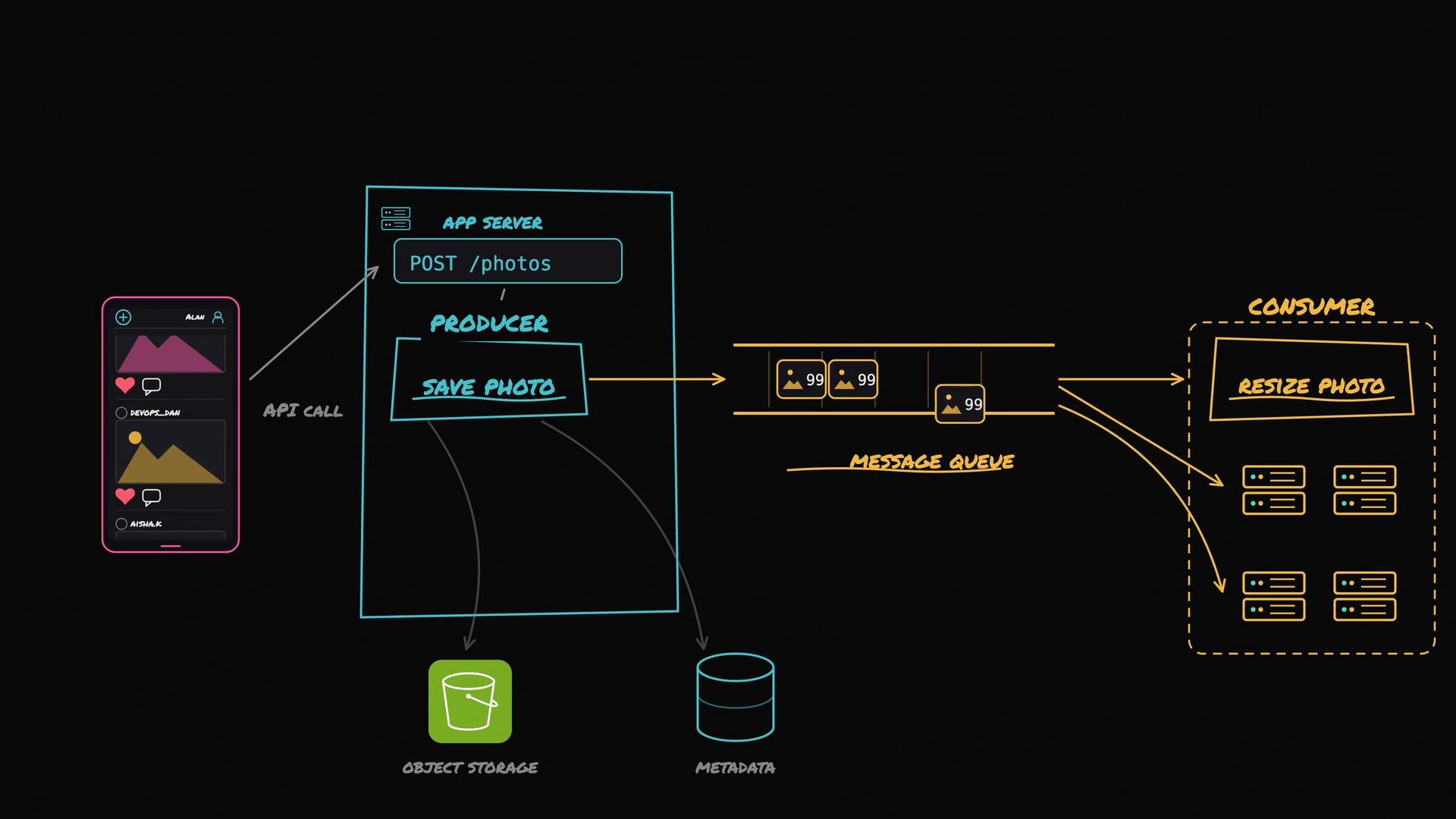
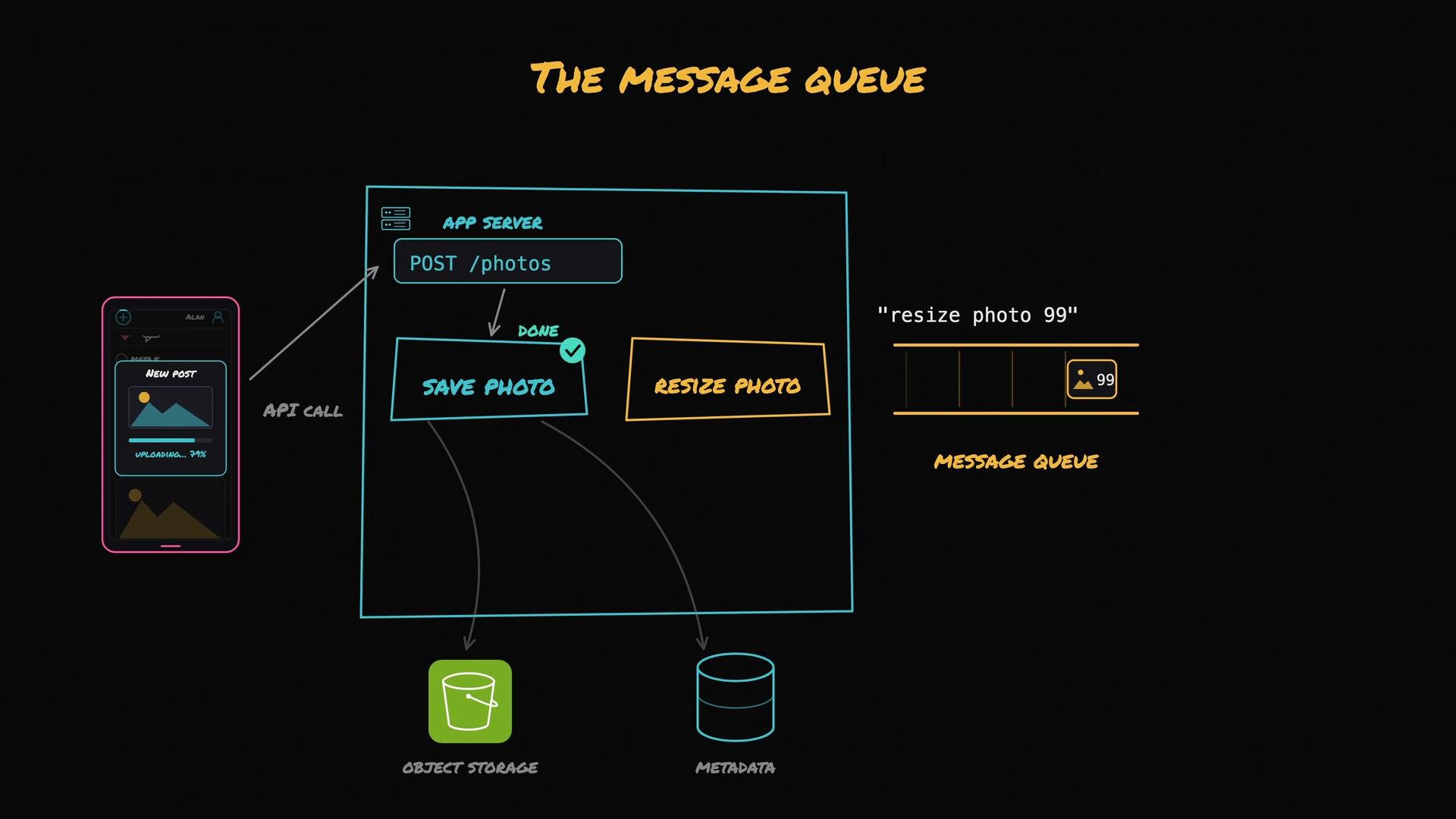 The message persists in the queue until a worker (consumer) picks it up. Thumbnail generation no longer runs inside the main app server; instead, independent worker processes or services poll the queue, process messages, and acknowledge completion.
 Key terms
| Term | Meaning |
| -------- | -------------------------------------------------------------------------------------- |
| Producer | The function or service that puts messages on the queue (e.g., `savePhoto`). |
| Consumer | The worker that pulls messages and performs the work (e.g., `resizePhoto` worker). |
| Queue | The intermediary that decouples producers and consumers; typically durable/persistent. |
Why this decoupling helps
* Producers and consumers are independent: they do not need to know each other's implementation or location.
* Producers return quickly and do not block on slow work.
* The queue acts as a buffer: it absorbs traffic spikes and stores work until consumers are ready.
* Workers can be scaled independently to increase processing throughput.
* If a worker crashes, the message remains in the queue until processed—improving fault tolerance.
Key terms
| Term | Meaning |
| -------- | -------------------------------------------------------------------------------------- |
| Producer | The function or service that puts messages on the queue (e.g., `savePhoto`). |
| Consumer | The worker that pulls messages and performs the work (e.g., `resizePhoto` worker). |
| Queue | The intermediary that decouples producers and consumers; typically durable/persistent. |
Why this decoupling helps
* Producers and consumers are independent: they do not need to know each other's implementation or location.
* Producers return quickly and do not block on slow work.
* The queue acts as a buffer: it absorbs traffic spikes and stores work until consumers are ready.
* Workers can be scaled independently to increase processing throughput.
* If a worker crashes, the message remains in the queue until processed—improving fault tolerance.
 Important nuance: delivery semantics and idempotency
Many queues provide at-least-once delivery. That means a message can sometimes be delivered more than once. Example: a worker receives a message, completes the resize, but crashes before acknowledging the queue; the queue will eventually redeliver the message. Resizing twice is usually harmless, but duplicate effects (such as charging a customer) can be catastrophic.
Design consumers to tolerate duplicate deliveries:
* Make operations idempotent (safe to repeat).
* Or check whether work is already done before acting (e.g., a `processed` flag in the database or checking object existence).
Important nuance: delivery semantics and idempotency
Many queues provide at-least-once delivery. That means a message can sometimes be delivered more than once. Example: a worker receives a message, completes the resize, but crashes before acknowledging the queue; the queue will eventually redeliver the message. Resizing twice is usually harmless, but duplicate effects (such as charging a customer) can be catastrophic.
Design consumers to tolerate duplicate deliveries:
* Make operations idempotent (safe to repeat).
* Or check whether work is already done before acting (e.g., a `processed` flag in the database or checking object existence).
 Message queues typically expose visibility timeouts and acknowledgement semantics. Consumers should acknowledge/delete messages only after successfully finishing their work. Implement idempotency checks or persistent flags so re-delivered messages do not cause duplicate side effects.
Minimal examples (illustrative pseudocode)
Producer — save the photo then enqueue a job:
```python theme={null}
# Producer: save photo and enqueue resize job
import json
def save_photo(file):
s3_key = upload_to_s3(file) # upload original to object storage
db.save({'s3_key': s3_key}) # save metadata
message = json.dumps({'s3_key': s3_key})
queue.send_message(QueueUrl=QUEUE_URL, MessageBody=message)
return {'status': 'ok'} # return immediately to the client
```
Consumer — poll the queue and process jobs idempotently:
```python theme={null}
# Consumer: poll queue, process messages idempotently
import json
def process_messages():
messages = queue.receive_messages(QueueUrl=QUEUE_URL, MaxNumberOfMessages=10)
for msg in messages:
body = json.loads(msg.body)
s3_key = body['s3_key']
if already_processed(s3_key): # idempotency check
queue.delete_message(QueueUrl=QUEUE_URL, ReceiptHandle=msg.receipt_handle)
continue
resize_image_from_s3(s3_key)
mark_processed(s3_key) # record that the job is done
queue.delete_message(QueueUrl=QUEUE_URL, ReceiptHandle=msg.receipt_handle)
```
When to use message queues (quick guide)
| Scenario | Use queue? |
| -------------------------------------------------- | ------------------------------------------------------------ |
| Short request/response tasks | No |
| Long-running or CPU-intensive background work | Yes |
| Rate-limited downstream services | Yes (buffer requests) |
| Need to decouple systems and absorb traffic spikes | Yes |
| Strict exactly-once side effects (e.g., billing) | Use caution — design idempotency or transactional safeguards |
Summary
Message queues let you safely hand off long-running or unreliable tasks, decouple producers from consumers, buffer traffic spikes, and simplify scaling and recovery. Common real-world options include [RabbitMQ](https://www.rabbitmq.com/) and [Amazon SQS](https://aws.amazon.com/sqs/). For operations with critical side effects, combine queues with idempotency checks, deduplication, or transactional outbox patterns.
Message queues typically expose visibility timeouts and acknowledgement semantics. Consumers should acknowledge/delete messages only after successfully finishing their work. Implement idempotency checks or persistent flags so re-delivered messages do not cause duplicate side effects.
Minimal examples (illustrative pseudocode)
Producer — save the photo then enqueue a job:
```python theme={null}
# Producer: save photo and enqueue resize job
import json
def save_photo(file):
s3_key = upload_to_s3(file) # upload original to object storage
db.save({'s3_key': s3_key}) # save metadata
message = json.dumps({'s3_key': s3_key})
queue.send_message(QueueUrl=QUEUE_URL, MessageBody=message)
return {'status': 'ok'} # return immediately to the client
```
Consumer — poll the queue and process jobs idempotently:
```python theme={null}
# Consumer: poll queue, process messages idempotently
import json
def process_messages():
messages = queue.receive_messages(QueueUrl=QUEUE_URL, MaxNumberOfMessages=10)
for msg in messages:
body = json.loads(msg.body)
s3_key = body['s3_key']
if already_processed(s3_key): # idempotency check
queue.delete_message(QueueUrl=QUEUE_URL, ReceiptHandle=msg.receipt_handle)
continue
resize_image_from_s3(s3_key)
mark_processed(s3_key) # record that the job is done
queue.delete_message(QueueUrl=QUEUE_URL, ReceiptHandle=msg.receipt_handle)
```
When to use message queues (quick guide)
| Scenario | Use queue? |
| -------------------------------------------------- | ------------------------------------------------------------ |
| Short request/response tasks | No |
| Long-running or CPU-intensive background work | Yes |
| Rate-limited downstream services | Yes (buffer requests) |
| Need to decouple systems and absorb traffic spikes | Yes |
| Strict exactly-once side effects (e.g., billing) | Use caution — design idempotency or transactional safeguards |
Summary
Message queues let you safely hand off long-running or unreliable tasks, decouple producers from consumers, buffer traffic spikes, and simplify scaling and recovery. Common real-world options include [RabbitMQ](https://www.rabbitmq.com/) and [Amazon SQS](https://aws.amazon.com/sqs/). For operations with critical side effects, combine queues with idempotency checks, deduplication, or transactional outbox patterns.