> ## Documentation Index
> Fetch the complete documentation index at: https://notes.kodekloud.com/llms.txt
> Use this file to discover all available pages before exploring further.
# Interview Byte Make the Numbers Earn Their Place
> Guides system design interview estimation by demonstrating how to calculate and verbalize assumptions and rounded traffic numbers to inform architecture and capacity planning.
When answering an estimation question in a system-design interview, always tie your numbers back to the architecture you propose. Speak your assumptions and rounding out loud so the interviewer can follow and validate your trade-offs. Walk through one concrete example and announce each rounding as you go.
Step-by-step example (announce each assumption and rounding):
1. State the core user assumptions:
* Total users: `100,000,000`
* Daily active rate: `20%` (0.20)
* Feed opens per active user per day: `20`
Calculate reads per day:
```text theme={null}
100,000,000 × 0.20 × 20 = 400,000,000 reads/day
```
2. Convert reads per day to reads per second.
* Say aloud: “I’ll call a day one hundred thousand seconds” (a convenient mental rounding; actual day = 86,400s).
```text theme={null}
400,000,000 reads / 100,000 seconds ≈ 4,000 reads/second
```
3. Account for traffic peaks with a peak factor (common practice: 3–5×).
* Announce: “I’ll round peak traffic to about 3–5×; let’s call it 15,000 reads/s for planning.”
```text theme={null}
4,000 × 3–5 ≈ 12,000–20,000 reads/second → plan ~15,000 reads/second
```
Use these verbal signals during the interview: “I’ll call a day one hundred thousand seconds” and “I’ll round peak traffic to about 3–5×, so let’s call it 15,000 reads/s.” Interviewers are evaluating your assumptions, reasoning, and trade-offs—not just the arithmetic.
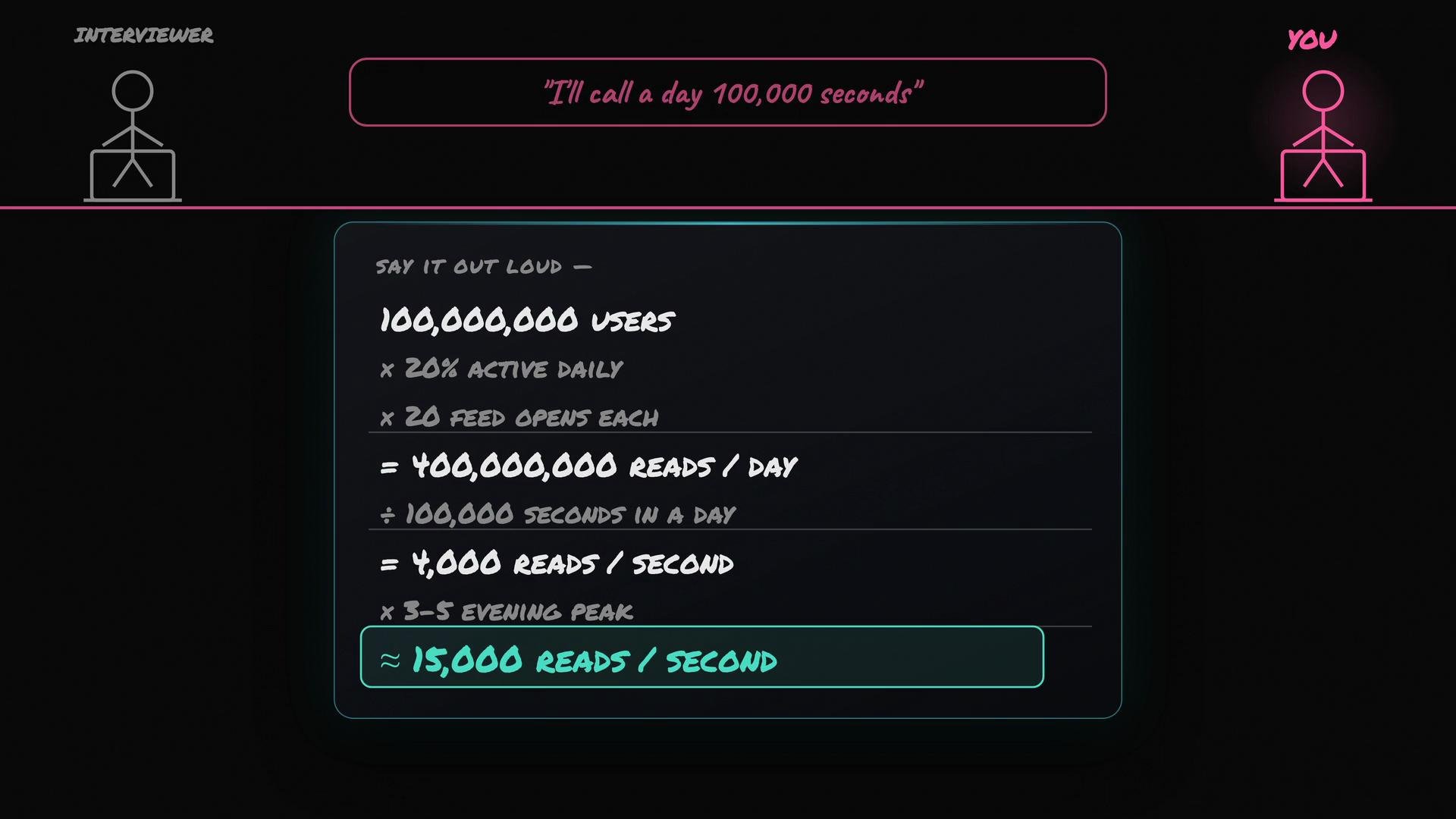 Say your assumptions and rounding aloud. Those are the signals interviewers use to grade your reasoning.
Quick reference constants to memorize
| Constant | Why it helps |
| ----------------------------------- | -------------------------------------------------------------------------------------------------- |
| `1 day ≈ 100,000 seconds` | Fast mental conversion for per-second estimates (actual = 86,400s). Announce that you’re rounding. |
| `1,000,000 requests/day ≈ 12 req/s` | Helpful benchmark: `1,000,000 / 86,400 ≈ 11.6` → round to `12` for quick sizing. |
How to use these numbers in design decisions
* Use the final reads/s to size front-end load balancers, web server pods, and API capacity.
* Multiply by average request cost (CPU, DB reads, cache hit rate) to size back-end services and databases.
* Convert reads/sec to IOPS, network bandwidth, and cache memory needs as you pick components (CDN, Redis, read replicas, etc.).
Further reading and references
* [System Design Basics](https://en.wikipedia.org/wiki/System_design)
* [Capacity Planning and Load Estimation](https://aws.amazon.com/architecture/well-architected/)
Memorize these two handy mental constants and always narrate your rounding choices — that clarity is often worth more than perfect arithmetic during interviews.
Say your assumptions and rounding aloud. Those are the signals interviewers use to grade your reasoning.
Quick reference constants to memorize
| Constant | Why it helps |
| ----------------------------------- | -------------------------------------------------------------------------------------------------- |
| `1 day ≈ 100,000 seconds` | Fast mental conversion for per-second estimates (actual = 86,400s). Announce that you’re rounding. |
| `1,000,000 requests/day ≈ 12 req/s` | Helpful benchmark: `1,000,000 / 86,400 ≈ 11.6` → round to `12` for quick sizing. |
How to use these numbers in design decisions
* Use the final reads/s to size front-end load balancers, web server pods, and API capacity.
* Multiply by average request cost (CPU, DB reads, cache hit rate) to size back-end services and databases.
* Convert reads/sec to IOPS, network bandwidth, and cache memory needs as you pick components (CDN, Redis, read replicas, etc.).
Further reading and references
* [System Design Basics](https://en.wikipedia.org/wiki/System_design)
* [Capacity Planning and Load Estimation](https://aws.amazon.com/architecture/well-architected/)
Memorize these two handy mental constants and always narrate your rounding choices — that clarity is often worth more than perfect arithmetic during interviews.