> ## Documentation Index
> Fetch the complete documentation index at: https://notes.kodekloud.com/llms.txt
> Use this file to discover all available pages before exploring further.
# Rate Limiter Requirements and Estimation
> A guide to designing a rate limiter covering identification methods, limits and responses, storage and traffic estimations, algorithms and deployment implications for protecting APIs from abusive clients.
In this lesson we design a rate limiter — a component that protects APIs and services from noisy clients who make too many requests in a short time. Rate limiting is essential for systems like public APIs, URL shorteners, and large web services (e.g., ChatGPT, Claude) to maintain performance and protect backend resources.
We’ll use a simple six-step design framework. Step 1 is clarifying requirements; step 2 is a back-of-the-envelope estimation. The content below follows that sequence, with code samples and diagrams retained in their original position.
Example attacker script (simple abusive client that posts repeatedly):
```bash theme={null}
# shadow — bash
U=shortlink.io/api/create
while true; do
curl -sX POST $U -d url=example.com
done
```
This could create millions of junk records and degrade service for normal users. We need a rate limiter that can slow down or block such noisy clients.
## Step 1 — Clarify requirements (ask these questions)
1. How do we identify who is making an API call?
Common identifiers:
* Account ID (logged-in users)
* IP address
* API key
Each approach has trade-offs. Use the table below to summarize these trade-offs for quick interview answers.
| Identifier | When to use | Trade-offs |
| - | - | - |
| Account ID | Logged-in users | Accurate for individual users; does not apply to unauthenticated traffic |
| IP address | Anonymous users | Works for unauthenticated clients; shared IPs (e.g., NAT) can unfairly aggregate users; easy for attackers to rotate |
| API key | Developer APIs | Precise for service-to-service or developer integrations; not applicable to general app users |
For this design exercise we assume:
* Count per account for logged-in users.
* Count per IP for non-logged-in requests.
2. What is the limit per user?
For this example we’ll set a limit of 100 requests per minute per user.
In interviews, avoid pretending limits are production-ready. Say you would measure real traffic (requests/minute per user) and set thresholds to sit comfortably above typical usage while protecting the system.
3. What should happen when the limit is exceeded?
Two main approaches:
* Queue excess requests and process later.
* Reject excess requests immediately.
Queuing can be useful in some contexts but introduces risk: clients often retry on slow or timed-out requests, which can create duplicates and extra load when the queue drains. For many APIs, rejecting excess requests with HTTP 429 and a `Retry-After` header is safer and clearer.
Queuing excess requests can lead to duplicate operations if clients retry while waiting. For most APIs, it's preferable to reject excess requests with a clear HTTP 429 response and an explicit retry window.
Summary of scope for this design:
* Limit: 100 requests per minute per user.
* Identification: by account for logged-in users, otherwise by IP.
* Behavior: reject excess requests with a clear response (HTTP 429 + `Retry-After`).
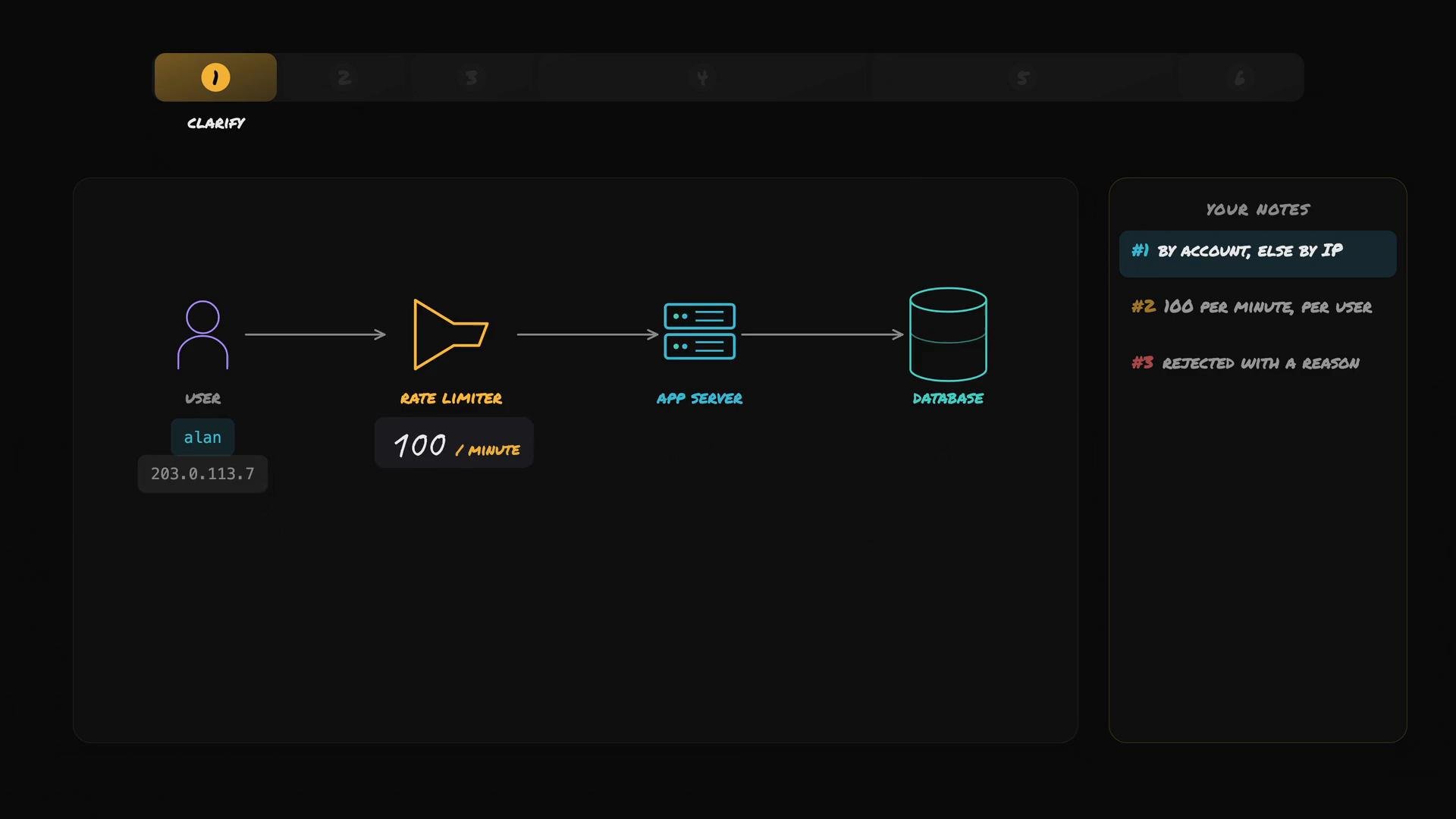 Normal users should be unaffected by the rate limiter — it operates transparently for typical usage and only intervenes when a client exceeds the agreed-upon threshold.
## Step 2 — Back-of-the-envelope estimation
Only estimate numbers that affect architecture choices (memory, throughput, peak QPS, etc.). Two key numbers for this design are: storage per user, and total request rate hitting the rate limiter.
### 1) Storage per user
A minimal per-user state for a fixed-window or sliding-window counter typically stores:
* a numeric counter
* a timestamp for the window start or last update
Estimated size: \~50 bytes per user (counter + timestamp + small metadata). Use this to reason about memory requirements.
Example estimate:
* 10,000,000 active users × 50 bytes/user ≈ 500 MB — small enough to store in memory on one reasonably sized server if desired, or sharded across multiple instances.
Normal users should be unaffected by the rate limiter — it operates transparently for typical usage and only intervenes when a client exceeds the agreed-upon threshold.
## Step 2 — Back-of-the-envelope estimation
Only estimate numbers that affect architecture choices (memory, throughput, peak QPS, etc.). Two key numbers for this design are: storage per user, and total request rate hitting the rate limiter.
### 1) Storage per user
A minimal per-user state for a fixed-window or sliding-window counter typically stores:
* a numeric counter
* a timestamp for the window start or last update
Estimated size: \~50 bytes per user (counter + timestamp + small metadata). Use this to reason about memory requirements.
Example estimate:
* 10,000,000 active users × 50 bytes/user ≈ 500 MB — small enough to store in memory on one reasonably sized server if desired, or sharded across multiple instances.
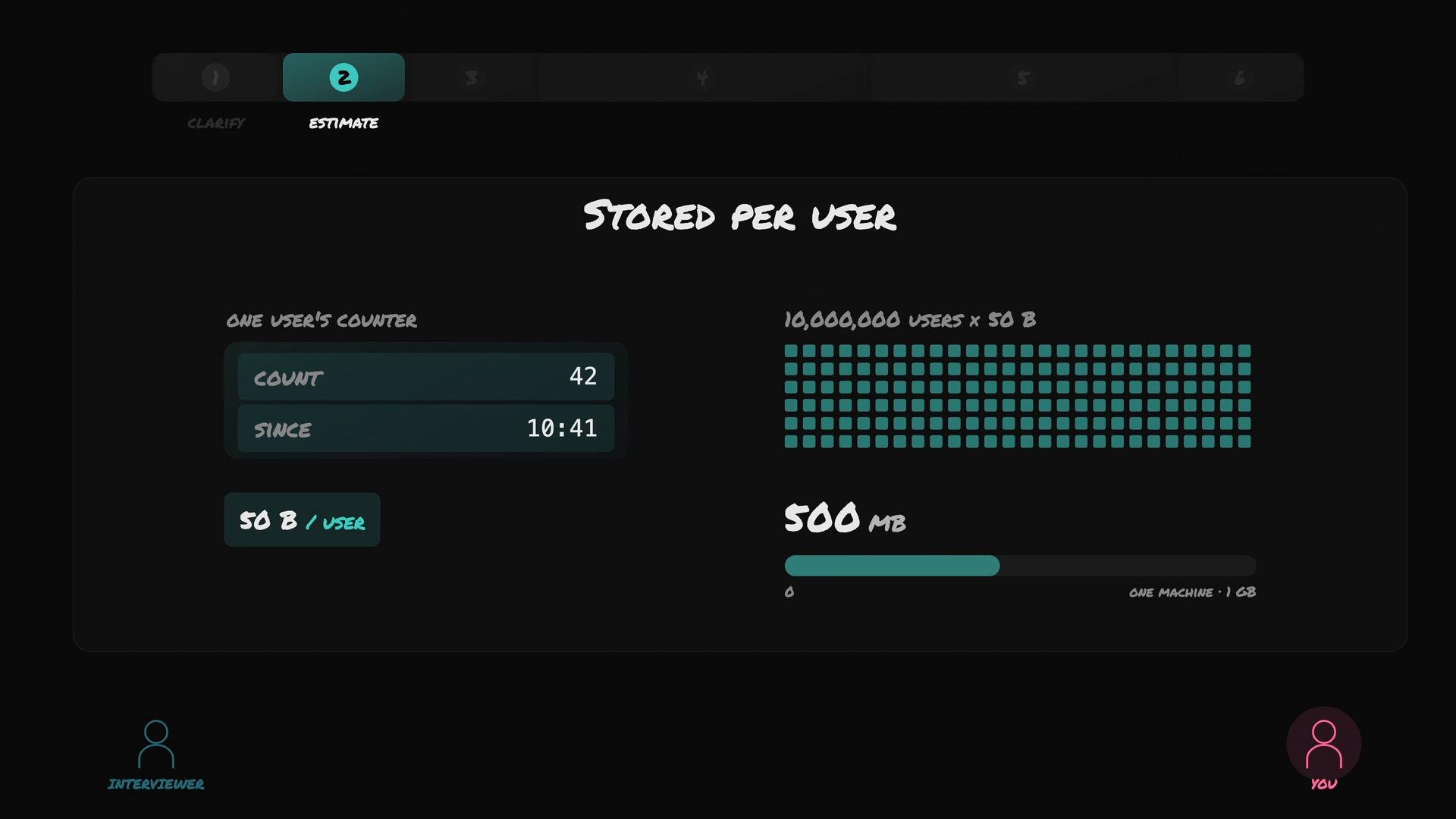 Keep the \~50 B/user estimate in mind for capacity planning. If you use richer data (sliding logs, per-minute buckets), memory increases accordingly.
### 2) Request traffic (QPS estimate)
Example scenario:
* 10,000,000 users, average 100 requests/day per user ⇒ 1,000,000,000 requests/day total.
Convert to QPS and peak:
* 1,000,000,000 requests/day ≈ 11,574 requests/second (≈ 12k RPS) average.
* If peak = 3× average, peak ≈ 35,000 RPS.
Use the table below for quick conversions you can present in an interview:
| Metric | Calculation | Result |
| - | - | - |
| Total/day | 10,000,000 × 100 | 1,000,000,000 requests/day |
| Avg RPS | 1,000,000,000 / 86,400 | ≈ 11,574 ≈ 12k RPS |
| Peak RPS (3×) | 12k × 3 | ≈ 35k RPS |
Important clarification: the "100 requests/day per user" is an average activity metric — not the per-minute throttle. The per-minute limit (100/min) protects against short bursty abuse; normal users typically generate far fewer than 100 requests in a single minute.
## Design implications (short checklist)
* Memory: \~50 B/user (adjust if design uses buckets or logs).
* Throughput: design rate limiter to handle average and peak RPS (e.g., 12k average, 35k peak in the example).
* Placement: rate limiter should be on the request path (edge or API gateway) to protect downstream services.
* Failure handling: fail-open vs fail-closed — prefer fail-open only if downstream can rate-limit again; otherwise fail-safe decisions depend on SLA.
* Responses: use HTTP 429 + `Retry-After` to guide clients.
## Links and further reading
* HTTP 429 Too Many Requests: [https://developer.mozilla.org/en-US/docs/Web/HTTP/Status/429](https://developer.mozilla.org/en-US/docs/Web/HTTP/Status/429)
* Common rate limiting algorithms: Token Bucket, Leaky Bucket, Fixed Window, Sliding Window
* Implementations and patterns: Redis-based counters, in-memory sharded counters, API gateways with built-in rate limiting
Use these talking points and numbers in interviews: they show you understand identifications, limits, client behavior trade-offs, storage and traffic estimation, and how to translate those estimates into capacity and placement decisions.
This documentation is built and hosted on [Mintlify](https://mintlify.com), a developer documentation platform.
Keep the \~50 B/user estimate in mind for capacity planning. If you use richer data (sliding logs, per-minute buckets), memory increases accordingly.
### 2) Request traffic (QPS estimate)
Example scenario:
* 10,000,000 users, average 100 requests/day per user ⇒ 1,000,000,000 requests/day total.
Convert to QPS and peak:
* 1,000,000,000 requests/day ≈ 11,574 requests/second (≈ 12k RPS) average.
* If peak = 3× average, peak ≈ 35,000 RPS.
Use the table below for quick conversions you can present in an interview:
| Metric | Calculation | Result |
| - | - | - |
| Total/day | 10,000,000 × 100 | 1,000,000,000 requests/day |
| Avg RPS | 1,000,000,000 / 86,400 | ≈ 11,574 ≈ 12k RPS |
| Peak RPS (3×) | 12k × 3 | ≈ 35k RPS |
Important clarification: the "100 requests/day per user" is an average activity metric — not the per-minute throttle. The per-minute limit (100/min) protects against short bursty abuse; normal users typically generate far fewer than 100 requests in a single minute.
## Design implications (short checklist)
* Memory: \~50 B/user (adjust if design uses buckets or logs).
* Throughput: design rate limiter to handle average and peak RPS (e.g., 12k average, 35k peak in the example).
* Placement: rate limiter should be on the request path (edge or API gateway) to protect downstream services.
* Failure handling: fail-open vs fail-closed — prefer fail-open only if downstream can rate-limit again; otherwise fail-safe decisions depend on SLA.
* Responses: use HTTP 429 + `Retry-After` to guide clients.
## Links and further reading
* HTTP 429 Too Many Requests: [https://developer.mozilla.org/en-US/docs/Web/HTTP/Status/429](https://developer.mozilla.org/en-US/docs/Web/HTTP/Status/429)
* Common rate limiting algorithms: Token Bucket, Leaky Bucket, Fixed Window, Sliding Window
* Implementations and patterns: Redis-based counters, in-memory sharded counters, API gateways with built-in rate limiting
Use these talking points and numbers in interviews: they show you understand identifications, limits, client behavior trade-offs, storage and traffic estimation, and how to translate those estimates into capacity and placement decisions.
This documentation is built and hosted on [Mintlify](https://mintlify.com), a developer documentation platform.