> ## Documentation Index
> Fetch the complete documentation index at: https://notes.kodekloud.com/llms.txt
> Use this file to discover all available pages before exploring further.
# Why CICD for Terraform
> Explains why CI/CD is essential for running Terraform in team and production environments, detailing pipeline stages, governance, secrets management, approvals, and auditability.
Before diving into pipelines, let’s clarify the problem CI/CD solves.
Terraform can be run locally, but production infrastructure requires more than a developer running `terraform apply` on their laptop. In a team or enterprise setting you need consistent execution, traceability, and governance. The diagram below shows a typical enterprise workflow and why CI/CD is essential.
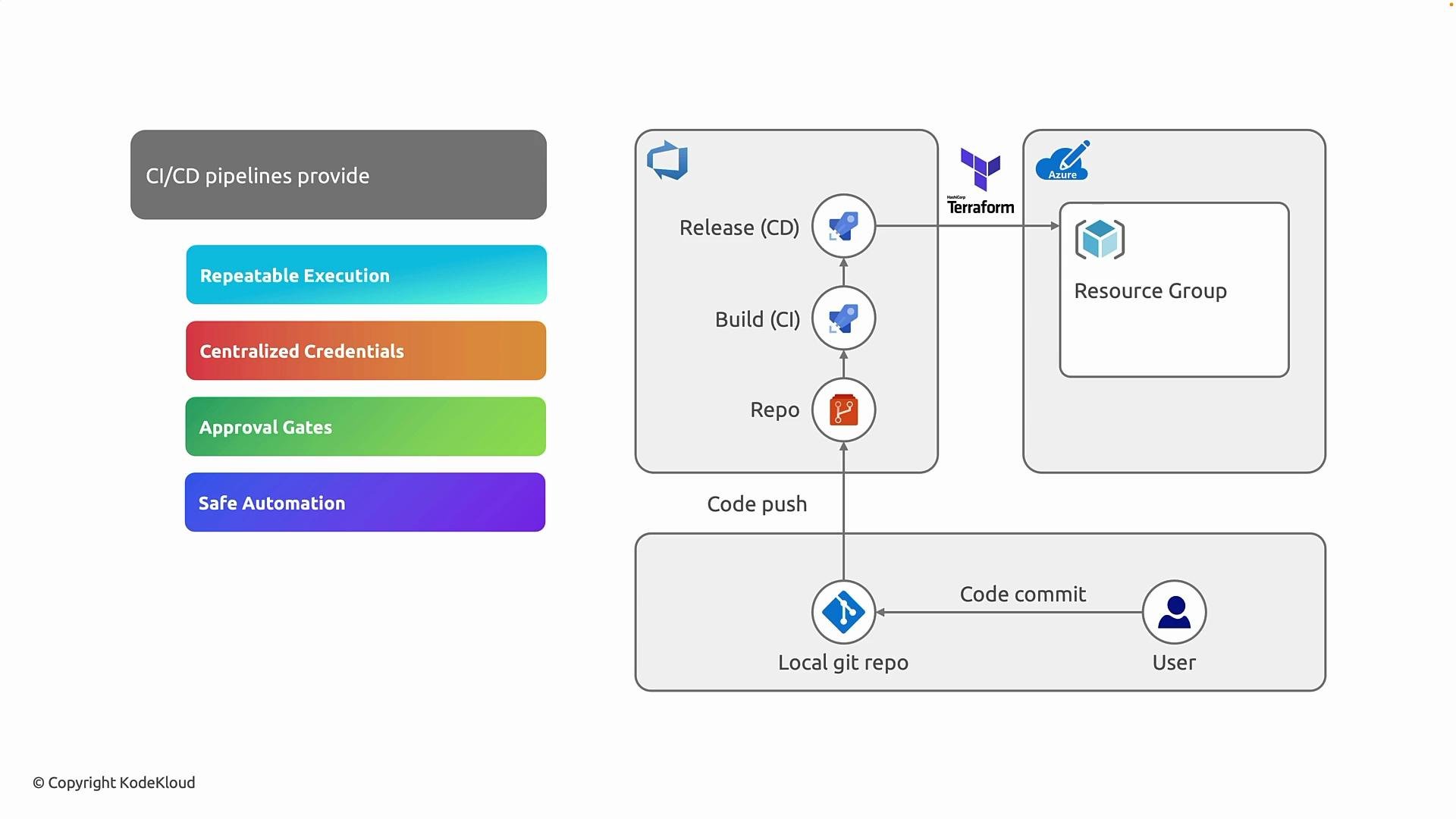
At the bottom is an engineer working in a local Git repository. They author Terraform code, commit it, and push to a centralized repo (for example, Azure DevOps). Pushing code triggers the CI pipeline, which prepares and validates the changes; after CI succeeds, the CD pipeline applies approved changes to the cloud provider (Azure in this example).
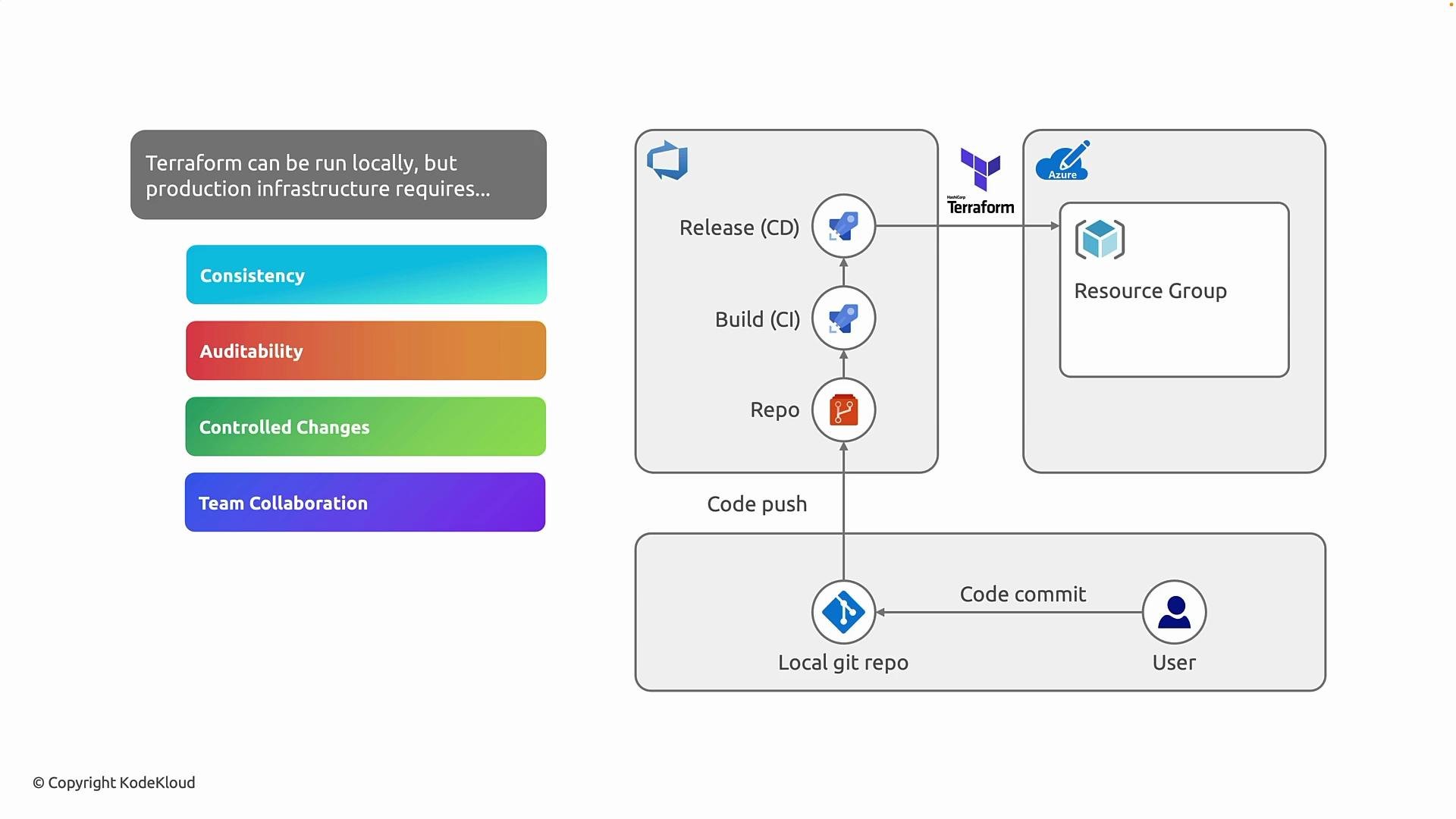 CI/CD provides consistency, repeatability, and an auditable trail—turning ad-hoc infrastructure changes into governed, reviewable, and reproducible operations.
What does CI do for Terraform?
CI automates the preparation and verification steps so every commit is treated uniformly. Typical CI stages for Terraform include:
* `terraform init` — configures backend, downloads providers and modules.
* `terraform validate` — checks syntax and internal consistency.
* `terraform plan` — produces an execution plan that shows proposed changes.
These steps ensure plugins and modules are initialized, configuration is validated, and a clear plan is produced that reviewers can inspect before any changes reach production.
CI tasks and their purpose:
| CI Task | Purpose | Typical Command |
| -------------------------------- | ------------------------------------------------- | -------------------- |
| Initialize backend and providers | Ensures consistent provider and module resolution | `terraform init` |
| Validate configuration | Catches syntax and structural issues early | `terraform validate` |
| Produce an execution plan | Shows exactly what will change for review | `terraform plan` |
Once CI finishes and reviewers approve the plan, CD performs the guarded `terraform apply`. The result is a separation of responsibilities:
* Developers write and version infrastructure code,
* Pipelines execute and enforce the delivery process,
* Azure (or another cloud) receives the validated deployment.
This removes the need for developers to have direct production access from their local machines.
Why CI/CD matters (short list):
* Consistency: Pipelines fix the Terraform version, provider versions, and command order so results are repeatable.
* Auditability: Runs, logs, and archived plans provide a searchable history of what changed, when, and by whom.
* Change governance: PRs, automated plan generation, and approval gates enforce review workflows before apply.
* Team collaboration: Infrastructure becomes part of the normal code review and delivery lifecycle.
Without CI/CD, an engineer could bypass gates and run `terraform apply` locally, creating risk and reducing traceability. Pipelines transform changes into controlled, auditable events.
Credentials and secrets
Store credentials centrally in your CI/CD system—use Azure DevOps service connections or service principals with secrets kept in the pipeline secret store. Where possible prefer managed identities to avoid long-lived credentials on machines.
Do not embed secrets in code or store long-lived credentials on developer machines. Centralize secrets in your pipeline or use managed identities to minimize operational risk.
Before the CD stage performs `terraform apply`, require approvals (manager, security, or change board) as appropriate. The recommended sequence is: plan → review → approve → apply. This preserves automation benefits while maintaining control.
CI/CD provides consistency, repeatability, and an auditable trail—turning ad-hoc infrastructure changes into governed, reviewable, and reproducible operations.
What does CI do for Terraform?
CI automates the preparation and verification steps so every commit is treated uniformly. Typical CI stages for Terraform include:
* `terraform init` — configures backend, downloads providers and modules.
* `terraform validate` — checks syntax and internal consistency.
* `terraform plan` — produces an execution plan that shows proposed changes.
These steps ensure plugins and modules are initialized, configuration is validated, and a clear plan is produced that reviewers can inspect before any changes reach production.
CI tasks and their purpose:
| CI Task | Purpose | Typical Command |
| -------------------------------- | ------------------------------------------------- | -------------------- |
| Initialize backend and providers | Ensures consistent provider and module resolution | `terraform init` |
| Validate configuration | Catches syntax and structural issues early | `terraform validate` |
| Produce an execution plan | Shows exactly what will change for review | `terraform plan` |
Once CI finishes and reviewers approve the plan, CD performs the guarded `terraform apply`. The result is a separation of responsibilities:
* Developers write and version infrastructure code,
* Pipelines execute and enforce the delivery process,
* Azure (or another cloud) receives the validated deployment.
This removes the need for developers to have direct production access from their local machines.
Why CI/CD matters (short list):
* Consistency: Pipelines fix the Terraform version, provider versions, and command order so results are repeatable.
* Auditability: Runs, logs, and archived plans provide a searchable history of what changed, when, and by whom.
* Change governance: PRs, automated plan generation, and approval gates enforce review workflows before apply.
* Team collaboration: Infrastructure becomes part of the normal code review and delivery lifecycle.
Without CI/CD, an engineer could bypass gates and run `terraform apply` locally, creating risk and reducing traceability. Pipelines transform changes into controlled, auditable events.
Credentials and secrets
Store credentials centrally in your CI/CD system—use Azure DevOps service connections or service principals with secrets kept in the pipeline secret store. Where possible prefer managed identities to avoid long-lived credentials on machines.
Do not embed secrets in code or store long-lived credentials on developer machines. Centralize secrets in your pipeline or use managed identities to minimize operational risk.
Before the CD stage performs `terraform apply`, require approvals (manager, security, or change board) as appropriate. The recommended sequence is: plan → review → approve → apply. This preserves automation benefits while maintaining control.
 When should you use CI/CD for Terraform?
Use CI/CD when the environment or organizational needs demand consistency, traceability, and governance. Common scenarios:
| Scenario | Why CI/CD is recommended |
| -------------------------- | ------------------------------------------------------------------------------------------ |
| Team environments | Standardizes execution, reduces merge conflicts, and provides shared visibility |
| Production environments | Ensures stability, traceability, and approval workflows for safe deployments |
| Regulated/audited settings | Provides demonstrable change control required by ISO, SOC, HIPAA, or financial regulations |
When should you use CI/CD for Terraform?
Use CI/CD when the environment or organizational needs demand consistency, traceability, and governance. Common scenarios:
| Scenario | Why CI/CD is recommended |
| -------------------------- | ------------------------------------------------------------------------------------------ |
| Team environments | Standardizes execution, reduces merge conflicts, and provides shared visibility |
| Production environments | Ensures stability, traceability, and approval workflows for safe deployments |
| Regulated/audited settings | Provides demonstrable change control required by ISO, SOC, HIPAA, or financial regulations |
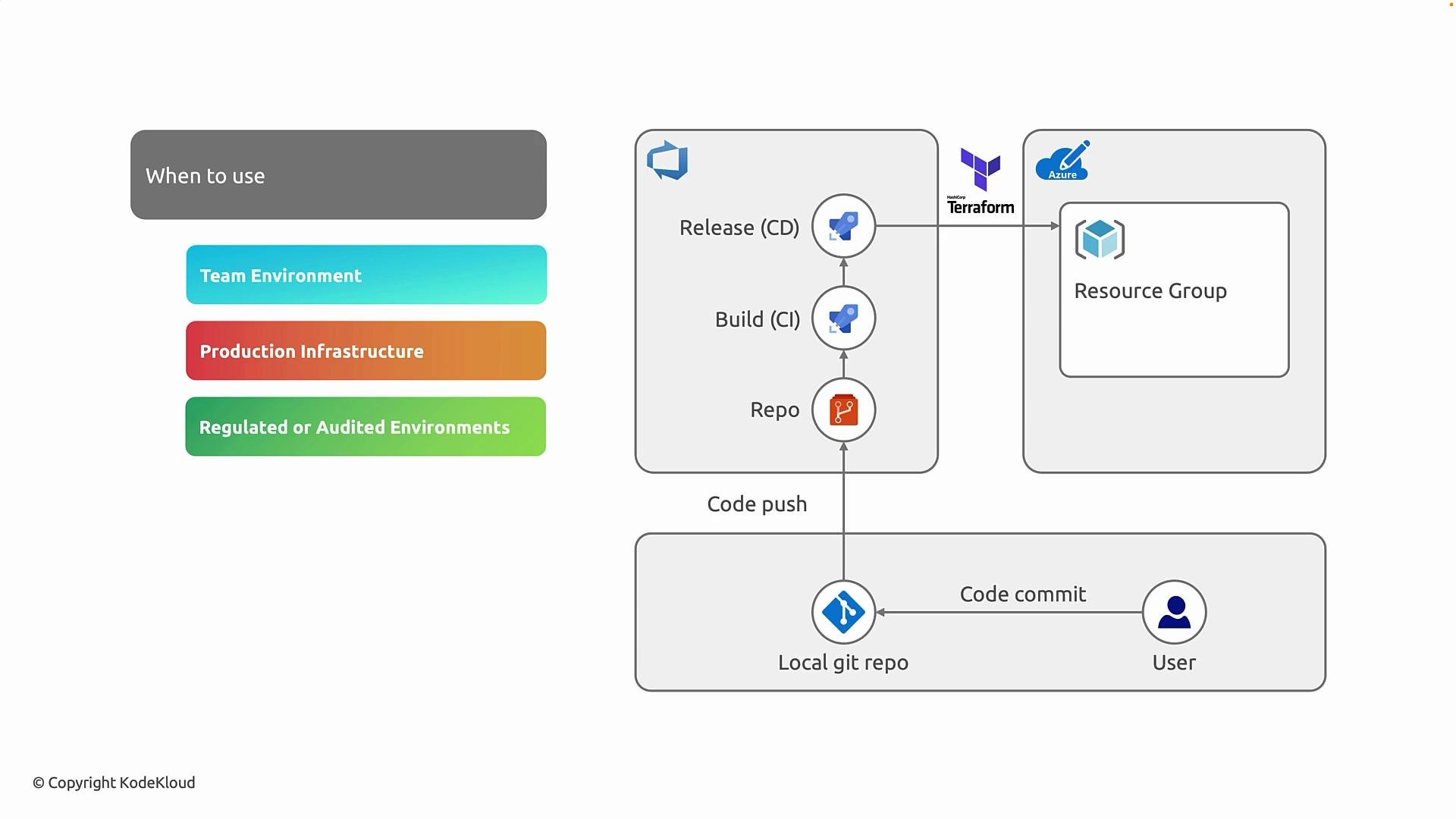 CI/CD pipelines give you reproducible runs, centralized secrets, approval gates, and audit logs—everything needed for production-grade infrastructure delivery. Running Terraform locally remains useful for learning and experimentation, but for any shared, production, or audited environment, CI/CD is not optional—it’s mandatory for safe, repeatable infrastructure operations.
Links and references
* [Terraform](https://www.terraform.io/)
* [Azure DevOps](https://azure.microsoft.com/services/devops/)
* Azure DevOps service connections: `https://learn.microsoft.com/azure/devops/pipelines/library/service-endpoints?view=azure-devops&tabs=yaml`
* Service principals: `https://learn.microsoft.com/azure/active-directory/develop/app-objects-and-service-principals`
* Managed identities: `https://learn.microsoft.com/azure/active-directory/managed-identities-azure-resources/overview`
* Compliance references: [ISO](https://www.iso.org/), [SOC](https://www.aicpa.org/interestareas/frc/assuranceadvisoryservices/soc-for-service-organizations.html), [HIPAA](https://www.hhs.gov/hipaa/index.html)
CI/CD pipelines give you reproducible runs, centralized secrets, approval gates, and audit logs—everything needed for production-grade infrastructure delivery. Running Terraform locally remains useful for learning and experimentation, but for any shared, production, or audited environment, CI/CD is not optional—it’s mandatory for safe, repeatable infrastructure operations.
Links and references
* [Terraform](https://www.terraform.io/)
* [Azure DevOps](https://azure.microsoft.com/services/devops/)
* Azure DevOps service connections: `https://learn.microsoft.com/azure/devops/pipelines/library/service-endpoints?view=azure-devops&tabs=yaml`
* Service principals: `https://learn.microsoft.com/azure/active-directory/develop/app-objects-and-service-principals`
* Managed identities: `https://learn.microsoft.com/azure/active-directory/managed-identities-azure-resources/overview`
* Compliance references: [ISO](https://www.iso.org/), [SOC](https://www.aicpa.org/interestareas/frc/assuranceadvisoryservices/soc-for-service-organizations.html), [HIPAA](https://www.hhs.gov/hipaa/index.html)