> ## Documentation Index
> Fetch the complete documentation index at: https://notes.kodekloud.com/llms.txt
> Use this file to discover all available pages before exploring further.
# Introduction
> Guide to Terraform iteration and logic using count, for_each, for expressions and conditional expressions for scalable maintainable resources and predictable state management
In this lesson we'll explore how Terraform handles repetition and decision-making so your infrastructure code can scale without duplication. You'll learn when to use `count` and when to prefer `for_each`, how to reshape data with `for` expressions, and how to apply conditional expressions for environment-specific or optional logic.
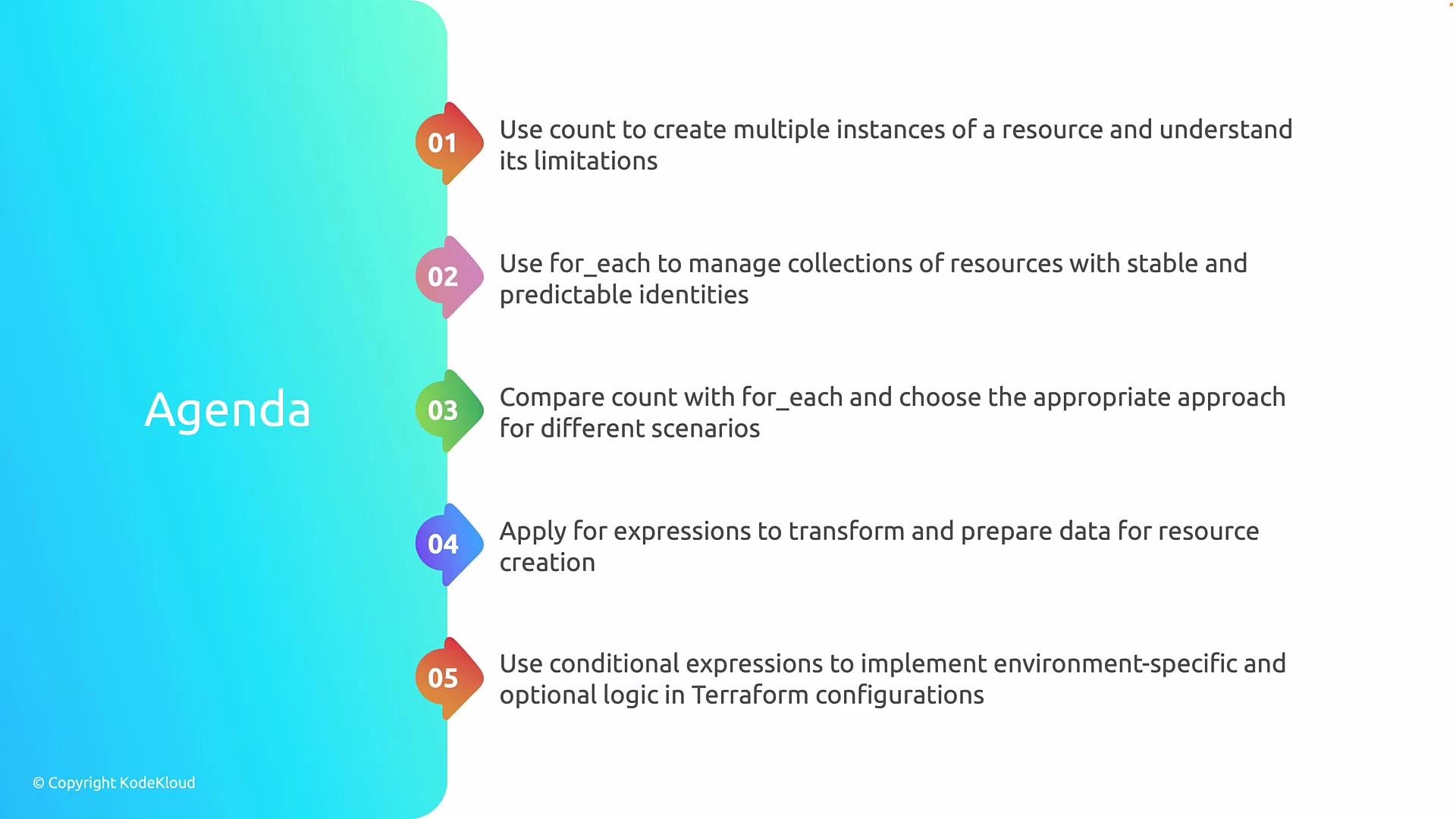
* Understand `count` and its limits for predictable resource addresses.
* Master `for_each` for stable identities and safer state management.
* Compare `count` vs `for_each` to choose the right approach for long-term maintenance.
* Use `for` expressions to transform collections.
* Use conditional expressions to implement environment or optional logic.
 All of these patterns let your configurations adapt programmatically, reducing repetition and making modules easier to maintain and evolve.
Use `count` when you need simple repetition of identical resources. Prefer `for_each` for collections where each instance needs a stable address or when keys/identities matter for the Terraform state.
## Quick overview: when to use each pattern
| Pattern | Best for | Example |
| ----------------------: | ------------------------------------------------------------------- | ------------------------------------------------------------------------------------------ |
| `count` | Creating N identical resources with a numeric index | `count = 3` |
| `for_each` | Creating resources from a collection with stable keys (`set`/`map`) | `for_each = toset(["a","b"])` or `for_each = { "app1" = "10.0.1.0", "app2" = "10.0.2.0" }` |
| `for` expressions | Transforming or mapping collections before use | `local.subnets = [for s in var.azs : "${s}-subnet"]` |
| Conditional expressions | Environment-specific or optional behavior | `count = var.enabled ? 1 : 0` |
## What you'll learn in this lesson
1. `count` — how it creates multiple instances and where it becomes limiting.
2. `for_each` — why it provides stable resource identities and predictable state addresses.
3. Side-by-side comparison — how changing between patterns affects state and resource replacement.
4. `for` expressions — reshaping data for use in resources.
5. Conditional expressions — gating resources and settings by environment or flags.
Changing between `count` and `for_each` (or changing keys used by `for_each`) can force Terraform to recreate resources. Test changes in a safe environment and plan before apply to avoid unexpected replacements.
## Links and references
* [Terraform documentation: count](https://www.terraform.io/docs/language/meta-arguments/count.html)
* [Terraform documentation: for\_each](https://www.terraform.io/docs/language/meta-arguments/for_each.html)
* [Terraform documentation: for expressions](https://www.terraform.io/docs/language/expressions/for.html)
* [Terraform documentation: conditional expressions](https://www.terraform.io/docs/language/expressions/conditionals.html)
These topics will help you write Terraform configurations that are both concise and resilient as your infrastructure grows.
All of these patterns let your configurations adapt programmatically, reducing repetition and making modules easier to maintain and evolve.
Use `count` when you need simple repetition of identical resources. Prefer `for_each` for collections where each instance needs a stable address or when keys/identities matter for the Terraform state.
## Quick overview: when to use each pattern
| Pattern | Best for | Example |
| ----------------------: | ------------------------------------------------------------------- | ------------------------------------------------------------------------------------------ |
| `count` | Creating N identical resources with a numeric index | `count = 3` |
| `for_each` | Creating resources from a collection with stable keys (`set`/`map`) | `for_each = toset(["a","b"])` or `for_each = { "app1" = "10.0.1.0", "app2" = "10.0.2.0" }` |
| `for` expressions | Transforming or mapping collections before use | `local.subnets = [for s in var.azs : "${s}-subnet"]` |
| Conditional expressions | Environment-specific or optional behavior | `count = var.enabled ? 1 : 0` |
## What you'll learn in this lesson
1. `count` — how it creates multiple instances and where it becomes limiting.
2. `for_each` — why it provides stable resource identities and predictable state addresses.
3. Side-by-side comparison — how changing between patterns affects state and resource replacement.
4. `for` expressions — reshaping data for use in resources.
5. Conditional expressions — gating resources and settings by environment or flags.
Changing between `count` and `for_each` (or changing keys used by `for_each`) can force Terraform to recreate resources. Test changes in a safe environment and plan before apply to avoid unexpected replacements.
## Links and references
* [Terraform documentation: count](https://www.terraform.io/docs/language/meta-arguments/count.html)
* [Terraform documentation: for\_each](https://www.terraform.io/docs/language/meta-arguments/for_each.html)
* [Terraform documentation: for expressions](https://www.terraform.io/docs/language/expressions/for.html)
* [Terraform documentation: conditional expressions](https://www.terraform.io/docs/language/expressions/conditionals.html)
These topics will help you write Terraform configurations that are both concise and resilient as your infrastructure grows.