> ## Documentation Index
> Fetch the complete documentation index at: https://notes.kodekloud.com/llms.txt
> Use this file to discover all available pages before exploring further.
# What is Remote State
> Explains using remote Terraform state with Azure Storage to centralize state, enable locking, secure sensitive data, and avoid storing state in Git.
Remote state is how teams share a single authoritative view of Terraform-managed infrastructure. When multiple people run Terraform against the same environment, using local state files quickly leads to inconsistencies, merge conflicts, and even data exposure.
Consider a common scenario:
* John has a local Terraform configuration and a `terraform.tfstate` file on his machine.
* Jack has a separate local configuration and a different `terraform.tfstate`.\
Both believe they manage the same infrastructure, yet each holds a different, potentially stale snapshot of the environment.
Why storing state in Git is a bad idea:
* Terraform state files change frequently and are not source code; treating them like code produces noisy commits.
* State often contains sensitive values (secrets, resource IDs, connection strings) that should not be in a code repository.
* Git is optimized for textual merges, not for reconciling concurrent binary-like state updates, so merge conflicts and corruption are common.
* Git provides no automatic concurrency control for Terraform operations; two simultaneous applies can overwrite each other’s state.
What Terraform needs instead is a remote backend that provides:
* A single, authoritative state location so every operation starts from the latest state and writes updates back centrally.
* Concurrency control (state locking) so only one operation can modify state at a time.
* Access controls and encryption to protect sensitive data.
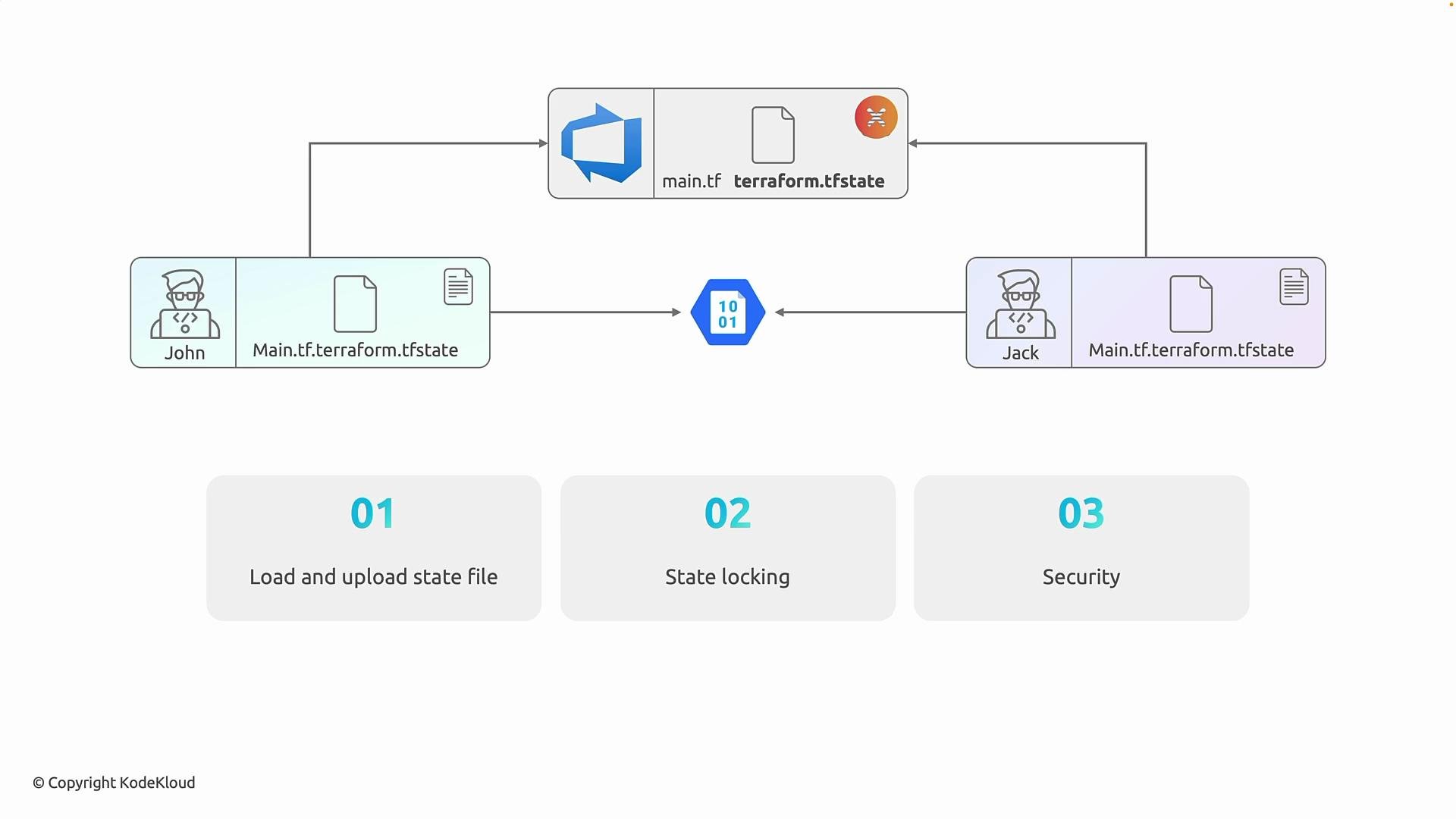 For Azure-based teams, the recommended approach is to use Azure Storage (Azure Blob Storage) as the Terraform backend via the `azurerm` backend. Azure Storage provides encryption at rest, RBAC integration, and state locking implemented with blob leases to prevent concurrent writes that would corrupt state.
Example `azurerm` backend block (HCL):
```hcl theme={null}
terraform {
backend "azurerm" {
resource_group_name = "rg-terraform-state"
storage_account_name = "tfstateacct"
container_name = "tfstate"
key = "prod.terraform.tfstate"
}
}
```
Backend configuration notes:
* The Storage account and container must exist before running `terraform init`, unless you create them out-of-band (for example, with a separate Terraform run or via Azure CLI).
* Ensure the identity used by Terraform (service principal, managed identity, or your user account) has read/write access to the storage container.
* State locking is implemented using blob leases, preventing simultaneous writes.
Common backend configuration options
| Option | Purpose | Example |
| ---------------------- | ------------------------------------------------------------------------------ | ------------------------ |
| `resource_group_name` | The Resource Group containing the Storage Account | `rg-terraform-state` |
| `storage_account_name` | The Storage Account used to store the state | `tfstateacct` |
| `container_name` | The Blob container within the Storage Account | `tfstate` |
| `key` | Path/name of the state file (acts like a unique identifier for this workspace) | `prod.terraform.tfstate` |
Initialize the backend after creating your storage resources and adding the backend block:
```bash theme={null}
terraform init
```
If you want to supply backend settings dynamically (for CI/CD or automation), pass them as `-backend-config` flags:
```bash theme={null}
terraform init \
-backend-config="resource_group_name=rg-terraform-state" \
-backend-config="storage_account_name=tfstateacct" \
-backend-config="container_name=tfstate" \
-backend-config="key=prod.terraform.tfstate"
```
Confirm the storage account and container exist and that the executing identity has the required permissions before running `terraform init`. If they don't, backend initialization will fail.
Do not store Terraform state files in Git. This can expose sensitive data, create frequent merge conflicts, and lead to state corruption.
How to migrate existing local state
* If you already have a `terraform.tfstate` locally, `terraform init` will detect the configured remote backend and prompt to migrate local state to the remote backend. You can automate migration using `terraform init -migrate-state`.
* Alternatively, you can use `terraform state push` to upload a local state, or follow a two-step process: create the backend resources out-of-band, then run `terraform init` and allow it to move state.
Key takeaways
* Local state does not scale for teams — it leads to inconsistent views and possible corruption.
* Source control is not a safe place for Terraform state due to sensitivity and concurrency concerns.
* Use a remote backend (for Azure: Azure Storage with the `azurerm` backend) to centralize state, enable locking, and secure sensitive data.
Links and references
* [Terraform Backends Documentation](https://www.terraform.io/docs/backends/index.html)
* [Azure Storage documentation](https://docs.microsoft.com/azure/storage/)
* [Terraform azurerm Backend Docs](https://registry.terraform.io/providers/hashicorp/azurerm/latest/docs/guides/terraform_backend)
For Azure-based teams, the recommended approach is to use Azure Storage (Azure Blob Storage) as the Terraform backend via the `azurerm` backend. Azure Storage provides encryption at rest, RBAC integration, and state locking implemented with blob leases to prevent concurrent writes that would corrupt state.
Example `azurerm` backend block (HCL):
```hcl theme={null}
terraform {
backend "azurerm" {
resource_group_name = "rg-terraform-state"
storage_account_name = "tfstateacct"
container_name = "tfstate"
key = "prod.terraform.tfstate"
}
}
```
Backend configuration notes:
* The Storage account and container must exist before running `terraform init`, unless you create them out-of-band (for example, with a separate Terraform run or via Azure CLI).
* Ensure the identity used by Terraform (service principal, managed identity, or your user account) has read/write access to the storage container.
* State locking is implemented using blob leases, preventing simultaneous writes.
Common backend configuration options
| Option | Purpose | Example |
| ---------------------- | ------------------------------------------------------------------------------ | ------------------------ |
| `resource_group_name` | The Resource Group containing the Storage Account | `rg-terraform-state` |
| `storage_account_name` | The Storage Account used to store the state | `tfstateacct` |
| `container_name` | The Blob container within the Storage Account | `tfstate` |
| `key` | Path/name of the state file (acts like a unique identifier for this workspace) | `prod.terraform.tfstate` |
Initialize the backend after creating your storage resources and adding the backend block:
```bash theme={null}
terraform init
```
If you want to supply backend settings dynamically (for CI/CD or automation), pass them as `-backend-config` flags:
```bash theme={null}
terraform init \
-backend-config="resource_group_name=rg-terraform-state" \
-backend-config="storage_account_name=tfstateacct" \
-backend-config="container_name=tfstate" \
-backend-config="key=prod.terraform.tfstate"
```
Confirm the storage account and container exist and that the executing identity has the required permissions before running `terraform init`. If they don't, backend initialization will fail.
Do not store Terraform state files in Git. This can expose sensitive data, create frequent merge conflicts, and lead to state corruption.
How to migrate existing local state
* If you already have a `terraform.tfstate` locally, `terraform init` will detect the configured remote backend and prompt to migrate local state to the remote backend. You can automate migration using `terraform init -migrate-state`.
* Alternatively, you can use `terraform state push` to upload a local state, or follow a two-step process: create the backend resources out-of-band, then run `terraform init` and allow it to move state.
Key takeaways
* Local state does not scale for teams — it leads to inconsistent views and possible corruption.
* Source control is not a safe place for Terraform state due to sensitivity and concurrency concerns.
* Use a remote backend (for Azure: Azure Storage with the `azurerm` backend) to centralize state, enable locking, and secure sensitive data.
Links and references
* [Terraform Backends Documentation](https://www.terraform.io/docs/backends/index.html)
* [Azure Storage documentation](https://docs.microsoft.com/azure/storage/)
* [Terraform azurerm Backend Docs](https://registry.terraform.io/providers/hashicorp/azurerm/latest/docs/guides/terraform_backend)