> ## Documentation Index
> Fetch the complete documentation index at: https://notes.kodekloud.com/llms.txt
> Use this file to discover all available pages before exploring further.
# Considerations
> Guidance comparing Terraform workspaces and separate state files, evaluating isolation, risk, complexity, and recommended patterns for governance, teams, and environment separation
Pause to review the key design trade-offs before adopting Terraform workspaces versus maintaining separate state files. Each approach has implications for isolation, risk, operational complexity, and suitability for enterprise governance. Use the guidance below to align your choice with team structure, compliance needs, and blast-radius tolerance.
## At a glance
* Workspaces share the same configuration across environments and keep separate state per workspace.
* Separate state files (backends) decouple environments, allowing independent configuration, pipelines, and ownership.
* The right pattern depends on your need for simplicity versus strict isolation and governance.
## Comparison: workspaces vs separate state files
| Criteria | Terraform Workspaces | Separate state files / backends |
| ---------------------- | -----------------------------------------------------------------------------------------------------: | --------------------------------------------------------------------------------------------- |
| Configuration | Shared across environments; differences handled via variables, conditionals, or workspace-aware logic. | Each environment can have its own configuration, enabling independent evolution. |
| State isolation | Each workspace maps to its own state file (isolated). | State files are explicitly separated in different backends or directories (strong isolation). |
| Blast radius & risk | Medium: shared config and CI/CD pipelines can produce cross-environment impact. | Smaller: decoupled backends/pipelines confine failures to a single environment. |
| Complexity | Lower: less duplication and simpler for small, single-team projects. | Higher: multiple repos/directories/pipelines add overhead but provide finer control. |
| Enterprise suitability | Limited: may struggle with strict compliance, fine-grained access control, and multi-team ownership. | Better: aligns with security boundaries, audit requirements, and organizational ownership. |
Key takeaway: workspaces optimize simplicity and reduced duplication; separate state files prioritize safety, scalability, and governance.
## When not to use workspaces
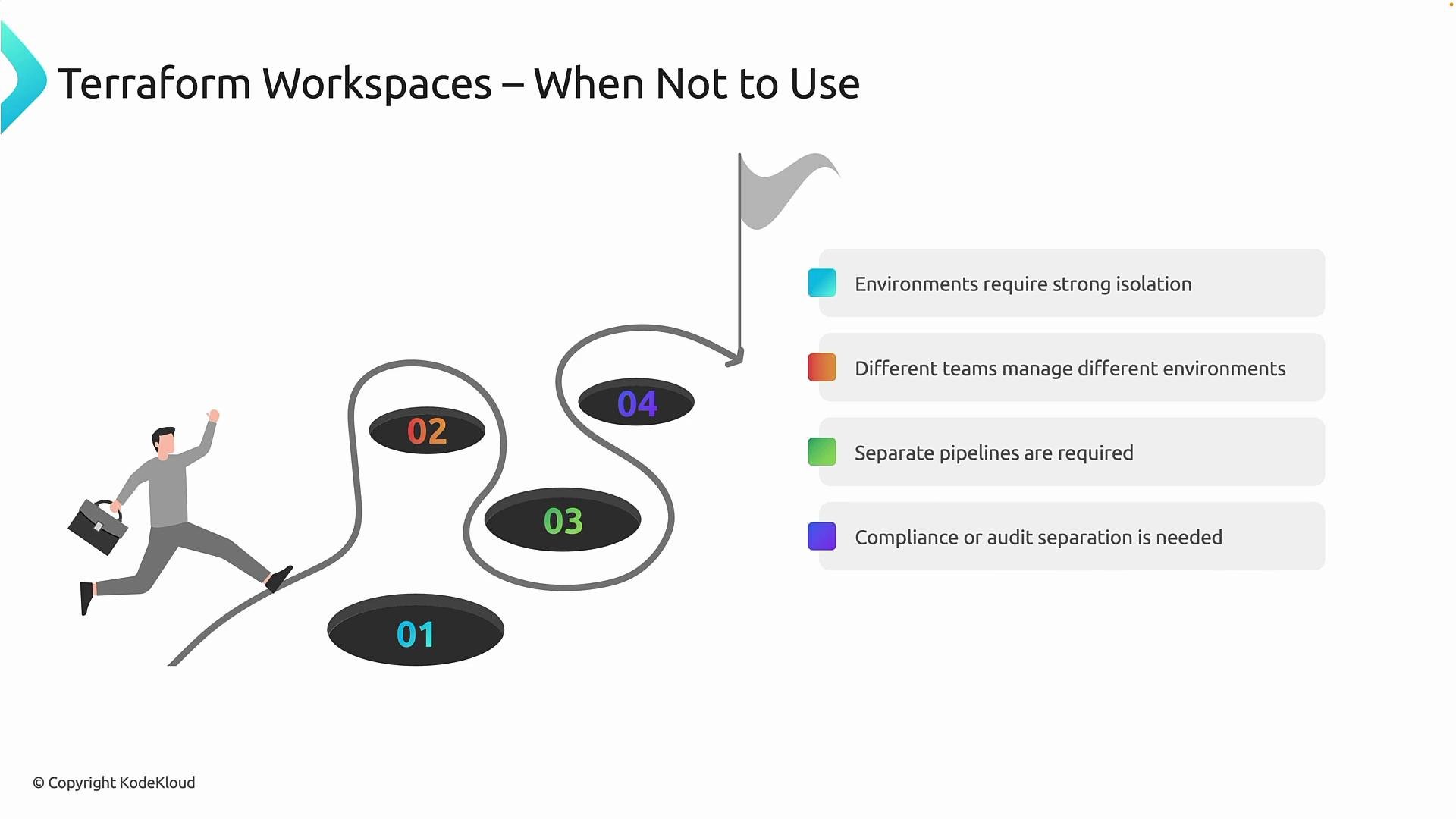
Avoid workspaces when any of the following apply:
* Your environment requires strong isolation between environments (security, compliance, or data separation).
* Different teams own different environments and need independent lifecycles or deployment control.
* Each environment must have its own pipeline lifecycle (plan/apply/approve) or separate audit trails.
* Organizational governance demands explicit boundaries and limited blast radius.
 In these scenarios, using workspaces can increase operational risk by introducing hidden coupling between environments.
## Recommended alternatives
When you need stronger separation, consider these patterns. They trade some convenience for predictability, safety, and governance:
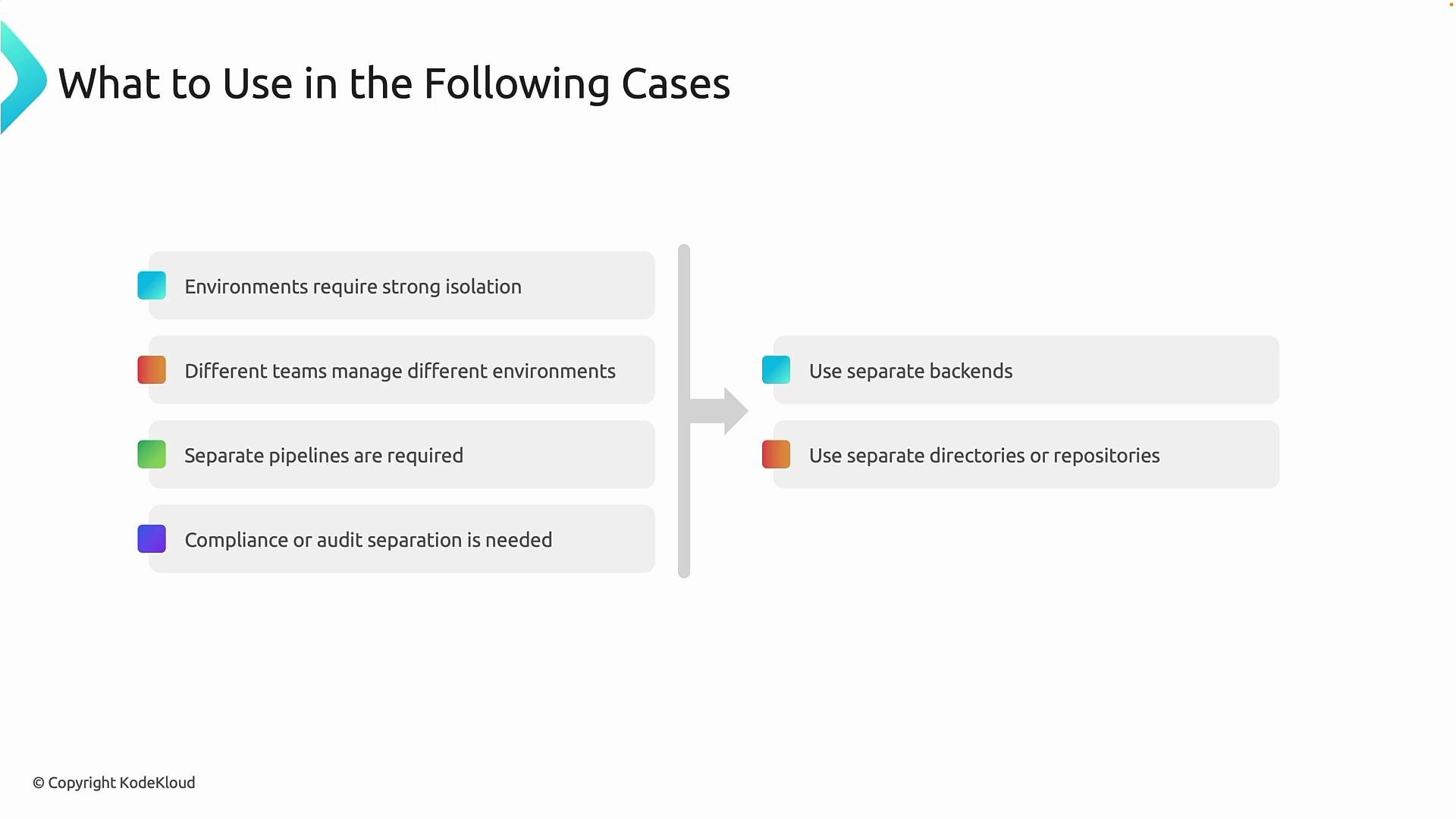
* Separate backends
* Use distinct remote backends (e.g., different state storage containers, buckets, or workspaces in a supported backend) to enforce state isolation and manage access controls independently.
* Separate directories or repositories per environment
* Put environment-specific configuration in different folders or repos so teams can evolve independently and apply different lifecycle rules.
* Independent pipelines per environment
* Create dedicated CI/CD pipelines per environment to enforce approvals, reduce accidental cross-environment changes, and provide auditable runs.
These patterns align well with large organizations, regulated industries, or multi-team ownership models where isolation and governance are paramount.
In these scenarios, using workspaces can increase operational risk by introducing hidden coupling between environments.
## Recommended alternatives
When you need stronger separation, consider these patterns. They trade some convenience for predictability, safety, and governance:
* Separate backends
* Use distinct remote backends (e.g., different state storage containers, buckets, or workspaces in a supported backend) to enforce state isolation and manage access controls independently.
* Separate directories or repositories per environment
* Put environment-specific configuration in different folders or repos so teams can evolve independently and apply different lifecycle rules.
* Independent pipelines per environment
* Create dedicated CI/CD pipelines per environment to enforce approvals, reduce accidental cross-environment changes, and provide auditable runs.
These patterns align well with large organizations, regulated industries, or multi-team ownership models where isolation and governance are paramount.
 ## Practical guidance
* Start by mapping ownership, compliance requirements, and acceptable blast radius for your systems. This will guide whether simplicity (workspaces) or strong boundaries (separate backends/repos) is the better fit.
* For small teams and non-critical workloads, workspaces can reduce duplication and speed onboarding.
* For production-critical or regulated systems, prefer separate backends/repositories and distinct pipelines to avoid accidental cross-environment impacts.
If you are unsure which approach to choose, map ownership, compliance requirements, and blast-radius tolerance. For small teams with simple requirements, workspaces may be acceptable. For multi-team, compliant, or production-critical environments, prefer separate backends and repositories.
## Links and references
* [Terraform Workspaces — HashiCorp Documentation](https://www.terraform.io/docs/state/workspaces.html)
* [Terraform Backends — HashiCorp Documentation](https://www.terraform.io/docs/language/settings/backends/index.html)
* [Best practices for managing Terraform state](https://www.terraform.io/docs/cloud/guides/recommended-practices/state.html)
## Practical guidance
* Start by mapping ownership, compliance requirements, and acceptable blast radius for your systems. This will guide whether simplicity (workspaces) or strong boundaries (separate backends/repos) is the better fit.
* For small teams and non-critical workloads, workspaces can reduce duplication and speed onboarding.
* For production-critical or regulated systems, prefer separate backends/repositories and distinct pipelines to avoid accidental cross-environment impacts.
If you are unsure which approach to choose, map ownership, compliance requirements, and blast-radius tolerance. For small teams with simple requirements, workspaces may be acceptable. For multi-team, compliant, or production-critical environments, prefer separate backends and repositories.
## Links and references
* [Terraform Workspaces — HashiCorp Documentation](https://www.terraform.io/docs/state/workspaces.html)
* [Terraform Backends — HashiCorp Documentation](https://www.terraform.io/docs/language/settings/backends/index.html)
* [Best practices for managing Terraform state](https://www.terraform.io/docs/cloud/guides/recommended-practices/state.html)