> ## Documentation Index
> Fetch the complete documentation index at: https://notes.kodekloud.com/llms.txt
> Use this file to discover all available pages before exploring further.
# What Is Terragrunt
> Terragrunt is a wrapper for Terraform that enhances Infrastructure as Code workflows by improving management of complex infrastructures with less repetition.
Terragrunt is a lightweight wrapper for [Terraform](https://www.terraform.io/), built by Gruntwork to bring structure and automation to Infrastructure as Code (IaC) workflows. Rather than replacing Terraform, Terragrunt enhances it—making it easier to manage complex, multi-environment infrastructures with less repetition and more consistency.
Terragrunt works *on top* of Terraform. You still write your IaC in Terraform language and benefit from the Terraform CLI.
## Why Terragrunt?
* Enforces best practices for Terraform configurations
* Simplifies remote state configuration and locking
* Promotes reuse of variables and modules
* Reduces code duplication with parent–child inheritance
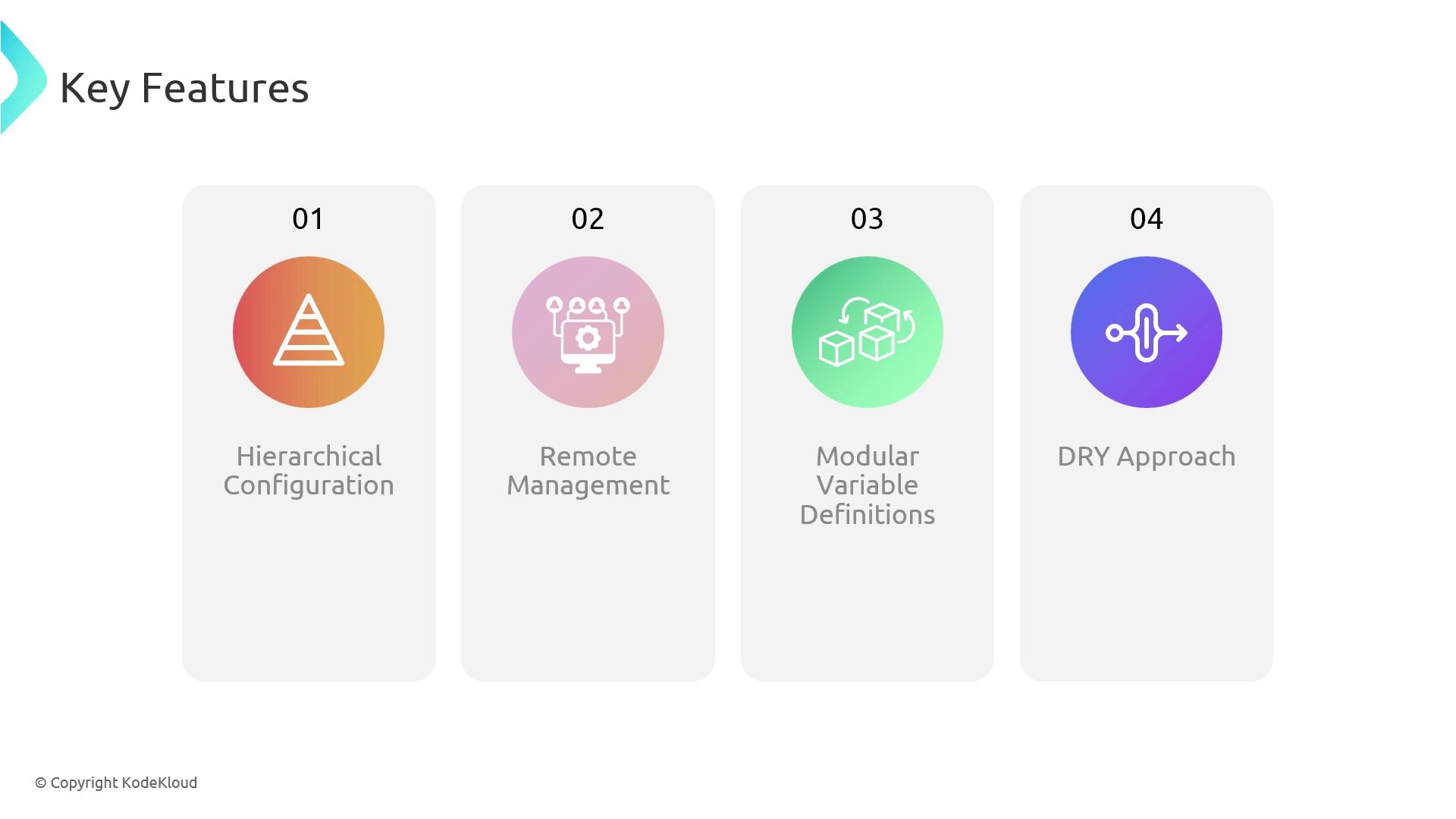
## Key Features
| Feature | Description |
| ---------------------------- | ---------------------------------------------------------------------------------------------------- |
| Hierarchical Configuration | Organize Terraform code in directories that reflect environments and regions. |
| Remote State Management | Automate backend setup (e.g., S3, Azure Blob, GCS) and enable state locking with DynamoDB or Consul. |
| Modular Variable Definitions | Define shared variables in one place and reference them across multiple modules and environments. |
| DRY (Don't Repeat Yourself) | Inherit and override configurations in a parent–child folder structure to minimize duplication. |
Always enable state locking and encryption for your remote backend to prevent concurrent writes and protect sensitive data.
## Common Use Cases
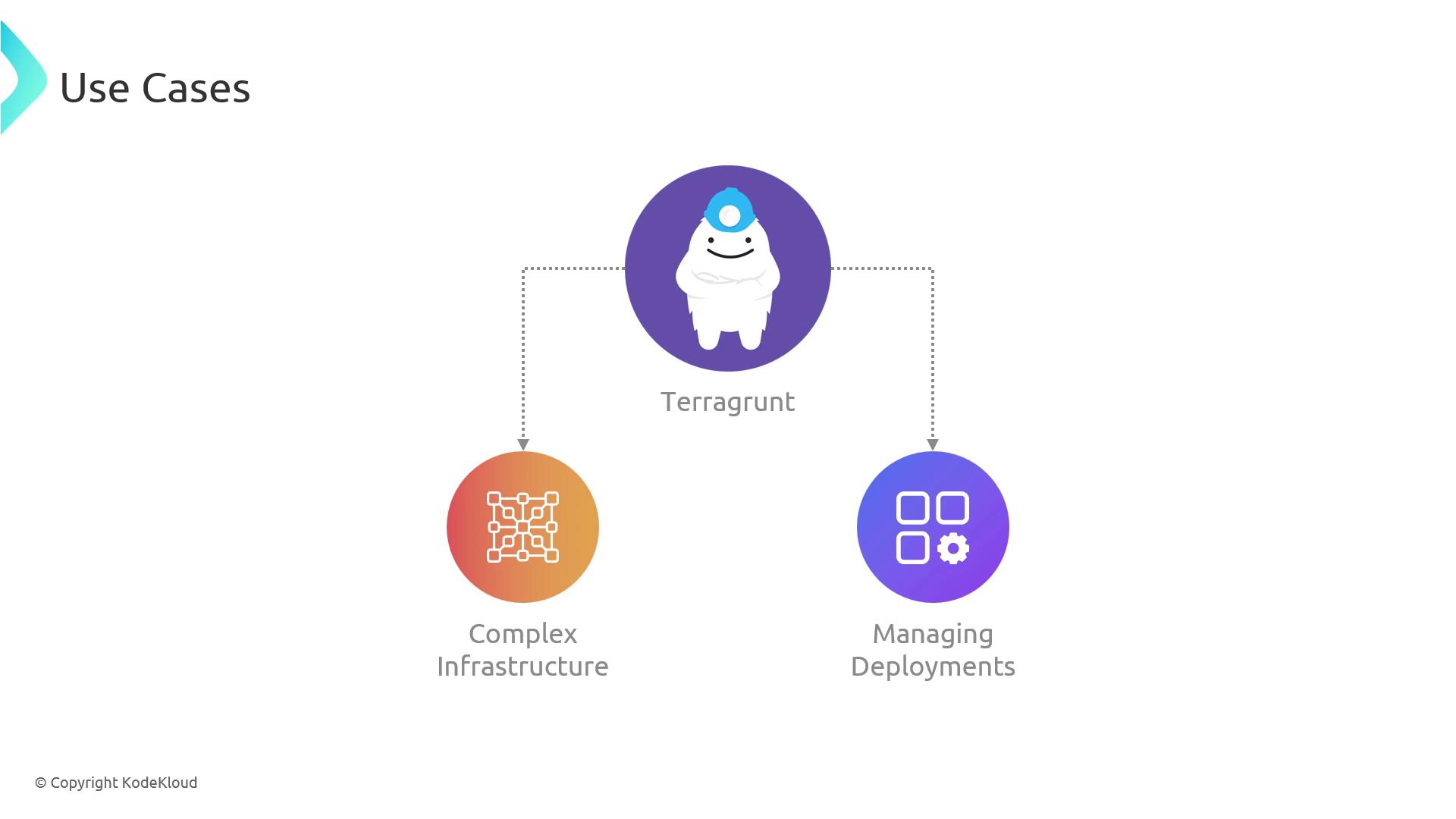
Terragrunt shines in scenarios where Terraform alone can become unwieldy:
| Use Case | Benefit |
| ------------------------------- | ---------------------------------------------------------------------------------------------- |
| Complex Infrastructure Projects | Simplifies management of interdependent modules, networks, and cloud resources. |
| Multi-Environment Deployments | Maintains consistency across dev, staging, and prod through shared remote state and variables. |
## Links and References
* [Terragrunt Documentation](https://terragrunt.gruntwork.io/)
* [Terraform Documentation](https://www.terraform.io/docs/)
* [Gruntwork Blog on Terragrunt](https://blog.gruntwork.io/introducing-terragrunt-9f9d2c2bdb34)