> ## Documentation Index
> Fetch the complete documentation index at: https://notes.kodekloud.com/llms.txt
> Use this file to discover all available pages before exploring further.
# What Problems Does Terragrunt Solve
> Terragrunt enhances Terraform by managing complexity, centralizing state, eliminating duplication, and maintaining consistency across environments for better team collaboration.
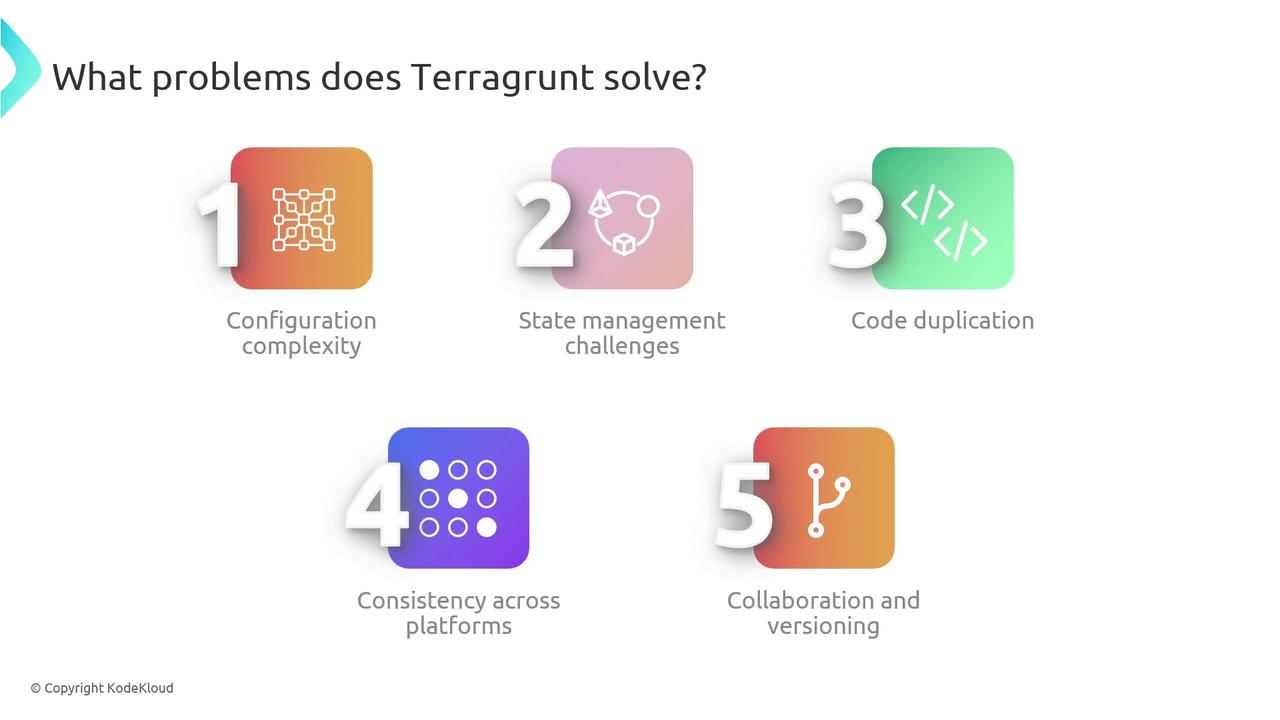
Terragrunt enhances Terraform by introducing a hierarchical project layout and workflow automation. This structured approach helps you manage complexity, centralize state, eliminate duplication, and maintain consistency across environments—all while fostering better team collaboration.
## At a Glance
| Challenge | Impact | Terragrunt Feature |
| -------------------------- | ---------------------------------------- | ------------------------------------------------ |
| Configuration Complexity | Hard to scale and navigate large configs | Modular folder structure & nesting |
| Remote State Management | State drift and conflicts | Automated backend configuration (S3/Azure/GCS) |
| Code Duplication | Maintenance overhead | DRY inheritance with `include` & `dependency` |
| Environment Consistency | Drift between dev/staging/prod | Environment-specific folder layouts |
| Collaboration & Versioning | Merge conflicts & upgrade challenges | Isolated workflows & semantic versioning support |
## 1. Configuration Complexity
As Terraform codebases grow, navigating dozens of `.tf` files and interdependent modules becomes challenging. Terragrunt enforces a clear directory hierarchy:
```text theme={null}
infrastructure/
├─ live/
│ ├─ dev/
│ │ └─ terragrunt.hcl
│ ├─ staging/
│ │ └─ terragrunt.hcl
│ └─ prod/
│ └─ terragrunt.hcl
└─ modules/
├─ vpc/
│ └─ main.tf
└─ app/
└─ main.tf
```
This layout makes it easy to locate code, define dependencies, and scale as your team grows.
## 2. Remote State Management
Managing Terraform state across multiple environments and engineers introduces risk of state drift. Terragrunt automates backend setup in your `terragrunt.hcl`:
```hcl theme={null}
remote_state {
backend = "s3"
config = {
bucket = "my-terraform-state"
key = "${path_relative_to_include()}/terraform.tfstate"
region = "us-east-1"
}
}
```
With a centralized and versioned state, everyone works from the same source of truth.
## 3. Code Duplication
Repeating provider, backend, and variable definitions for each environment leads to errors and maintenance pain. Terragrunt’s DRY approach allows you to share common configuration:
```hcl theme={null}
# live/common.hcl
include {
path = find_in_parent_folders()
}
inputs = {
project = "my-app"
}
```
Then inherit in each environment:
```hcl theme={null}
# live/dev/terragrunt.hcl
include { path = "../common.hcl" }
inputs = { environment = "dev" }
```
Use `dependency` blocks to pass outputs between modules, further reducing repetition.
## 4. Environment Consistency
Differences between dev, staging, and prod can cause unexpected behavior. By defining environment-specific variables and settings in separate folders, Terragrunt ensures each stage uses the intended configuration:
```text theme={null}
live/
└─ prod/
└─ terragrunt.hcl # Overrides common inputs with production values
```
## 5. Collaboration and Versioning
Multiple engineers working on the same Terraform code can collide on merges or apply the wrong versions of modules. Terragrunt addresses this by:
* Isolated apply/plan contexts per environment
* Support for semantic versioning of modules
* Encouraging small, incremental changes
This leads to safer upgrades and clearer audit trails.
## References
* [Terraform](https://www.terraform.io/)
* [Infrastructure as Code](https://en.wikipedia.org/wiki/Infrastructure_as_Code)