> ## Documentation Index
> Fetch the complete documentation index at: https://notes.kodekloud.com/llms.txt
> Use this file to discover all available pages before exploring further.
# get parent terragrunt dir
> This article explains the `get_parent_terragrunt_dir()` function for managing hierarchical configurations in Terragrunt by returning the parent directory path.
Terragrunt’s built-in function `get_parent_terragrunt_dir()` simplifies hierarchical configuration management by returning the file path of the parent Terragrunt directory. Use it to construct relative `source` paths, inherit common settings, and keep your infrastructure code modular and maintainable.
## What Is `get_parent_terragrunt_dir()`?
`get_parent_terragrunt_dir()` resolves at runtime to the directory containing the nearest parent `terragrunt.hcl`. This enables:
* Dynamic discovery of module or state backend locations
* Reuse of shared configurations defined in a parent folder
* Cleaner directory structures for multi-environment setups
Ensure your Terragrunt directory layout follows a clear hierarchy—each child folder must reside under a parent that contains a `terragrunt.hcl`.
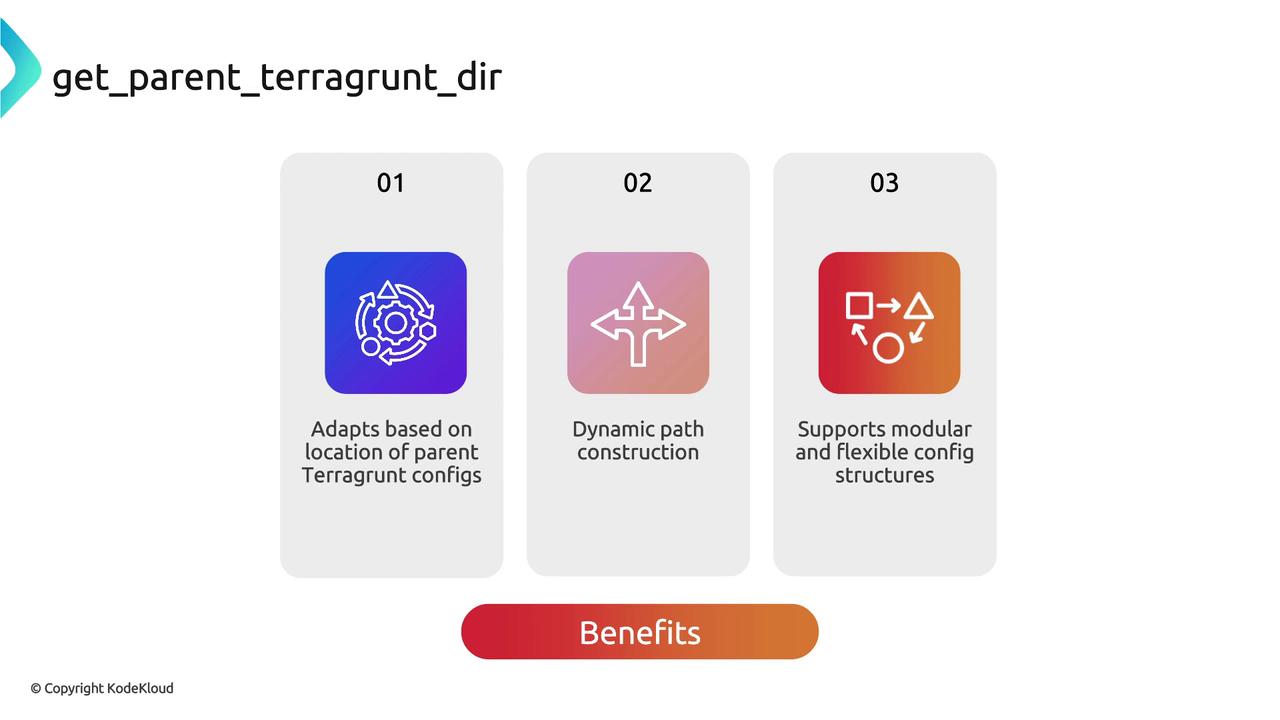
## Key Benefits
| Feature | Description |
| ----------------------------- | --------------------------------------------------------------------------- |
| Dynamic Path Construction | Automatically build paths for Terraform modules relative to parent folders. |
| Hierarchical Inheritance | Share backend or provider settings from a top-level `terragrunt.hcl`. |
| Modular & Flexible Structures | Keep each environment or component isolated while reusing common logic. |
## Example Usage
Place the following in a child environment’s `terragrunt.hcl` to reference a module stored alongside the parent configuration:
```hcl theme={null}
# terragrunt.hcl in /envs/dev
terraform {
source = "${get_parent_terragrunt_dir()}/modules/network"
}
inputs = {
vpc_cidr = "10.0.0.0/16"
}
```
This resolves to `/envs/modules/network` if the parent `terragrunt.hcl` lives in `/envs`.
Calling `get_parent_terragrunt_dir()` at the root level (where no parent exists) will result in an error. Always validate your folder structure before using this function.
## Best Practices
* Keep a **consistent directory layout** so returned paths remain predictable.
* Use `get_parent_terragrunt_dir()` for `source` definitions in **nested** configurations only.
* Combine with other Terragrunt functions like `find_in_parent_folders()` to import common settings.
## Links and References
* [Terragrunt Official Documentation](https://terragrunt.gruntwork.io/docs/)
* [Terraform Modules](https://www.terraform.io/language/modules)
* [Terragrunt GitHub Repository](https://github.com/gruntwork-io/terragrunt)