> ## Documentation Index
> Fetch the complete documentation index at: https://notes.kodekloud.com/llms.txt
> Use this file to discover all available pages before exploring further.
# Vectors Made Simple
> Explains vectors and embeddings, how embedding maps data into high dimensional numeric space, and how vector search enables semantic similarity for search, recommendations, and retrieval
Welcome back. In this lesson we’ll demystify a term that sounds fancy but is actually straightforward: vectors. If you're creating search, recommendation, or generative AI systems, understanding vectors and embeddings is essential.
## What is a vector?
A vector is a numeric list (an array) that encodes descriptive attributes about an item so a computer can process and compare meaning. Think of describing a friend to someone who has never met them: "tall, funny, loves coffee, speaks quickly." A vector does the same for data — it turns characteristics into numbers.
* Words, images, audio, and video can all be converted into arrays of numbers.
* Each array (vector) is a sequence of numeric values (usually floating-point) that capture features or semantics of the original item.
* As you encode more attributes, the vector’s dimensionality increases.
Example (conceptual):
```Python theme={null}
vector = [0.12, -0.03, 0.99, ...]
```
In short: a vector is a list of real numbers (positive or negative) where each position corresponds to a feature or coordinate in a multidimensional space. Those coordinates together represent the item’s meaning.
## The embedding process
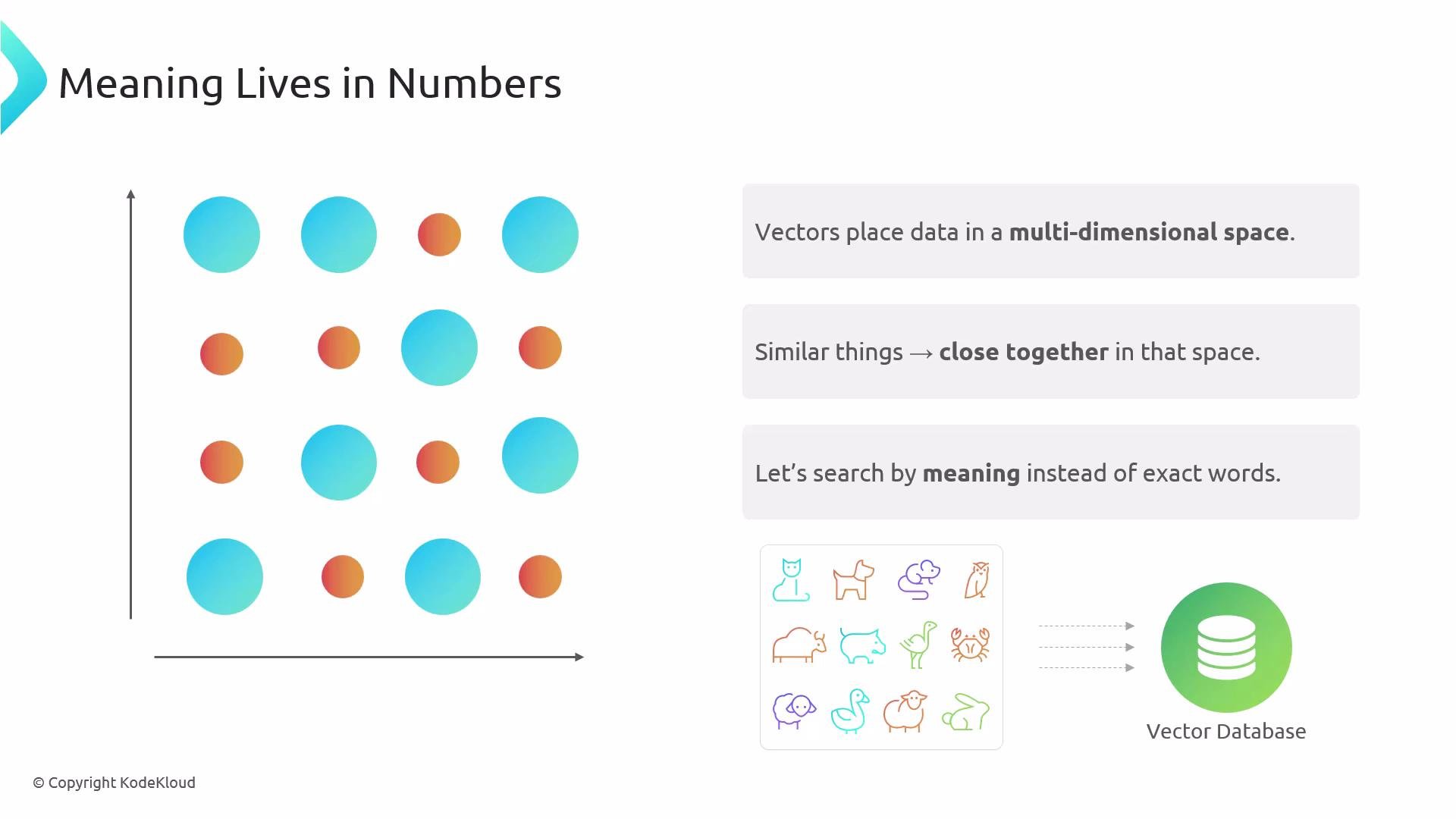
Turning text, images, or audio into vectors is called embedding. Embeddings are produced by models that map inputs into a numeric space where similar items are positioned near each other. When you embed many items (millions or billions), each becomes a point in this high-dimensional space, enabling similarity-based retrieval.
 ## Why proximity matters
Imagine storing one vector per animal in a vector database. Animals that share attributes (for example, "can fly") cluster together because their embeddings are similar. That makes it possible to ask semantic questions like:
* "Give me a bird that cannot fly" — even if the term "penguin" never appears in the query, the database can surface relevant matches based on geometric closeness in vector space.
A short analogy: latitude and longitude pinpoint physical location in 2D. Embeddings pinpoint meaning in many more dimensions.
## How vector search works (brief)
* Index: embeddings are stored and indexed (often with techniques like approximate nearest neighbor search) to enable fast similarity queries.
* Query embedding: a query (text, image, etc.) is embedded into the same vector space.
* Nearest neighbors: the system finds vectors closest to the query embedding using a distance metric (e.g., cosine similarity, Euclidean distance).
* Return ranked results: items most semantically similar to the query are returned.
## Common vector use cases
| Use Case | Description | Example |
| --------------------------- | --------------------------------------------------- | ------------------------------------------------------------------- |
| Semantic search | Find results by meaning rather than keywords | Search documents for conceptually similar passages |
| Recommendations | Suggest similar items based on user/item embeddings | Recommend products or songs |
| Clustering & categorization | Group similar items automatically | Organize image collections by visual similarity |
| Retrieval for LLMs | Provide context to language models | Retrieve relevant documents for summarization or question answering |
## Examples of embeddable data types
| Data Type | Why embed it? | Typical application |
| --------- | ----------------------------------- | ---------------------------------- |
| Text | Captures semantics and context | Document search, Q\&A |
| Images | Encodes visual features | Image search, reverse image lookup |
| Audio | Encodes timbre, speech features | Speaker detection, audio retrieval |
| Video | Combines visual & temporal features | Video recommendation, scene search |
## Key points
* A vector is a numeric representation (array) encoding features or semantics.
* Dimensionality increases as you encode more attributes.
* Embeddings place similar items near each other in high-dimensional space.
* Vector search finds items by semantic similarity (nearest neighbors), not only keyword matches.
Embedding = converting data (text, images, audio) into numeric vectors so that semantic similarity corresponds to geometric proximity in vector space.
## Further reading & references
* [Vector Databases — An introduction (Pinecone)](https://www.pinecone.io/learn/what-is-a-vector-database/)
* [Semantic Search — Wikipedia](https://en.wikipedia.org/wiki/Semantic_search)
* [Approximate Nearest Neighbors (ANN) — overview and algorithms](https://en.wikipedia.org/wiki/Approximate_nearest_neighbor_search)
That’s the core idea: vectors are numbers that carry meaning. This lesson covered what vectors are, how embeddings are created, and why vector proximity enables semantic search and retrieval.
Thanks for reading.
## Why proximity matters
Imagine storing one vector per animal in a vector database. Animals that share attributes (for example, "can fly") cluster together because their embeddings are similar. That makes it possible to ask semantic questions like:
* "Give me a bird that cannot fly" — even if the term "penguin" never appears in the query, the database can surface relevant matches based on geometric closeness in vector space.
A short analogy: latitude and longitude pinpoint physical location in 2D. Embeddings pinpoint meaning in many more dimensions.
## How vector search works (brief)
* Index: embeddings are stored and indexed (often with techniques like approximate nearest neighbor search) to enable fast similarity queries.
* Query embedding: a query (text, image, etc.) is embedded into the same vector space.
* Nearest neighbors: the system finds vectors closest to the query embedding using a distance metric (e.g., cosine similarity, Euclidean distance).
* Return ranked results: items most semantically similar to the query are returned.
## Common vector use cases
| Use Case | Description | Example |
| --------------------------- | --------------------------------------------------- | ------------------------------------------------------------------- |
| Semantic search | Find results by meaning rather than keywords | Search documents for conceptually similar passages |
| Recommendations | Suggest similar items based on user/item embeddings | Recommend products or songs |
| Clustering & categorization | Group similar items automatically | Organize image collections by visual similarity |
| Retrieval for LLMs | Provide context to language models | Retrieve relevant documents for summarization or question answering |
## Examples of embeddable data types
| Data Type | Why embed it? | Typical application |
| --------- | ----------------------------------- | ---------------------------------- |
| Text | Captures semantics and context | Document search, Q\&A |
| Images | Encodes visual features | Image search, reverse image lookup |
| Audio | Encodes timbre, speech features | Speaker detection, audio retrieval |
| Video | Combines visual & temporal features | Video recommendation, scene search |
## Key points
* A vector is a numeric representation (array) encoding features or semantics.
* Dimensionality increases as you encode more attributes.
* Embeddings place similar items near each other in high-dimensional space.
* Vector search finds items by semantic similarity (nearest neighbors), not only keyword matches.
Embedding = converting data (text, images, audio) into numeric vectors so that semantic similarity corresponds to geometric proximity in vector space.
## Further reading & references
* [Vector Databases — An introduction (Pinecone)](https://www.pinecone.io/learn/what-is-a-vector-database/)
* [Semantic Search — Wikipedia](https://en.wikipedia.org/wiki/Semantic_search)
* [Approximate Nearest Neighbors (ANN) — overview and algorithms](https://en.wikipedia.org/wiki/Approximate_nearest_neighbor_search)
That’s the core idea: vectors are numbers that carry meaning. This lesson covered what vectors are, how embeddings are created, and why vector proximity enables semantic search and retrieval.
Thanks for reading.