> ## Documentation Index
> Fetch the complete documentation index at: https://notes.kodekloud.com/llms.txt
> Use this file to discover all available pages before exploring further.
# Vector Database Feature Comparison
> Comparison guide to choosing vector databases for AI workloads based on deployment model, core strengths, scalability, and primary usage patterns
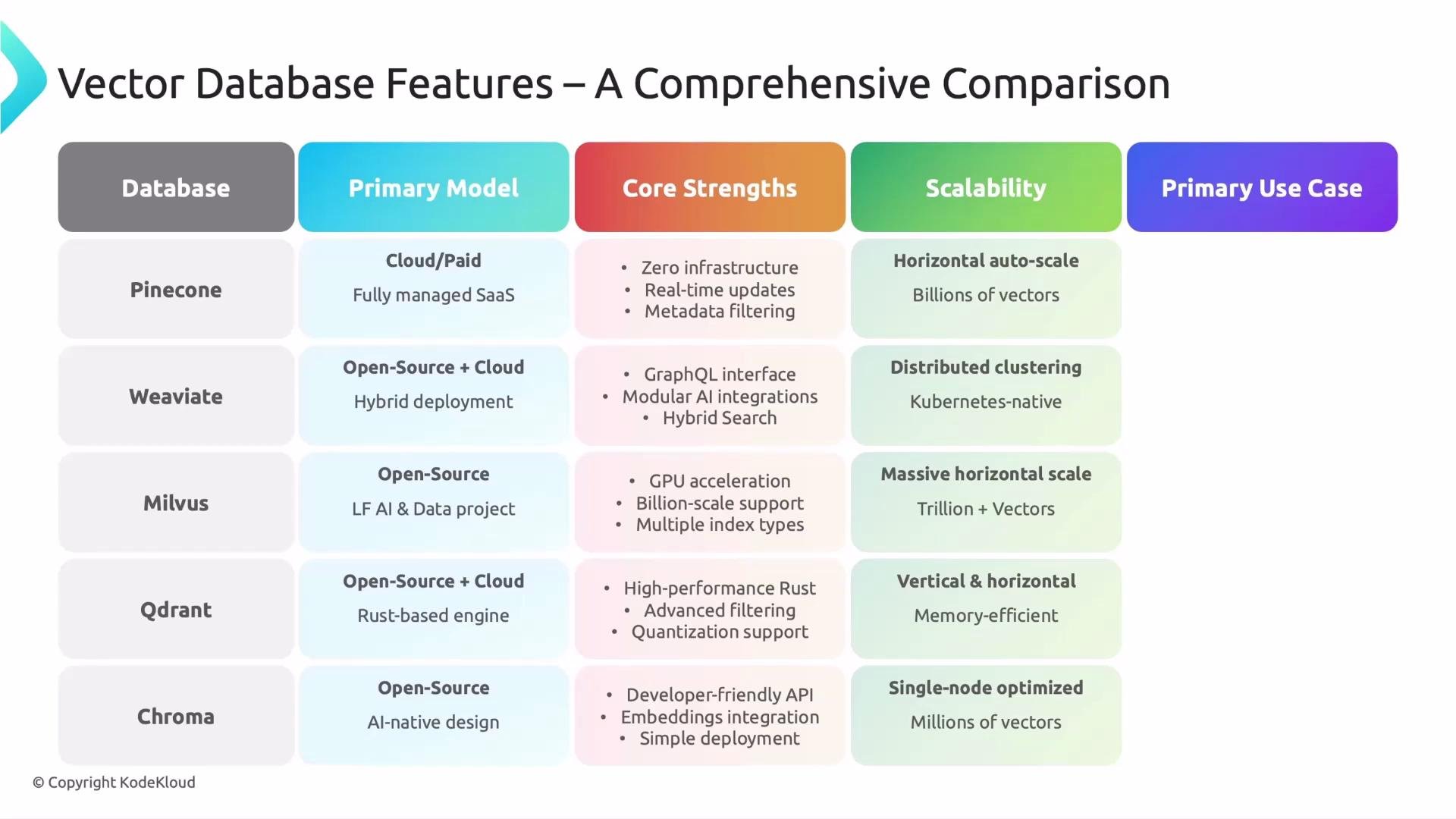
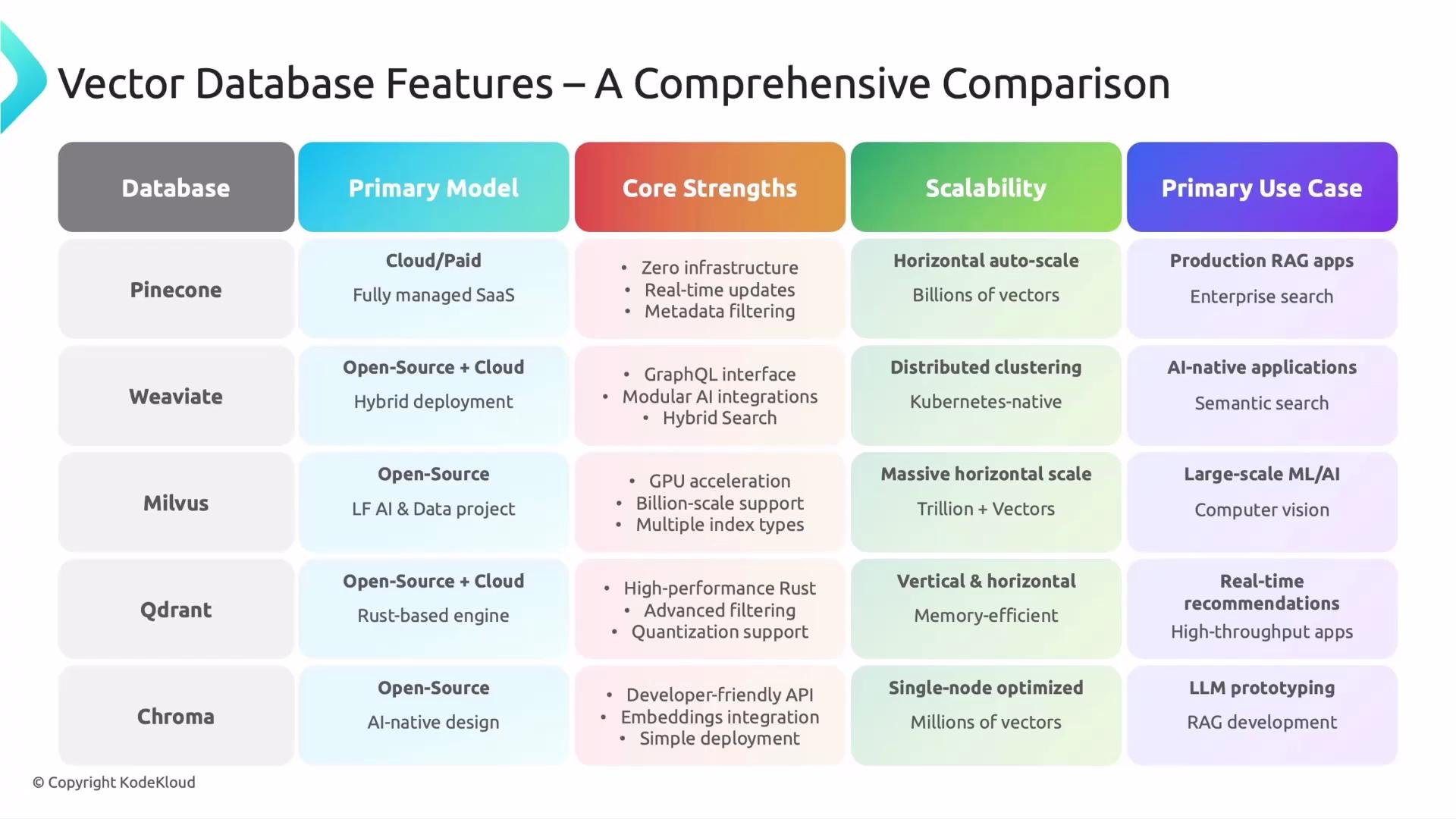
This lesson surveys the leading vector databases and shows how to compare them for real-world AI workloads. The ecosystem includes managed and open-source options such as [Pinecone](https://www.pinecone.io/), [Weaviate](https://weaviate.io/), [Milvus](https://milvus.io/), [Qdrant](https://qdrant.tech/), [Chroma](https://www.trychroma.com/), and others.
Rather than treating a single product as the “best,” evaluate each system as a purpose-built tool that favors particular engineering trade-offs. Use the four practical pillars below to compare and select a vector database for your project:
* Primary model — managed SaaS vs. self-hosted open source.
* Core strengths — architectural trade-offs such as simplicity, modularity, or advanced indexing.
* Scalability — target vector counts, distributed architecture, and GPU support.
* Primary usage — the workload the database optimizes for: semantic search, RAG (retrieval-augmented generation), recommendations, or experiments.
## Four practical pillars to evaluate vector databases
| Pillar | What to evaluate | Questions to ask |
| -------------- | ---------------------------------------------------------: | ------------------------------------------------------------------- |
| Primary model | Managed SaaS vs. self-hosted open source | Do you want minimal ops or full control of deployment and cost? |
| Core strengths | API/feature set, indexing options, real-time updates | Does it support hybrid search, filters, GraphQL, modular pipelines? |
| Scalability | Vector capacity, distributed storage, GPU acceleration | Will you scale to millions, billions, or trillions of vectors? |
| Primary usage | Optimized workload patterns (RAG, search, recommendations) | Is low-latency filtering or high-recall retrieval more important? |
### Primary model: managed vs. self-hosted
Choosing a managed cloud service versus an open-source, self-hosted system is primarily an operational decision about how much infrastructure your team will own.
| Model | Pros | Cons | Typical use cases |
| ----------------------------------------------------------------- | ------------------------------------------------------------- | -------------------------------------------------------- | ------------------------------------------------------- |
| Managed SaaS (e.g., Pinecone) | Minimal ops, built-in scaling, predictable SLAs | Less deployment control, potential higher recurring cost | Production search, RAG without ops overhead |
| Self-managed open source (e.g., Milvus, Weaviate, Qdrant, Chroma) | Full control, customization, potentially lower long-term cost | More operational complexity, maintenance burden | Custom indexing, cost-sensitive large-scale deployments |
Key trade-off: convenience versus control. For many teams, managed services accelerate time-to-value; for others, open-source gives flexibility for custom pipelines or tighter cost control.
### Core strengths: engineering philosophies
Each database emphasizes a different set of features and trade-offs:
* Simplicity and fast iteration — ideal for prototyping and local development (Chroma is commonly chosen for developer experience).
* Modularity and integrated features — flexible APIs, GraphQL, and rich metadata filtering (Weaviate excels here).
* Real-time updates and low-latency filtering — important for recommendation systems and streaming pipelines.
* Advanced indexing and query features — optimized for strict latency and recall at large scale.
 ## Scalability: match the database to your dataset size
Vector databases differ in target scale and hardware assumptions:
* Small-scale / local: best for rapid prototyping and low-cost experimentation.
* Mid-scale: supports millions of vectors using efficient CPU-based indexes.
* Large-scale / massive: built for billions+ vectors with distributed storage and optional GPU acceleration (Milvus is notable for GPU support and large collections).
If your product roadmap anticipates extremely large datasets, prioritize systems designed for distributed storage, sharding, and GPU indexing to minimize query latency at scale.
## Primary usage patterns
Different databases are optimized for distinct application patterns:
* Enterprise search & RAG: prioritize high-quality semantic retrieval across documents.
* Real-time recommendations & high-throughput filtering: require low-latency similarity search and robust filtering (Qdrant is commonly used here).
* Experimentation and prototyping: prefer simple APIs and quick onboarding (Chroma is frequently used during early LLM development).
## Scalability: match the database to your dataset size
Vector databases differ in target scale and hardware assumptions:
* Small-scale / local: best for rapid prototyping and low-cost experimentation.
* Mid-scale: supports millions of vectors using efficient CPU-based indexes.
* Large-scale / massive: built for billions+ vectors with distributed storage and optional GPU acceleration (Milvus is notable for GPU support and large collections).
If your product roadmap anticipates extremely large datasets, prioritize systems designed for distributed storage, sharding, and GPU indexing to minimize query latency at scale.
## Primary usage patterns
Different databases are optimized for distinct application patterns:
* Enterprise search & RAG: prioritize high-quality semantic retrieval across documents.
* Real-time recommendations & high-throughput filtering: require low-latency similarity search and robust filtering (Qdrant is commonly used here).
* Experimentation and prototyping: prefer simple APIs and quick onboarding (Chroma is frequently used during early LLM development).
 ## Quick reference: how popular options map to the pillars
| Database | Primary model | Core strengths | Scalability | Best fit |
| -------- | ------------------------------ | --------------------------------------- | --------------: | -------------------------------------------- |
| Pinecone | Managed SaaS | Simplicity, robust scaling | Mid → large | Production RAG without ops |
| Weaviate | Open-source (managed options) | Modularity, GraphQL, integrations | Mid → large | Semantic search with rich filters |
| Milvus | Open-source | High-performance, distributed, GPU | Large → massive | Extremely large vector stores, GPU workloads |
| Qdrant | Open-source (hosted available) | Real-time filtering, low-latency search | Mid → large | Recommender systems, streaming updates |
| Chroma | Open-source | Developer experience, local prototyping | Small → mid | Experimentation and rapid iteration |
## Key takeaway
There is no universally “best” vector database. Choose the one whose operational model, core strengths, and scalability align with your product requirements—whether that’s high-recall enterprise search, low-latency recommendations, or rapid prototyping.
Choose a vector database based on your team’s tolerance for operational complexity, your target dataset size, and the application workload (semantic search, recommendations, RAG, or experimentation).
## Next steps
In the next lesson we’ll dig into benchmarking: how engineers measure throughput, latency, recall, and cost across vector databases so you can make evidence-based choices.
## Links and further reading
* [Pinecone](https://www.pinecone.io/) — managed vector database
* [Weaviate](https://weaviate.io/) — modular open-source vector search with GraphQL
* [Milvus](https://milvus.io/) — high-performance vector database with GPU support
* [Qdrant](https://qdrant.tech/) — real-time vector search and filtering
* [Chroma](https://www.trychroma.com/) — developer-friendly vector store for experimentation
## Quick reference: how popular options map to the pillars
| Database | Primary model | Core strengths | Scalability | Best fit |
| -------- | ------------------------------ | --------------------------------------- | --------------: | -------------------------------------------- |
| Pinecone | Managed SaaS | Simplicity, robust scaling | Mid → large | Production RAG without ops |
| Weaviate | Open-source (managed options) | Modularity, GraphQL, integrations | Mid → large | Semantic search with rich filters |
| Milvus | Open-source | High-performance, distributed, GPU | Large → massive | Extremely large vector stores, GPU workloads |
| Qdrant | Open-source (hosted available) | Real-time filtering, low-latency search | Mid → large | Recommender systems, streaming updates |
| Chroma | Open-source | Developer experience, local prototyping | Small → mid | Experimentation and rapid iteration |
## Key takeaway
There is no universally “best” vector database. Choose the one whose operational model, core strengths, and scalability align with your product requirements—whether that’s high-recall enterprise search, low-latency recommendations, or rapid prototyping.
Choose a vector database based on your team’s tolerance for operational complexity, your target dataset size, and the application workload (semantic search, recommendations, RAG, or experimentation).
## Next steps
In the next lesson we’ll dig into benchmarking: how engineers measure throughput, latency, recall, and cost across vector databases so you can make evidence-based choices.
## Links and further reading
* [Pinecone](https://www.pinecone.io/) — managed vector database
* [Weaviate](https://weaviate.io/) — modular open-source vector search with GraphQL
* [Milvus](https://milvus.io/) — high-performance vector database with GPU support
* [Qdrant](https://qdrant.tech/) — real-time vector search and filtering
* [Chroma](https://www.trychroma.com/) — developer-friendly vector store for experimentation