> ## Documentation Index
> Fetch the complete documentation index at: https://notes.kodekloud.com/llms.txt
> Use this file to discover all available pages before exploring further.
# Dot Product Similarity
> Explains dot product similarity, how it combines vector magnitude and alignment, contrasts with cosine and Euclidean measures, and discusses applications like recommendation systems and maximum inner product search.
Euclidean distance measures how far apart two points are in space. Cosine similarity compares the angle between vectors (direction only). Dot product, however, combines both direction and magnitude into a single score — making it particularly useful when both alignment and strength matter.
## What the dot product measures
If A and B are vectors and θ is the angle between them, the dot product is:
A · B = |A| × |B| × cos(θ)
* `|A|` and `|B|` are the magnitudes (strength) of the vectors.
* `cos(θ)` is the alignment (direction) component.
So the dot product answers two questions at once:
* How strongly do the vectors point? (magnitude)
* How well do they point in the same direction? (alignment)
Think of two people pushing a heavy box:
* Cosine similarity only checks whether they push in the same direction.
* Dot product also checks how hard each person is pushing.
Dot product therefore rewards vectors that are both aligned and strong — not just aligned.
Now let’s look at the typical comparison scenarios.
The long vectors that are well aligned, that's the high score.
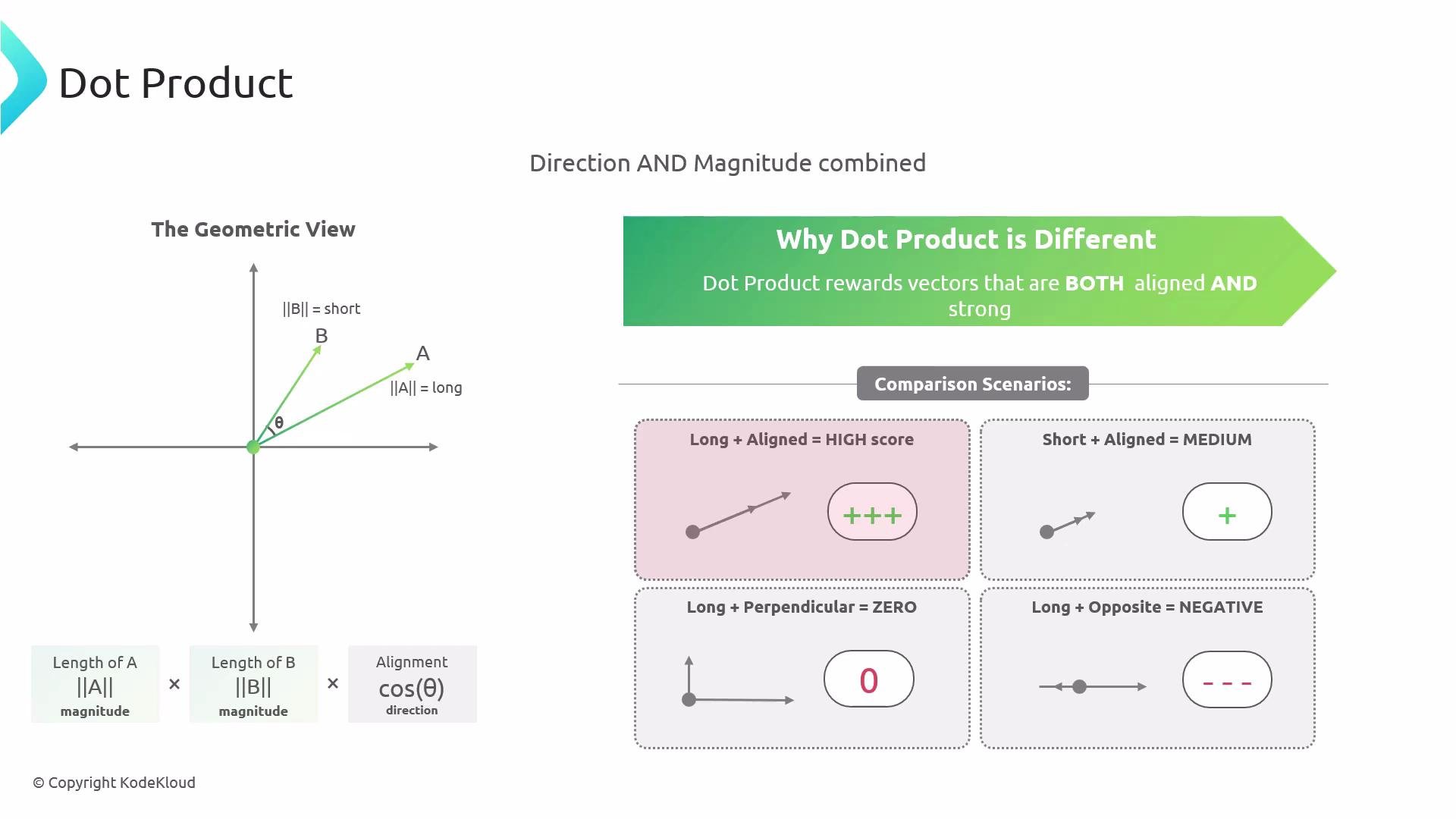 * Long vectors, well aligned: very high dot product. Alignment and large magnitudes multiply to a strong positive score.
* Short vectors, aligned: moderate (medium) score. Direction agrees but magnitudes are small.
* Long vectors, perpendicular: dot product ≈ 0. No alignment means the score collapses regardless of magnitude.
* Long vectors, opposite directions: negative dot product. Strong but contradictory signals cancel out and go below zero.
Remember: a large positive dot product means a strong, aligned match. A large negative dot product means a strong but opposite signal.
## Where dot product matters in practice
Dot product is the natural similarity measure for Maximum Inner Product Search (MIPS). MIPS searches for items that maximize the inner product with a query vector — a common requirement in production recommendation engines and advertising systems.
* Long vectors, well aligned: very high dot product. Alignment and large magnitudes multiply to a strong positive score.
* Short vectors, aligned: moderate (medium) score. Direction agrees but magnitudes are small.
* Long vectors, perpendicular: dot product ≈ 0. No alignment means the score collapses regardless of magnitude.
* Long vectors, opposite directions: negative dot product. Strong but contradictory signals cancel out and go below zero.
Remember: a large positive dot product means a strong, aligned match. A large negative dot product means a strong but opposite signal.
## Where dot product matters in practice
Dot product is the natural similarity measure for Maximum Inner Product Search (MIPS). MIPS searches for items that maximize the inner product with a query vector — a common requirement in production recommendation engines and advertising systems.
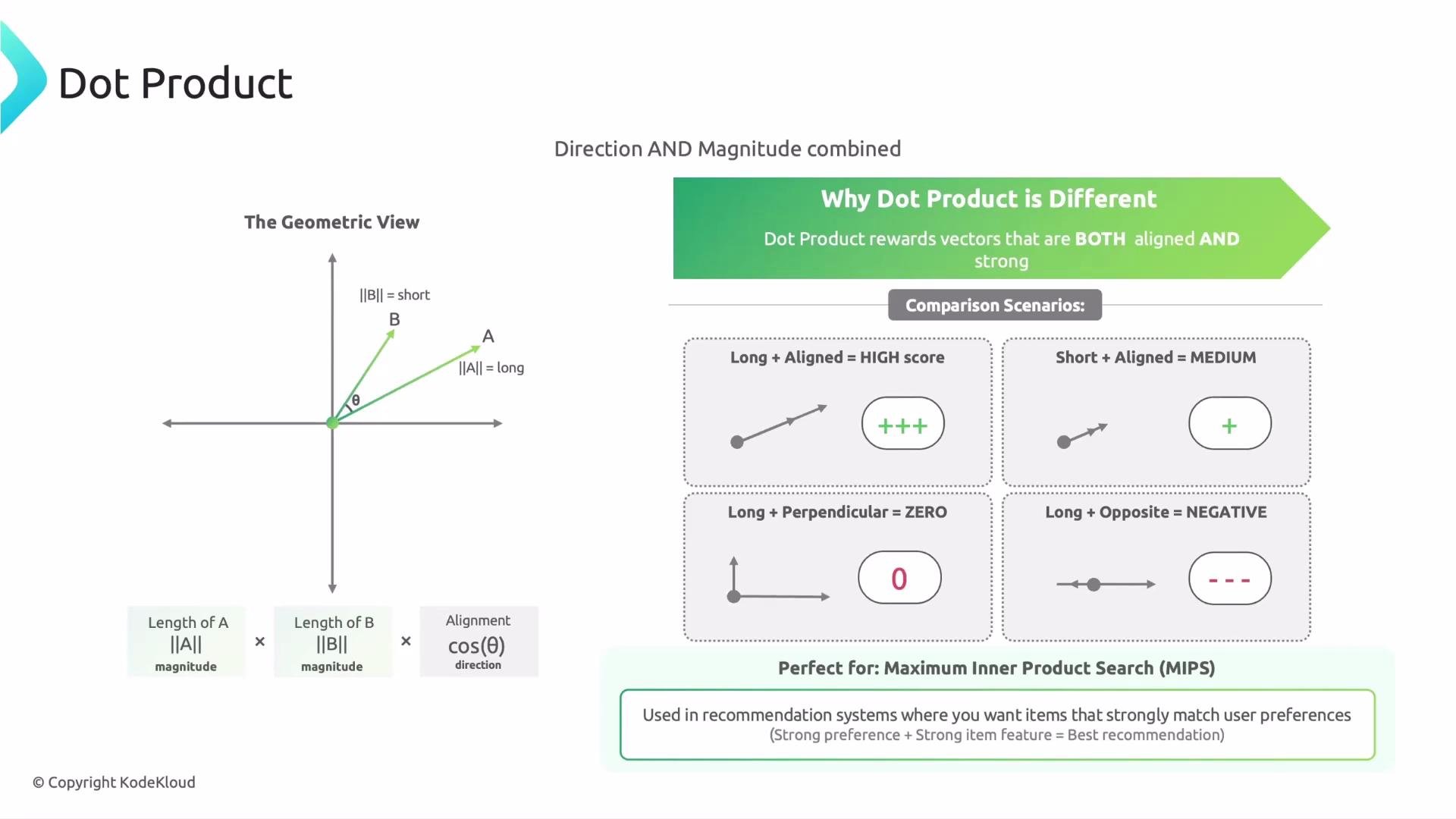 Example: In content recommendations (Netflix, YouTube, etc.)
* A user preference vector encodes what the user strongly likes.
* A content feature vector encodes what a piece of content strongly represents.
* The dot product measures both whether the content matches the user's taste (alignment) and how confidently it matches (magnitude).
A high dot product ⇒ a strong recommendation.
When using dot product as a scoring function, be aware that magnitudes influence scores. Score normalization or alternative metrics (e.g., cosine) may be preferable if you want to ignore magnitude and focus on pure directional similarity.
## Quick comparison: Dot product vs Cosine vs Euclidean
| Similarity Measure | What it captures | Typical use cases | Pros | Cons |
| ------------------ | ------------------------: | ------------------------------------------------------------------------ | -------------------------------------------------------------- | ----------------------------------------------------- |
| Dot product | `magnitude × alignment` | MIPS, recommendation ranking, when magnitude implies confidence | Rewards strong, aligned matches; fast for inner-product search | Sensitive to vector norms; may require normalization |
| Cosine similarity | `alignment only` (cos(θ)) | Semantic similarity, embedding comparisons where magnitude is irrelevant | Normalized to \[-1, 1]; ignores scale differences | Loses confidence information represented by magnitude |
| Euclidean distance | `absolute distance` | Clustering, anomaly detection, nearest neighbors in metric space | Intuitive geometric distance | Scale-dependent; sensitive to feature scaling |
## Links and references
* [Maximum inner product search (MIPS) — Wikipedia](https://en.wikipedia.org/wiki/Maximum_inner_product_search)
* [Cosine similarity — Wikipedia](https://en.wikipedia.org/wiki/Cosine_similarity)
* [Euclidean distance — Wikipedia](https://en.wikipedia.org/wiki/Euclidean_distance)
Having examined dot product and its role in similarity search, the next step is to compare all three major similarity measures (Dot Product, Cosine, Euclidean) along performance, invariances, and production considerations — summarized in a consolidated table in the following section.
Example: In content recommendations (Netflix, YouTube, etc.)
* A user preference vector encodes what the user strongly likes.
* A content feature vector encodes what a piece of content strongly represents.
* The dot product measures both whether the content matches the user's taste (alignment) and how confidently it matches (magnitude).
A high dot product ⇒ a strong recommendation.
When using dot product as a scoring function, be aware that magnitudes influence scores. Score normalization or alternative metrics (e.g., cosine) may be preferable if you want to ignore magnitude and focus on pure directional similarity.
## Quick comparison: Dot product vs Cosine vs Euclidean
| Similarity Measure | What it captures | Typical use cases | Pros | Cons |
| ------------------ | ------------------------: | ------------------------------------------------------------------------ | -------------------------------------------------------------- | ----------------------------------------------------- |
| Dot product | `magnitude × alignment` | MIPS, recommendation ranking, when magnitude implies confidence | Rewards strong, aligned matches; fast for inner-product search | Sensitive to vector norms; may require normalization |
| Cosine similarity | `alignment only` (cos(θ)) | Semantic similarity, embedding comparisons where magnitude is irrelevant | Normalized to \[-1, 1]; ignores scale differences | Loses confidence information represented by magnitude |
| Euclidean distance | `absolute distance` | Clustering, anomaly detection, nearest neighbors in metric space | Intuitive geometric distance | Scale-dependent; sensitive to feature scaling |
## Links and references
* [Maximum inner product search (MIPS) — Wikipedia](https://en.wikipedia.org/wiki/Maximum_inner_product_search)
* [Cosine similarity — Wikipedia](https://en.wikipedia.org/wiki/Cosine_similarity)
* [Euclidean distance — Wikipedia](https://en.wikipedia.org/wiki/Euclidean_distance)
Having examined dot product and its role in similarity search, the next step is to compare all three major similarity measures (Dot Product, Cosine, Euclidean) along performance, invariances, and production considerations — summarized in a consolidated table in the following section.