

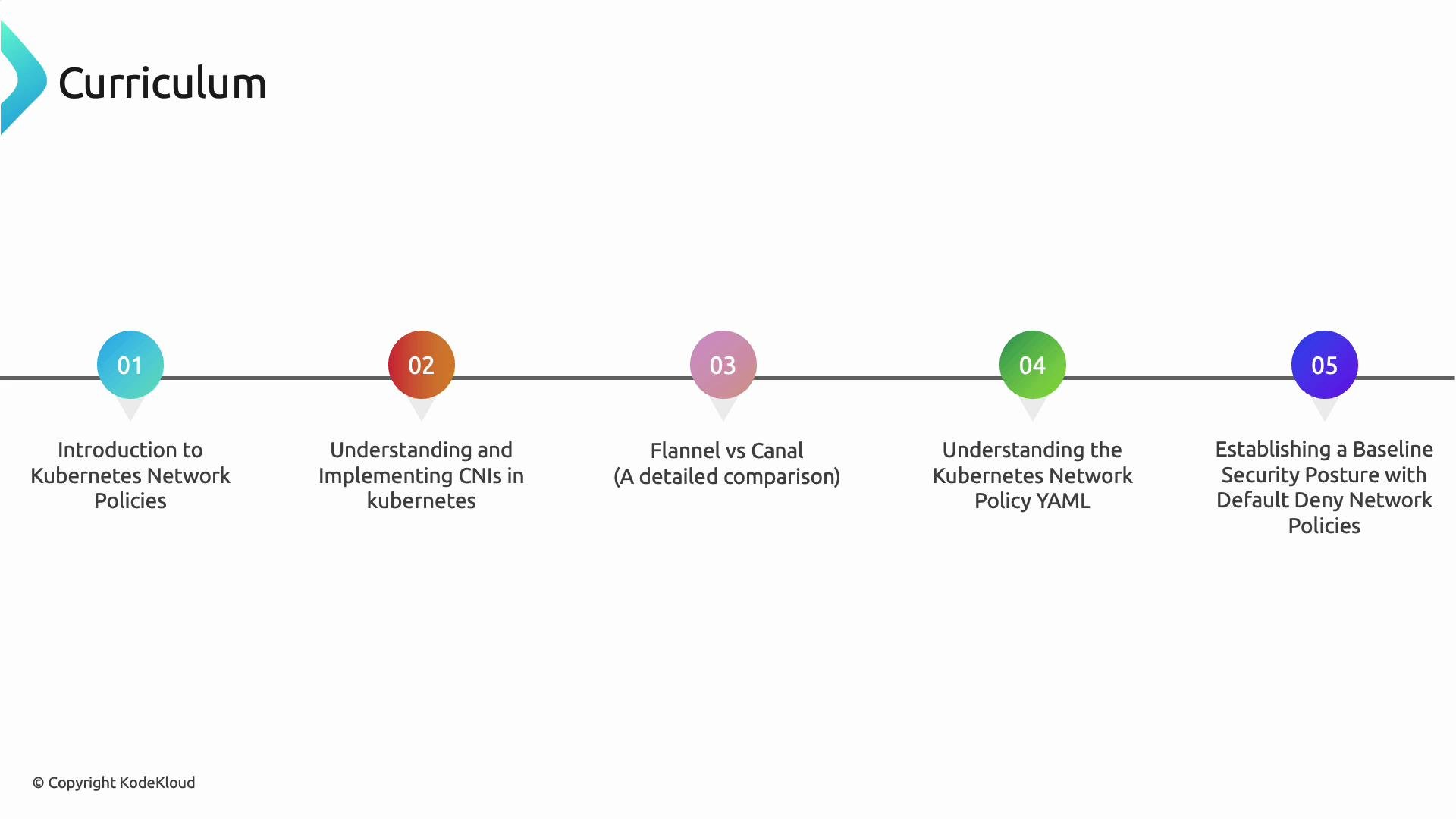
- What a NetworkPolicy is and why it matters in Kubernetes.
- Container Network Interfaces (CNIs): why they exist and how they work.
- Installing two popular network plugins across separate Kubernetes clusters.
- Comparing two commonly used network plugins: Flannel and Canal — features, differences, and when to choose each.
- Dissecting a NetworkPolicy YAML file to learn every component.
- Implementing the default-deny NetworkPolicy to enforce a secure baseline.
- Every topic is delivered as a lab. Labs start with a concise description of objectives and key concepts.
- You work directly in hands-on environments to implement NetworkPolicies that solve real-world problems.
- Each lab includes a step-by-step instructions page with commands and explanations to guide you to a working solution.
This course is suitable for beginners and practitioners who want hands-on practice with Kubernetes network security. If you already know Kubernetes basics (pods, services, namespaces), you’ll get the most value.
- The course ends with a cumulative challenge that combines the key skills from the labs — designing and implementing NetworkPolicies that meet realistic security requirements.
- Action-first labs rather than long theory sections.
- Immediate feedback in real environments to reinforce learning.
- Guided instructions with curated commands and explanations to build confidence.