

- Comparison summary (analogy: library vs filing cabinet)
- Structure, integrity, performance, and scale (with visual aids)
- Quick pop quiz
- MongoDB CRUD demo (Create, Read, Update, Delete)
- Summary and key takeaways
- Links and references
- Relational databases: well-defined schemas, ACID guarantees, great for accuracy and complex transactions.
- NoSQL databases: schema-flexible, often designed for horizontal scale and simple high-volume operations.
- Choosing the right database depends on data shape, access patterns, and consistency requirements.
Analogy: library (relational) vs filing cabinet (NoSQL)
- Library (relational): every book follows the same catalog — title, author, ISBN, subject — placed on the correct shelf. That predictable catalog is a schema (tables, columns, data types).
- Filing cabinet (NoSQL): drawers can be organized independently; each folder may contain different fields. You can add new fields without redesigning the entire system.
- Libraries are predictable and consistent; schemas enforce the shape of data before it’s stored.
- Filing cabinets (documents, key-value, etc.) are flexible, allowing varied records and easy schema evolution.
- Libraries have librarians who enforce uniqueness and cross-references — analogous to relational constraints (primary keys, foreign keys, data types).
- Filing cabinets can accept diverse entries quickly and reconcile them later — many NoSQL systems favor eventual consistency for higher write throughput.
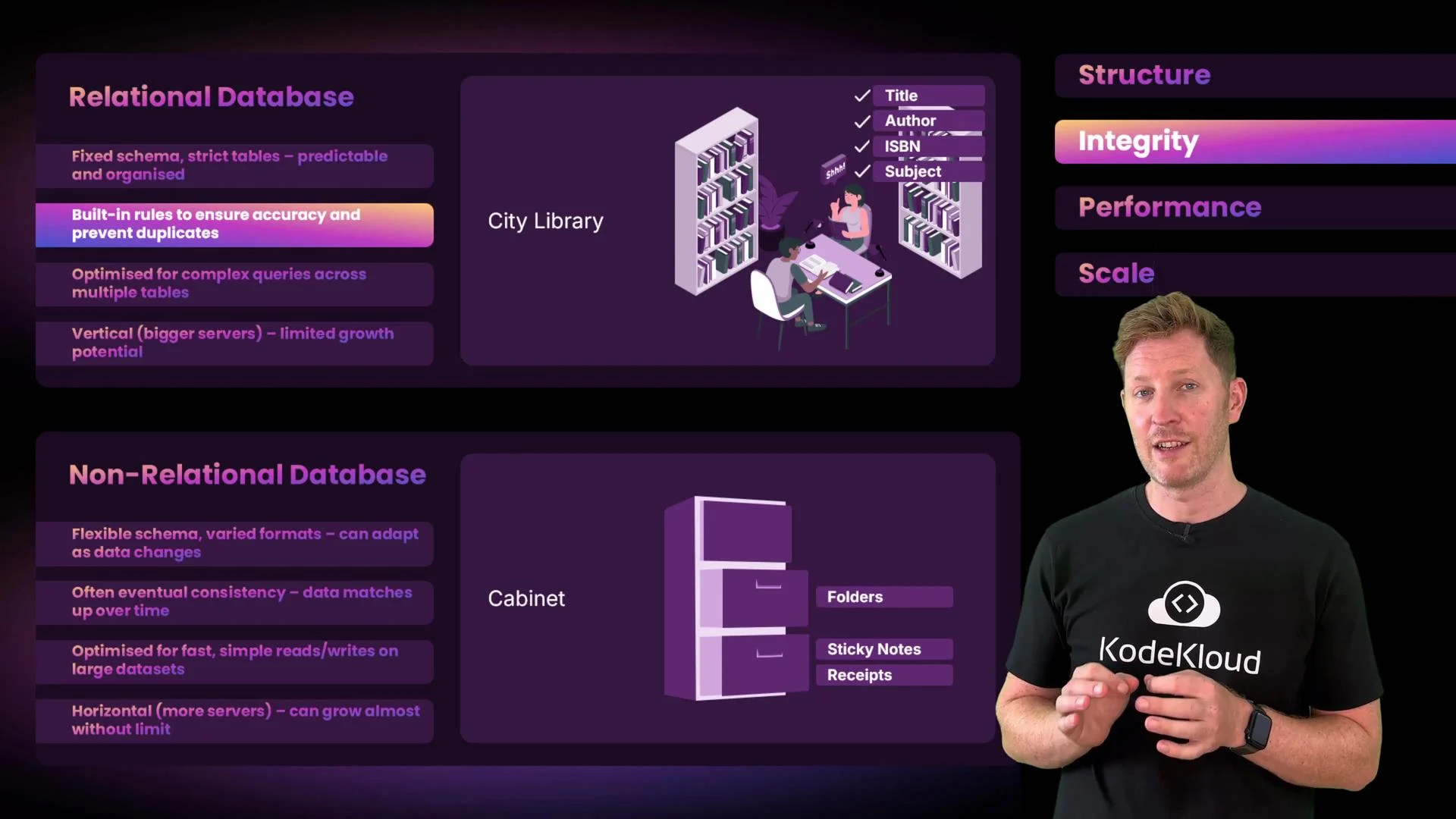
- Libraries are optimized for deep research and complex cross-references — similar to SQL queries and joins across multiple normalized tables.
- Filing cabinets can be faster for simple lookups when related data is stored together; many NoSQL systems store denormalized records for quick reads.
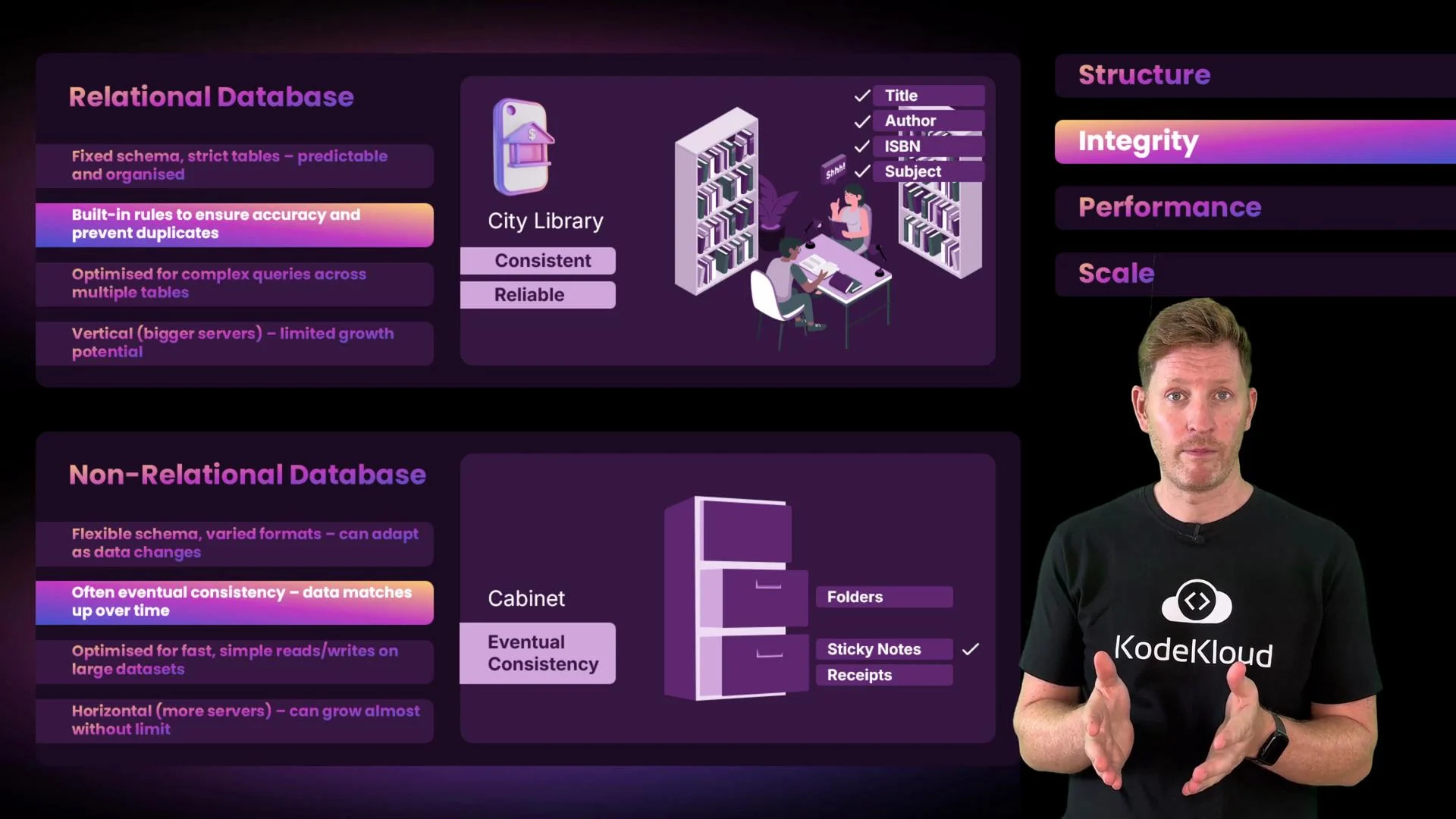
- Vertical scaling (adding CPU, RAM) is like enlarging a library building — effective but expensive and finite.
- Horizontal scaling (adding more cabinets/machines) is often simpler for NoSQL systems; many are built to shard and replicate across nodes.
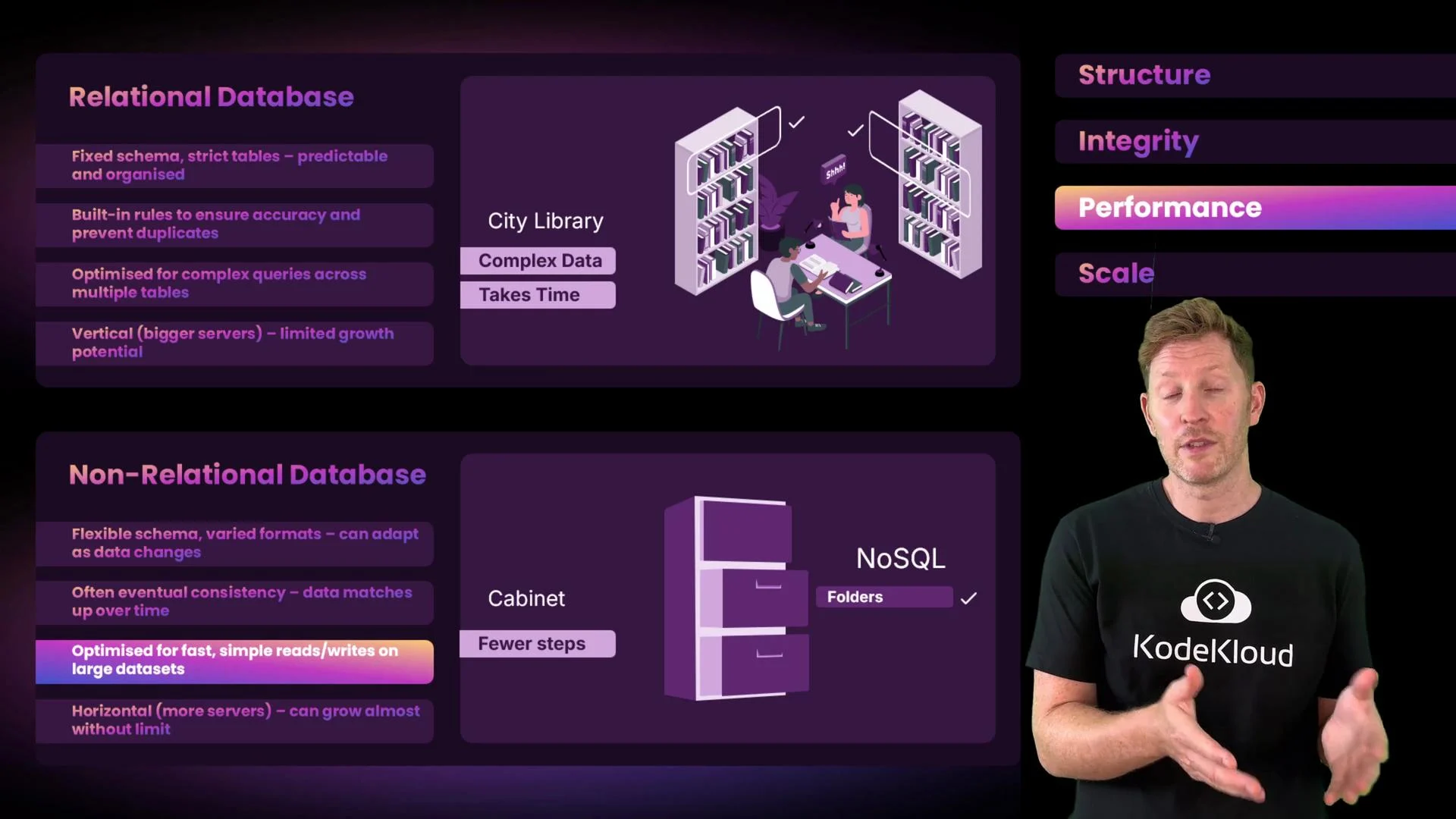
- There is no universally “better” choice. Use relational databases when data integrity and complex transactions are critical. Use NoSQL when flexibility, massive scale, or specialized access patterns are more important.
- Hybrid architectures are common: relational systems for core transactional data and NoSQL for flexible or high-throughput services.
B. Relational databases require a fixed schema.
C. Graph databases store data in rows and columns. Answer: B is correct. Relational databases typically use a fixed schema (tables, columns, and data types are defined before storing data). Why the others are false:
- A is false: NoSQL can be faster for simple operations, but relational databases may outperform for complex queries.
- C is false: Graph databases use nodes and edges, not rows and columns.
miaowtube database with users and videos collections:
MongoDB collections are schema-flexible by default. You can enforce validation rules if you need stricter structure, but it’s optional and can be applied incrementally.
user_id to mimic a conventional primary-key reference:
user_id:
Schema flexibility is powerful but can lead to inconsistent or inefficient queries if unchecked. Use indexes and, where appropriate, schema validation to maintain performance and data quality.
- CRUD operations map directly to familiar SQL concepts, but MongoDB uses flexible JSON-like documents.
- Shell responses return JSON-style objects (
acknowledged,insertedIds,matchedCount, etc.). - Schema and integrity: SQL enforces structure up front; MongoDB gives you flexibility but lets you add validation rules or handle constraints in application logic.
- Performance and scale: document models and horizontal-sharding designs commonly make MongoDB and other NoSQL systems suitable for high-throughput workloads.
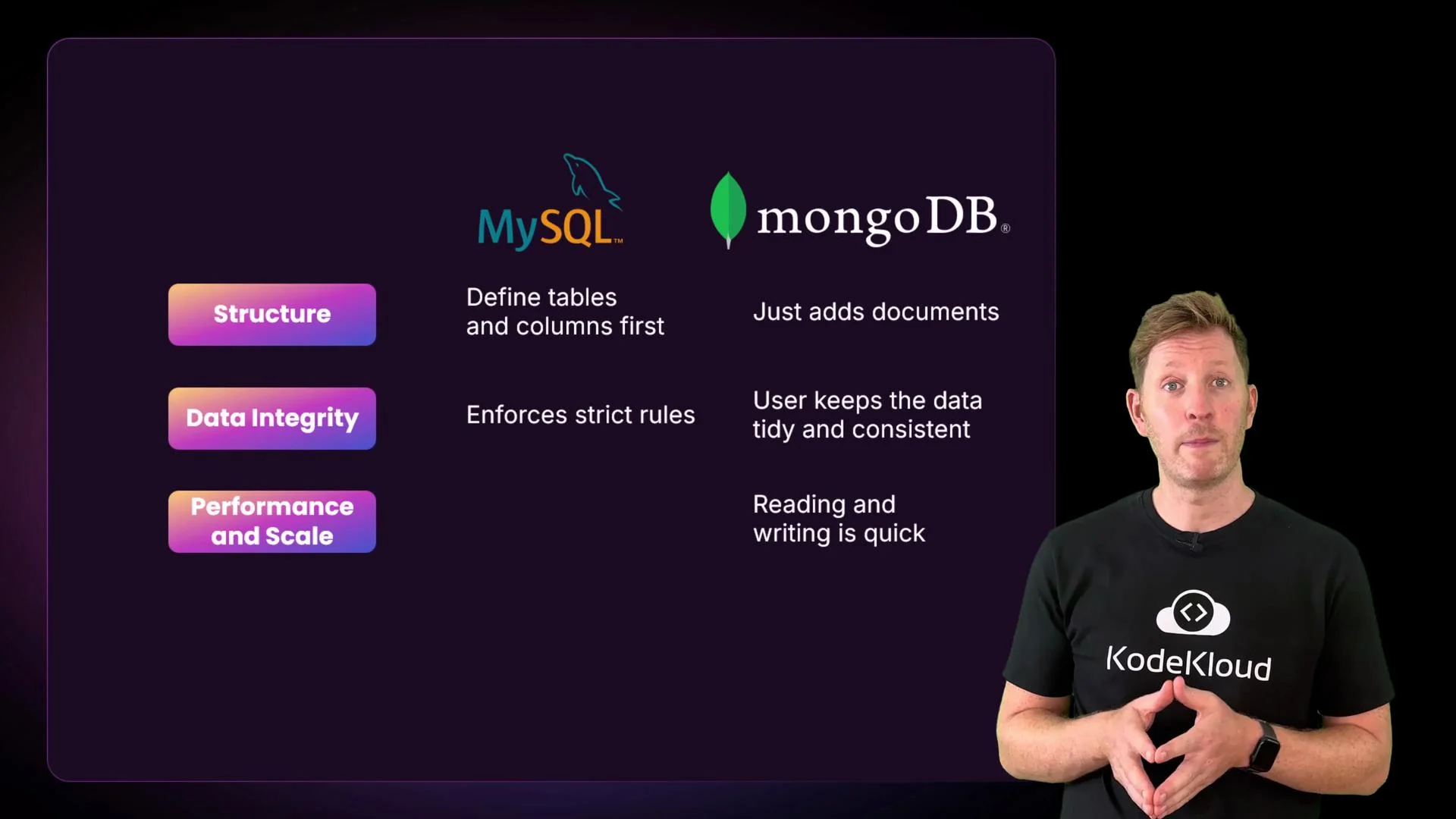
- Relational databases: structured tables, strong consistency, ideal for accuracy and complex transactions.
- NoSQL databases: flexible formats (document, key-value, column, graph), better for varied or rapidly changing data and massive scale.
- Use the right tool for the job — many systems combine relational and non-relational databases to leverage strengths from both.
- Indexes and well-designed queries matter in both paradigms for search speed and overall performance.
- MongoDB manual: https://www.mongodb.com/docs/
- Choosing a database: https://martinfowler.com/articles/nosql-intro.html
- Database scaling patterns: https://www.digitalocean.com/community/tutorials/