Hey there, future AWS Solutions Architect. Ready to start your AWS certification journey? This AWS Solutions Architect — Associate (SAA) course from KodeKloud is built to teach you practical cloud architecture skills and prepare you for the exam. The course focuses on two primary tracks:
  • Skills (services) — taught by Sanjeev, covering the AWS service portfolio you must know for the exam.
  • Design (architectural principles) — taught by Michael Forrester, focusing on designing for the AWS Well-Architected Framework.
This course will be released in two parts. Below is a clear roadmap of what to expect and how the course is organized so you can plan your study and practice. Instructor introduction
  • Michael Forrester — design lead for the course content and Well-Architected scenarios.
  • Sanjeev — services and hands-on labs lead.
What makes this course practical and exam-focused
  • Browser-based, real AWS labs so you can practice with real resources without local setup.
  • Bite-sized, exam-relevant lectures to build theory and concepts.
  • Hands-on demos showing real-world implementations and best practices.
  • Quizzes and reinforcement checkpoints to test knowledge as you go.
  • Gamified exercises (drag-and-drop architecture diagrams) to strengthen design intuition.
  • Diagnostic mock exam at the start and a comprehensive mock exam at the end to measure readiness.
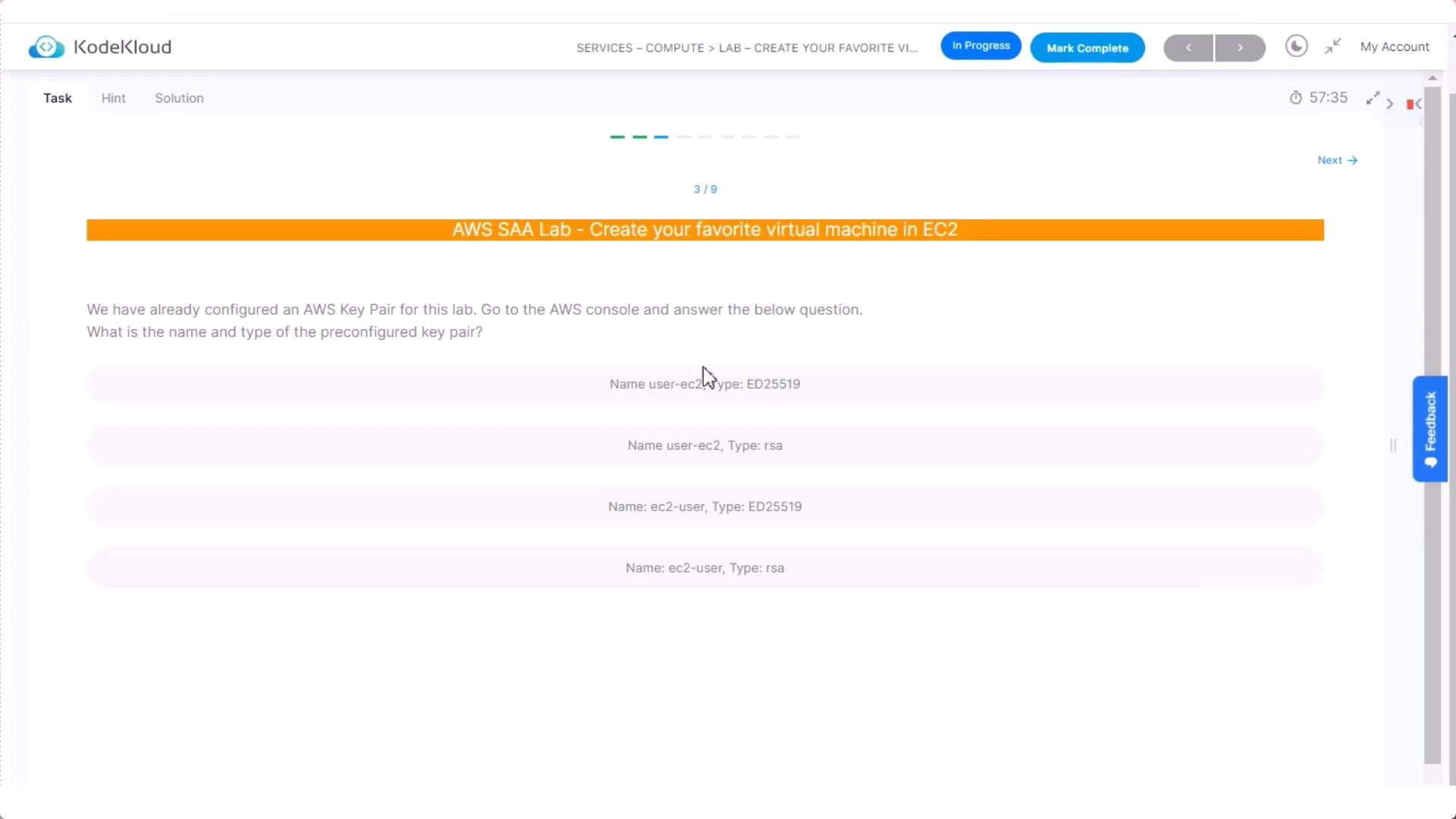
A KodeKloud lab webpage for an "AWS SAA Lab - Create your favorite virtual machine in EC2" showing a question about the name and type of a preconfigured AWS key pair with several multiple-choice answers. The page also shows a progress bar, navigation controls, and a feedback button.
You do not need your own AWS account to run these in-browser labs, although having one is recommended for additional practice outside the course environment.
Hands-on labs give you immediate access to AWS resources so you can explore, experiment, and build confidence deploying architectures directly in your browser. No toolchain or environment setup is required. Exam-focused learning elements
  • Lecture concepts mapped to exam objectives
  • Demos that translate concepts into deployments
  • Frequent short quizzes and reinforcement questions
  • Mock exams for baseline and final readiness
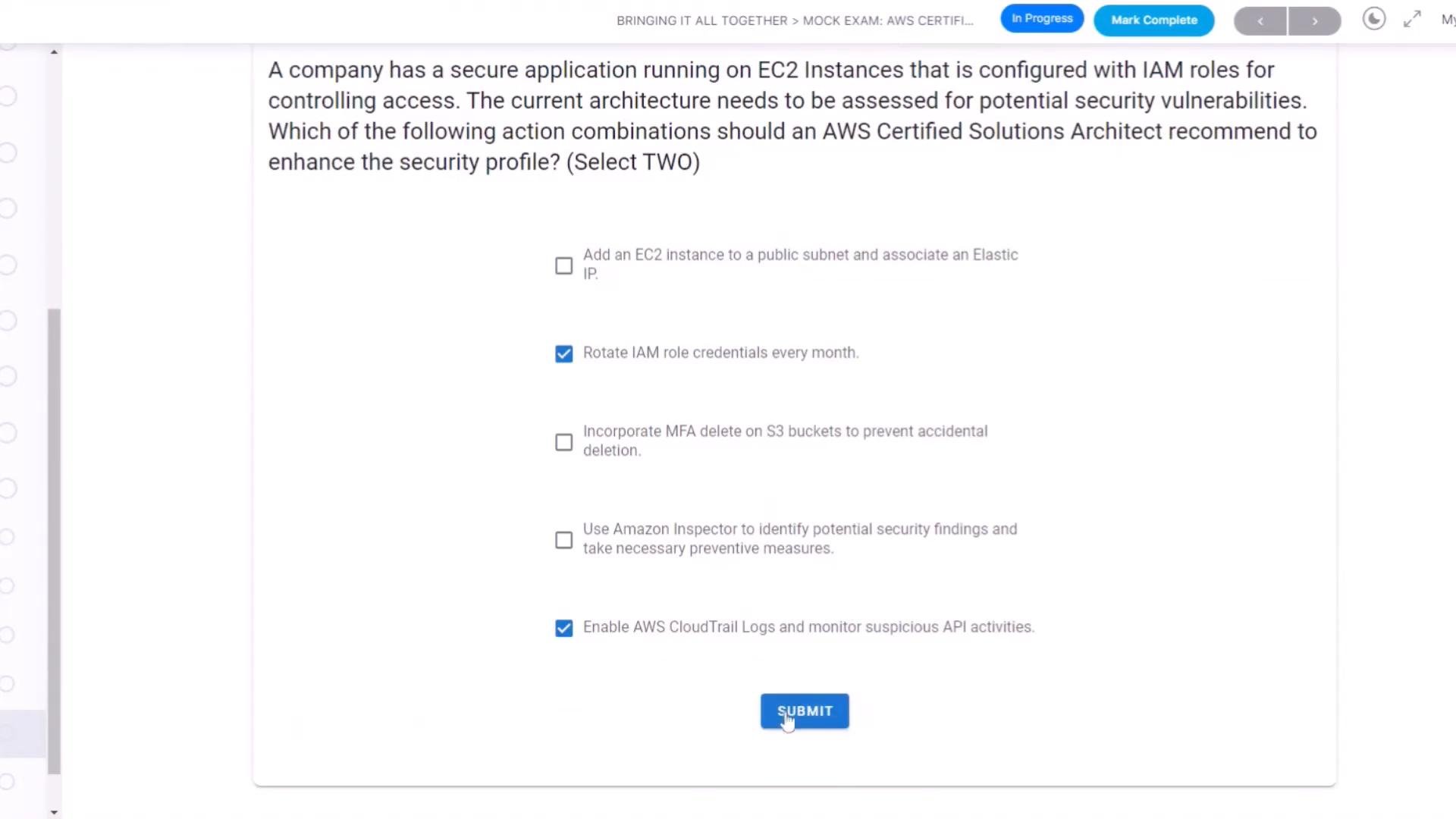
A screenshot of an AWS certification mock exam question about improving security for an application on EC2 instances with IAM roles. It shows multiple-choice checkbox options (for example: rotate IAM credentials monthly and enable CloudTrail logs) and a blue "Submit" button.
Course content categories (services and concepts) Below is a summary of the service categories we’ll cover in the skills track, with examples and exam relevance. Storage topic highlight We will go into storage selection and tradeoffs (object vs. block vs. file), when to use lifecycle policies, and how to design for data durability and cost.
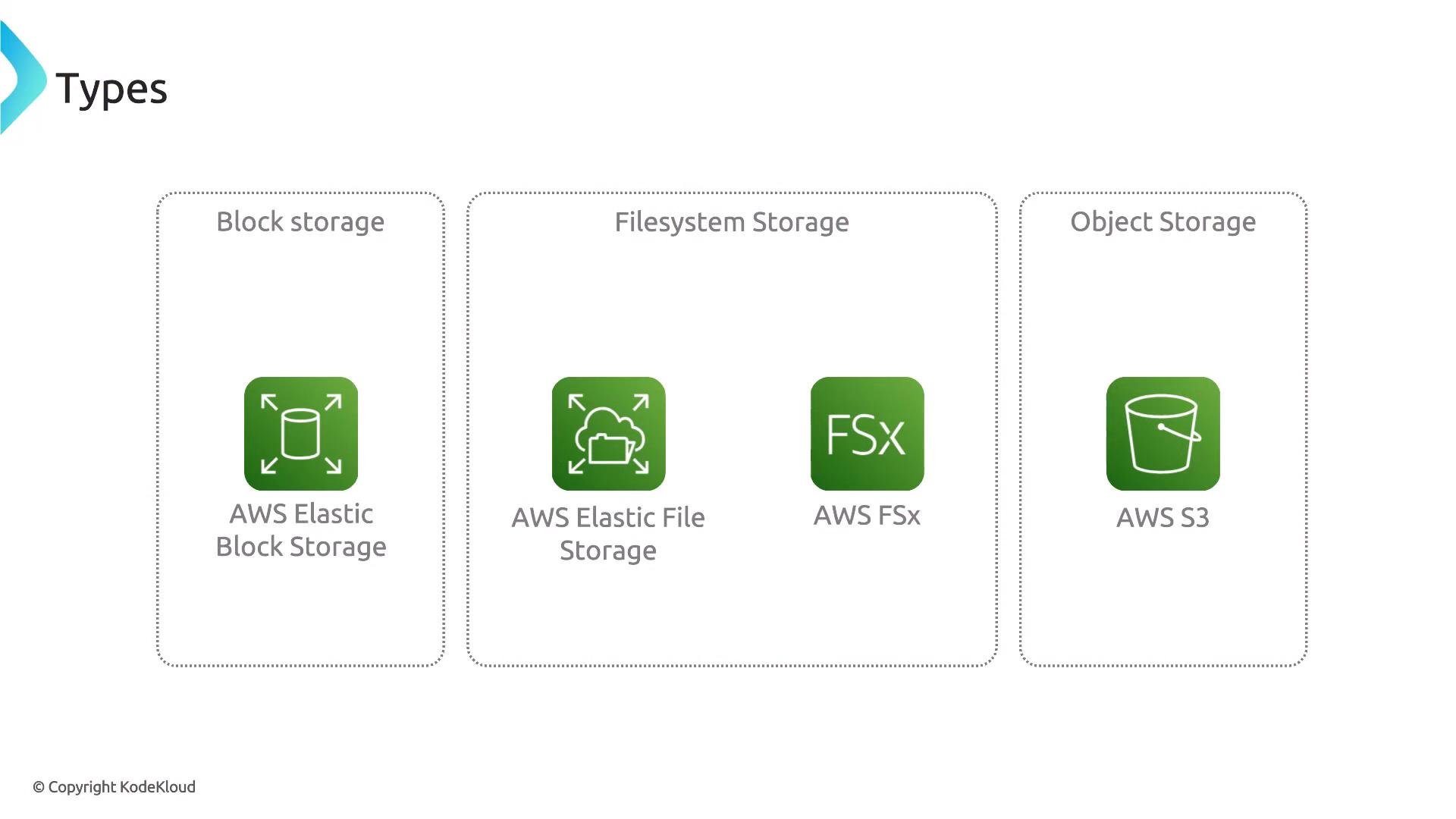
A slide diagram of AWS storage types showing three categories — Block storage (AWS Elastic Block Storage), Filesystem Storage (AWS Elastic File Storage and AWS FSx), and Object Storage (AWS S3) — with green service icons. Each category is shown in a dotted box across the slide.
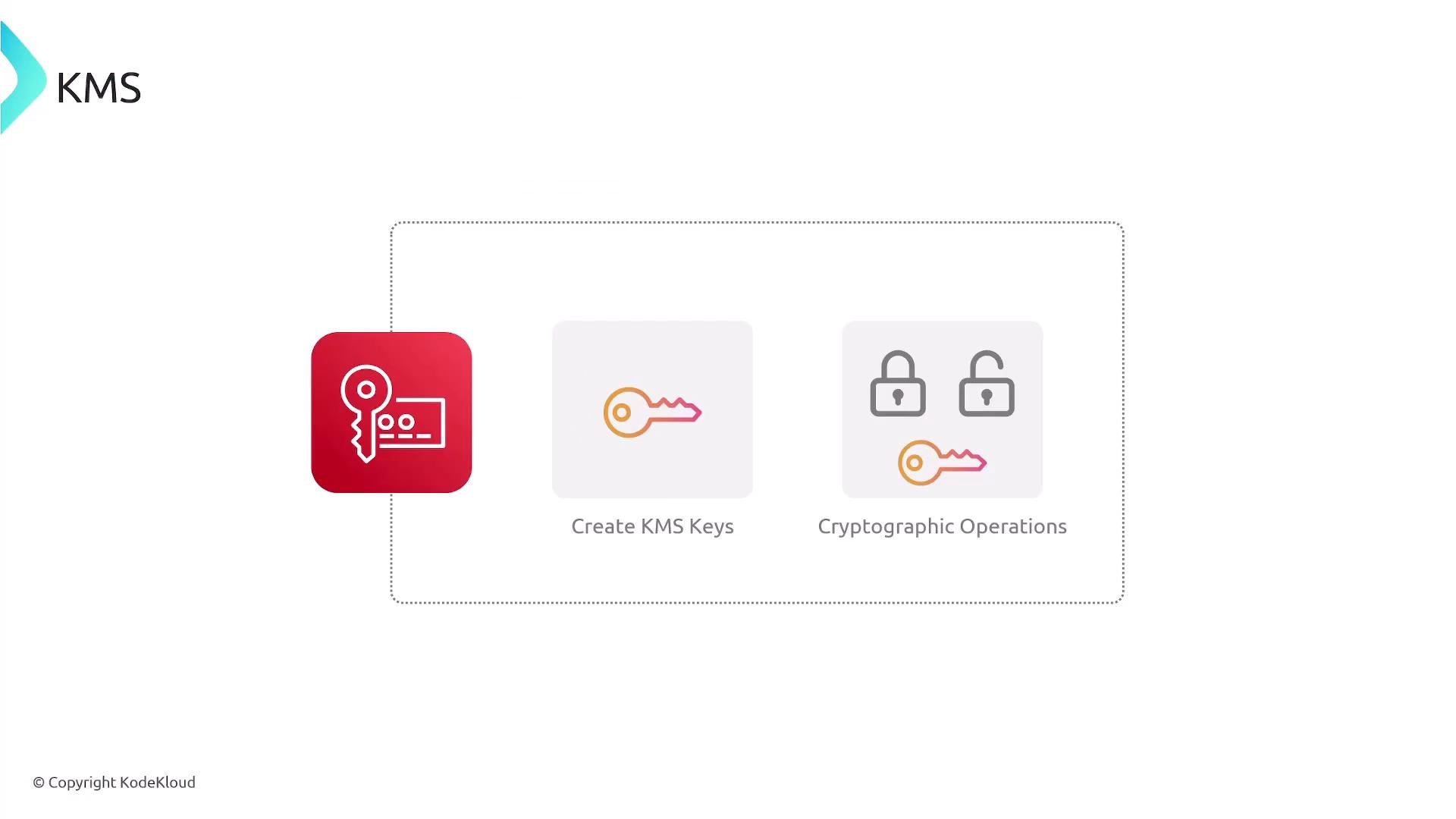
Security and cryptography We’ll cover IAM principles, key management, and cryptographic operations with KMS so you can design secure key usage and encryption-at-rest/in-transit strategies.
A KMS-themed slide showing icons of keys and locks with a KMS logo at the top-left. The dotted box highlights two panels labeled "Create KMS Keys" and "Cryptographic Operations."
How the design section is structured The design section transitions from service-level knowledge to architecture decisions mapped to the AWS Well-Architected Framework. This section is organized into five parts, each aligned to one or more Well-Architected pillars:
  1. Security — design secure systems: encryption, fine-grained access control, and threat mitigation.
  2. Reliability — patterns for fault tolerance, failover, and high availability.
  3. Performance Efficiency — choosing services and patterns for scalability and responsiveness.
  4. Cost Optimization — run workloads efficiently using cost-aware choices and AWS cost tools.
  5. Operational Excellence — monitoring, runbooks, automation, and continuous improvement.
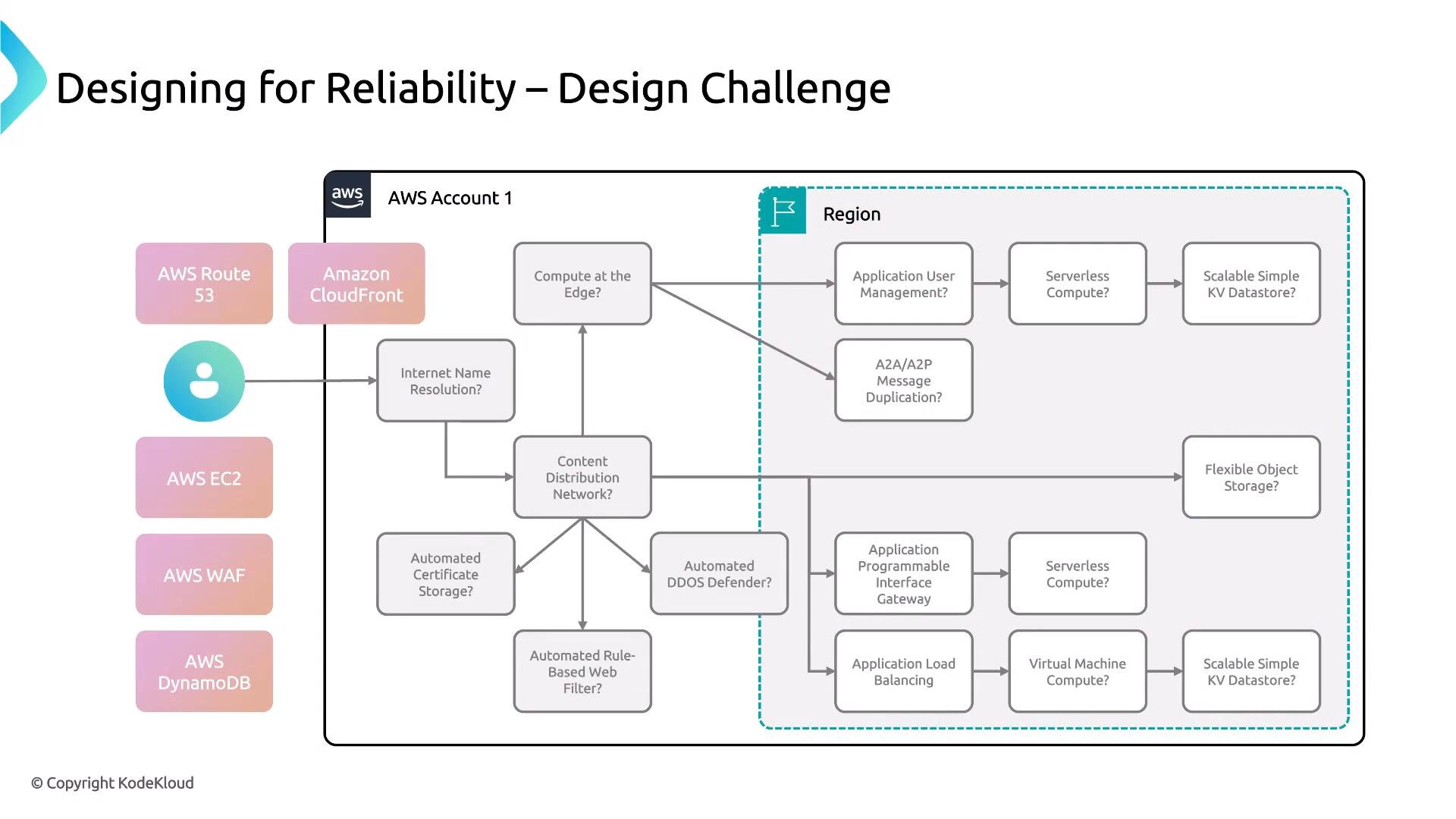
Each part contains scenario-based challenges, labs, and a design walkthrough that highlights trade-offs and the reasoning you’ll need for exam-style questions. Design-for-reliability example We’ll walk through real architecture challenges—routing, edge services, caching, serverless alternatives, and data storage choices to design resilient, high-availability systems.
A cloud architecture diagram titled "Designing for Reliability – Design Challenge" showing AWS components (Route 53, CloudFront, EC2, WAF, DynamoDB) on the left and a region boundary on the right with boxes for edge/compute, CDN, serverless compute, load balancing, and scalable storage services. The flowchart-style layout maps internet name resolution and content distribution to various automated security and compute/storage options.
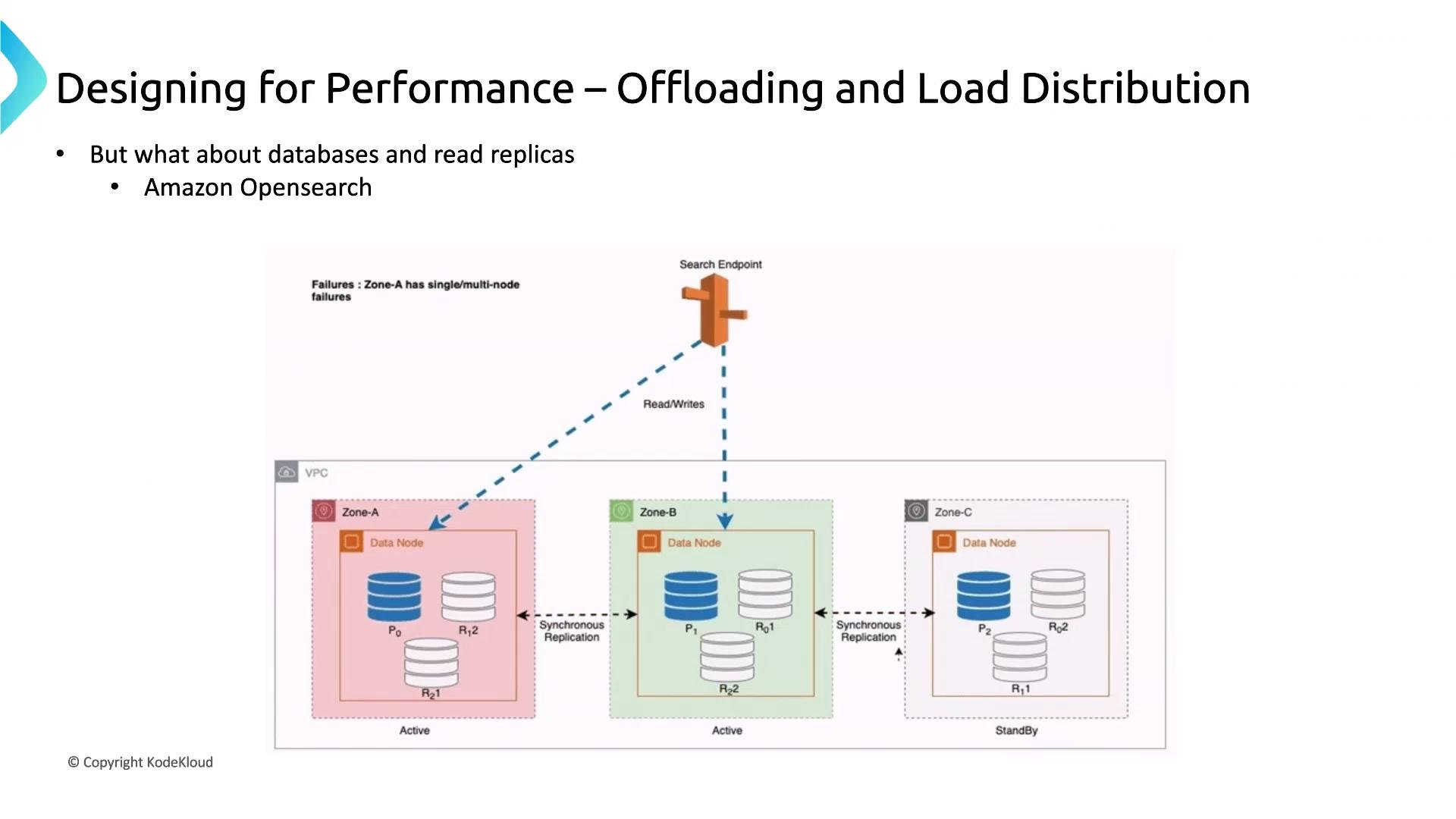
Performance efficiency and offloading We’ll cover read/write scaling strategies, replication patterns, and when to offload work to managed services (example: search, analytics, or caching).
A slide titled "Designing for Performance – Offloading and Load Distribution" showing an Amazon OpenSearch architecture. It depicts three availability zones with data nodes and synchronous replication between them, plus a search endpoint routing read/write traffic to the replicas.
Capstone design challenge and exam readiness The design section concludes with an integrated design challenge that brings together all five pillars. After that, you’ll receive a concise summary of the key takeaways to focus your final exam preparation.
Final summary content will be completed when the final component of the course is released at the end of December. Check the course updates area for release notes and timelines.
Recommended study strategy
  • Start with the diagnostic mock exam to identify weak areas.
  • Alternate between labs and lectures—apply concepts immediately after learning them.
  • Use quizzes and reinforcement questions as checkpoint milestones.
  • Practice the final mock exam under timed conditions.
  • Review Well-Architected scenarios and learn to justify trade-offs in answers.
Resources and links Need help? If something in the course is unclear or you want guidance on study plans, reach out via the KodeKloud community: Over to Sanjeev Thanks, Michael. Hey everyone — next, I’ll walk you through the service categories and deeper hands-on examples you’ll see throughout the skills section. See you in the labs.

Watch Video