

- An AWS account with permissions to create S3 buckets and manage objects.
- The S3 console (AWS Management Console) open in your browser.
Step 1 — Create a bucket
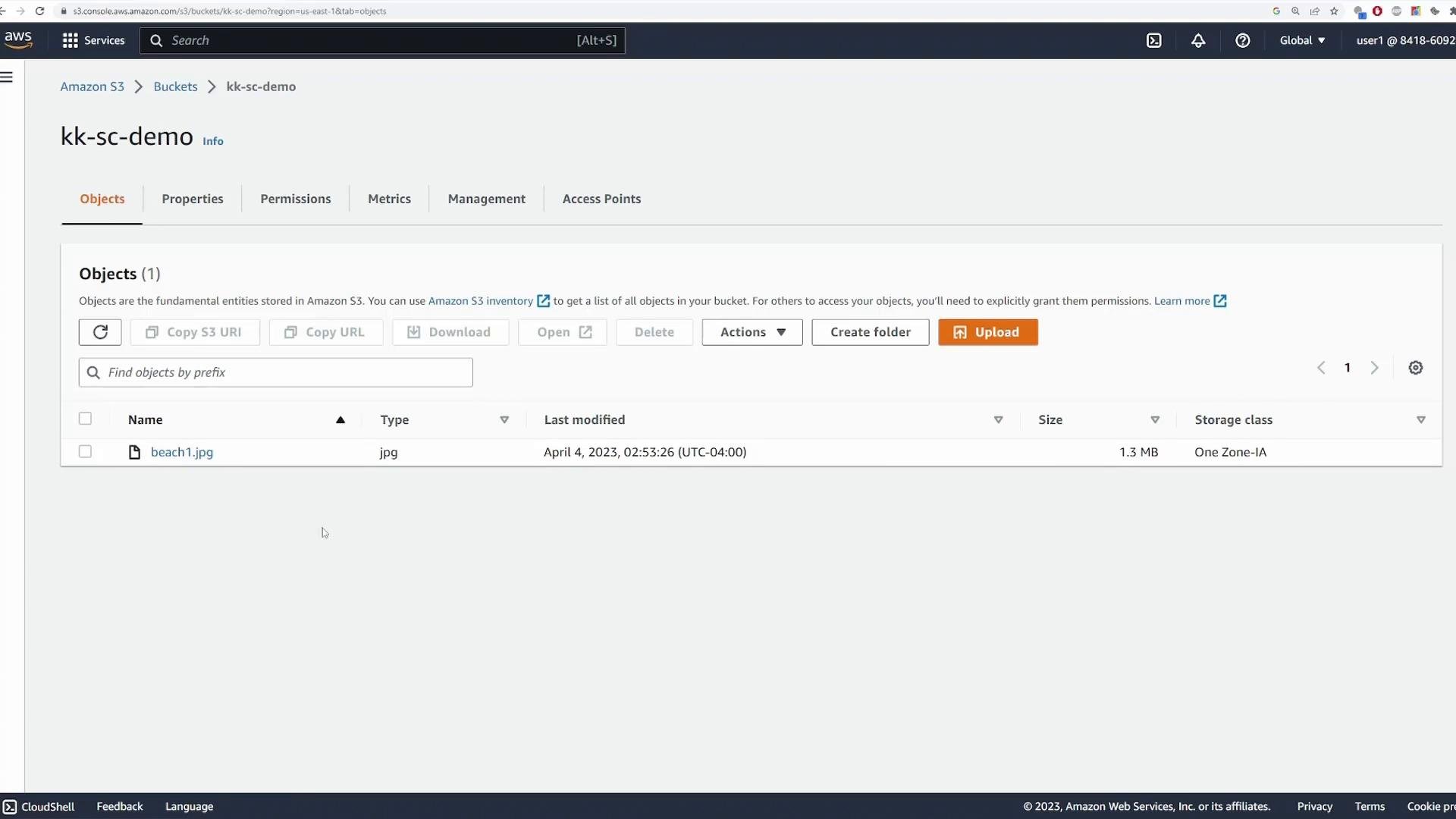
- In the S3 console, create a new bucket. In this example the bucket name used is
kk-sc-demo. - Leave the other settings as the defaults, or configure region and access settings as required for your organization.
Step 2 — Upload a file and set the storage class
- Open the
kk-sc-demobucket and click Upload. - Choose the file to upload (e.g.,
beach1.jpg). - In the Upload dialog, open the Properties panel. The Storage class option is shown there and defaults to S3 Standard.
- Change the Storage class to One Zone-Infrequent Access (One Zone-IA) and complete the upload.
Step 3 — Change the storage class for an existing object
- In the Objects list, click the object name to open its details (for example,
beach1.jpg). - Open the Properties pane for the object.
- Find the Storage class section and choose Edit (or Change).
- Select the desired storage class (for example, change it back to S3 Standard) and save.
- If versioning is enabled on the bucket, changing the storage class may create a new object version with the new storage class.
- If versioning is disabled, the object’s metadata is updated in place.
Changing storage classes can trigger S3 requests and possible data transfer or operational charges (for example, retrieving from Glacier or cross-region transfers). Also note that changing storage class on a versioned bucket may create new object versions which could affect storage costs. Review AWS S3 pricing and your lifecycle policies before making bulk changes.
S3 Standard is the default and provides high durability and availability across multiple Availability Zones. One Zone-IA stores data in a single Availability Zone — it’s more cost-effective but has lower availability and resilience. Use One Zone-IA for easily re-creatable or non-critical secondary backups. To automate class transitions, configure S3 lifecycle rules. See the Amazon S3 Storage Classes documentation for details.
Storage class comparison (quick reference)
Links and references
Summary
- Set the storage class during upload: Upload → Properties → Storage class.
- Change the storage class later from the object’s Properties pane.
- Select a storage class based on durability, availability, and cost trade-offs.
- Use lifecycle rules to automate transitions between storage classes.