

- A Kubernetes cluster with sufficient resources (CPU, RAM, and storage) for model serving.
- kubectl configured to point to your target cluster.
- Helm 3 installed.
- Appropriate cluster permissions to create CRDs and namespace resources.
- The following Helm commands install the KServe CRDs and the KServe controller in
RawDeploymentmode. Adjust versions or values to match your environment.
- Deploy a quantized Qwen large language model using KServe, creating the appropriate KServe serving resources (
LLMISvcorInferenceService) and sending inference requests. - Serve generative AI workloads and observe how request formats and response handling differ from traditional predictive models.
- Deploy a text-classification model to learn patterns for predictive inference (batch vs. real-time, request/response schemas).
- Inspect InferenceService status, identify deployment issues, and troubleshoot common problems in KServe environments.
- Reinforce concepts with demonstrations, hands-on labs, and quizzes.
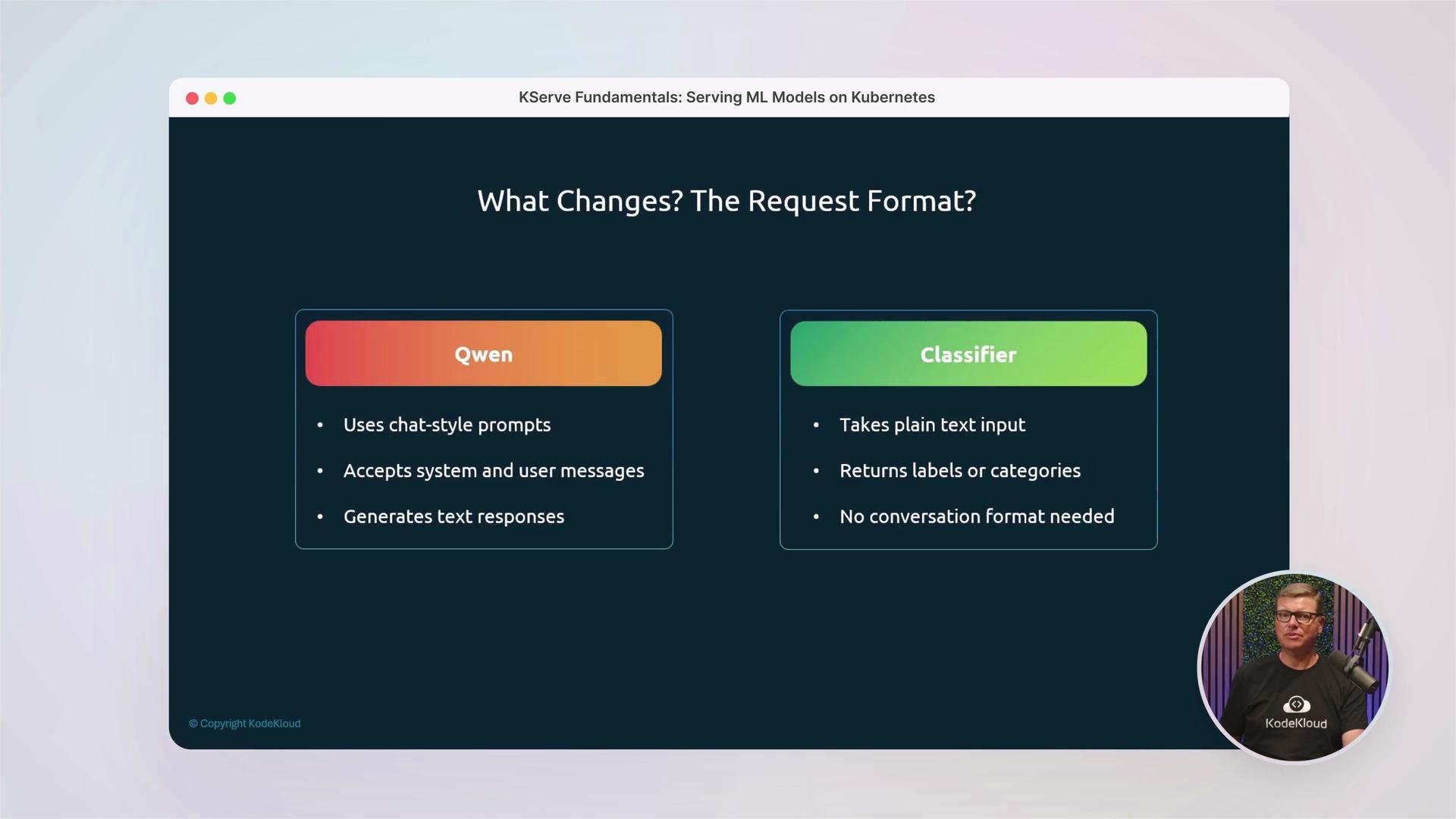
- Generative LLMs often use chat-style prompts or structured inputs with streaming responses and token-level outputs.
- Predictive/classification models typically accept plain text or feature vectors and return structured labels or probabilities.
Links and references
Throughout the course you’ll practice deploying, serving, and troubleshooting both generative and predictive ML models using KServe on Kubernetes. Each hands-on module includes sample manifests and inference examples so you can reproduce the demos in your own cluster.
Before running the Helm commands, ensure your kubectl context points to the Kubernetes cluster where you intend to install KServe and that you have sufficient permissions to create cluster-level resources.