

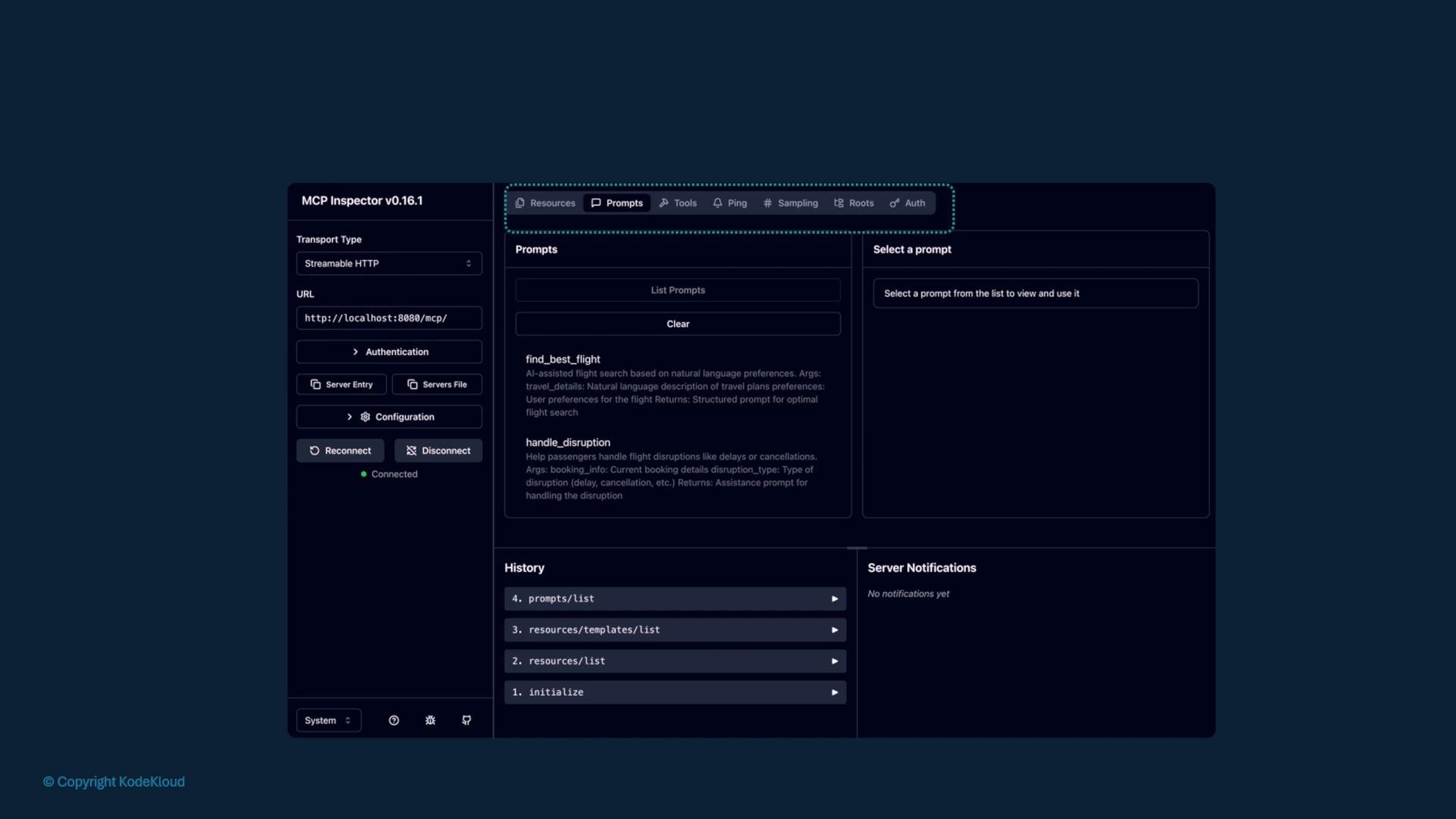
- Browse available prompts and inspect prompt definitions.
- Explore tools and resources registered on the MCP server.
- Review server history, notifications, and execution traces.
- MCP course: https://learn.kodekloud.com/user/courses/mcp-for-beginners
- Model Context Protocol (MCP) reference: https://learn.kodekloud.com/user/courses/mcp-for-beginners
Install & run
The inspector is published as an npm package and can be launched directly vianpx. Depending on the package namespace, use one of these commands:
Connect the Inspector to an MCP server
- Open the URL reported by the inspector in your browser (for example
http://localhost:8080/mcp/). - In the Inspector UI, use the Connect control in the left column to enter the MCP server base URL (for example
http://localhost:8080/mcp/) and click Connect. - Once connected, the UI displays Prompts, Tools, Resources, History, and Notifications. You can click individual entries to view details and run or inspect calls.
Quick reference
Troubleshooting & tips
- If the Inspector prints an address like
http://localhost:8080/mcp/but you are connecting from a different machine, replacelocalhostwith the host IP or hostname reachable from your browser (or run the inspector on the workstation directly). - If the browser shows CORS or network errors, verify the MCP server URL is correct and that any proxies, firewalls, or VPNs allow access.
- For automated testing or CI, you can run the inspector on a headless host and access it via a tunneled port or reverse proxy.
Further reading
- MCP course — Learn KodeKloud
- Node.js: https://nodejs.org/
- npx package runner: https://www.npmjs.com/package/npx