

Roadmap overview
- History and definition
- Core ingredients
- How models learn
- Generalization and evaluation
- Types of learning
- Neural networks and modern models
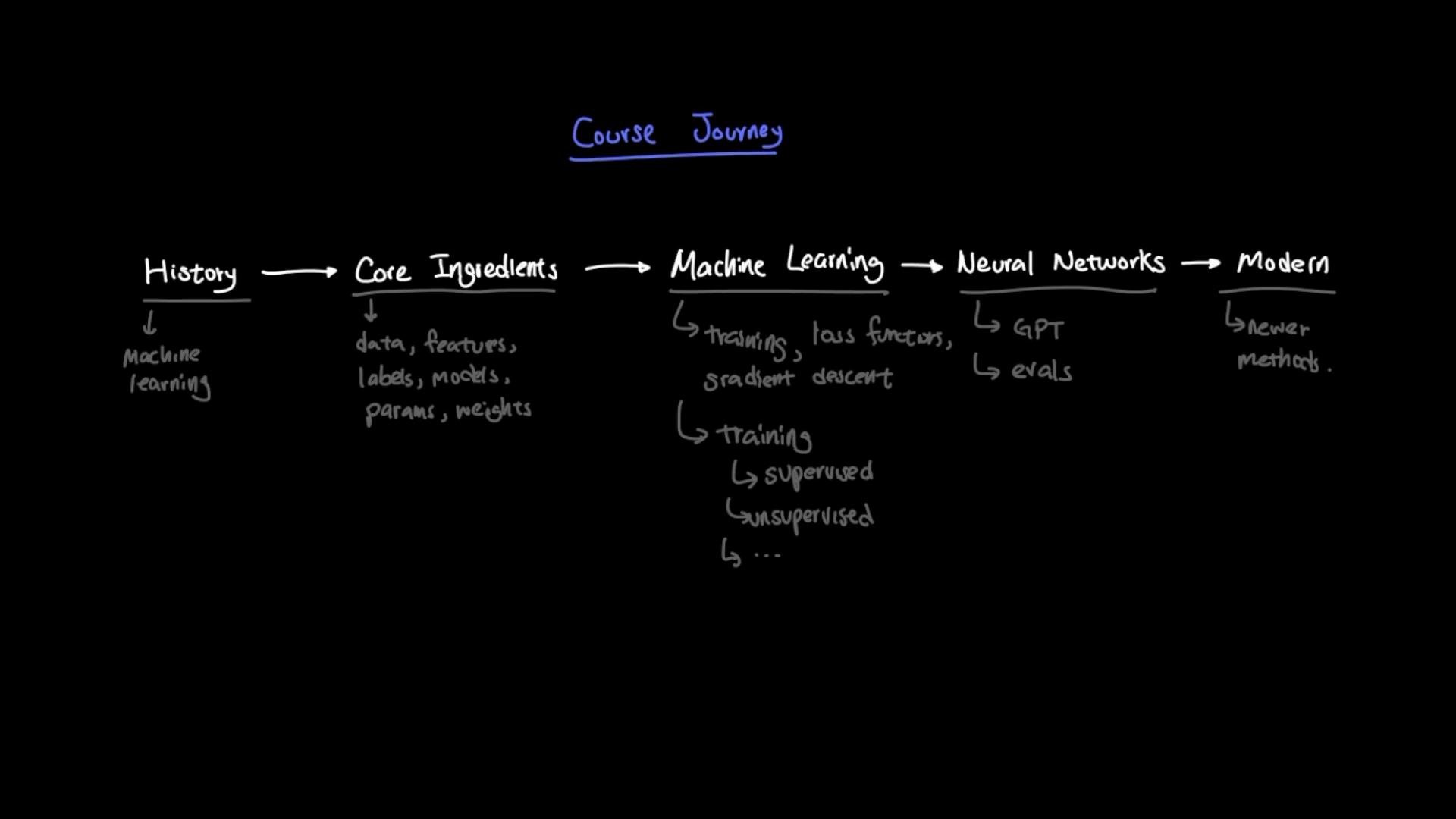
This roadmap is intentionally linear: you’ll start with conceptual foundations and build toward practical model design, evaluation, and an introduction to how modern large models are trained and assessed.
What each section covers
1) History and definition
A brief history of machine learning and a working definition of the field.- Why ML emerged (statistical learning, compute and data availability).
- What “machine learning” means today vs. classical programming.
- Key milestones that shaped modern ML.
2) Core ingredients
The fundamental building blocks every ML practitioner should know:- Data: how data is collected and basic quality concerns.
- Features: representation and feature engineering basics.
- Labels: supervised targets and labeling considerations.
- Models: hypothesis space and common model families.
- Parameters & weights: how a model’s behavior is controlled.
3) How models learn
Key mechanics behind training:- Training procedures and pipelines.
- Loss functions — how we measure errors.
- Optimization techniques, with emphasis on gradient descent and variants (SGD, Adam).
4) Generalization and evaluation
How to determine if a model works on new data:- Train/validation/test splits and cross-validation.
- Metrics for classification vs. regression.
- Overfitting vs. underfitting and regularization strategies.
5) Types of learning
Categorization of learning paradigms:- Supervised learning (classification, regression).
- Unsupervised learning (clustering, dimensionality reduction).
- Brief look at semi-supervised, self-supervised, and reinforcement learning.
6) Neural networks and modern models
How modern models are structured and trained, plus current trends:- Neural network architectures and training dynamics.
- Large models (e.g., GPT-style transformers): pretraining, fine-tuning, and scaling behavior.
- Modern evaluation practices, safety considerations, and active research directions.
Quick reference table
Learning outcomes & next steps
By the end of this lesson you should be able to:- Trace the path from raw data to a trained model and deployed predictions.
- Choose the right model and evaluation strategy for a simple real-world problem.
- Describe how neural networks and large pretrained models are trained and evaluated.
- A brief introduction to machine learning (Wikipedia)
- Deep Learning Book (Goodfellow, Bengio, Courville)
- scikit-learn: Machine Learning in Python
If you’re new to ML, a basic familiarity with linear algebra, probability, and Python will make the concepts easier to follow. Consider refreshing those fundamentals before deep-diving into model training.