

How ML differs from traditional programming
In traditional programming you write explicit instructions: an input goes in, the program follows defined rules, and an output comes out. For many simple tasks this is ideal — for example, an age-check for website access can be written as a single rule:- If the user is 18 or older, allow access.
- If the user is younger than 18, block access.
if age >= 18.
But many real-world problems are messy, noisy, and constantly changing. Consider spam detection:
- Heuristics like “contains ‘free money’” or “has many links” can catch some spam.
- Spammers change tactics, legitimate messages sometimes match those heuristics, and complete coverage by hand-written rules becomes infeasible.
- https://en.wikipedia.org/wiki/Arthur_Samuel_(computer_scientist)
- https://en.wikipedia.org/wiki/Netflix_Prize
What a model is
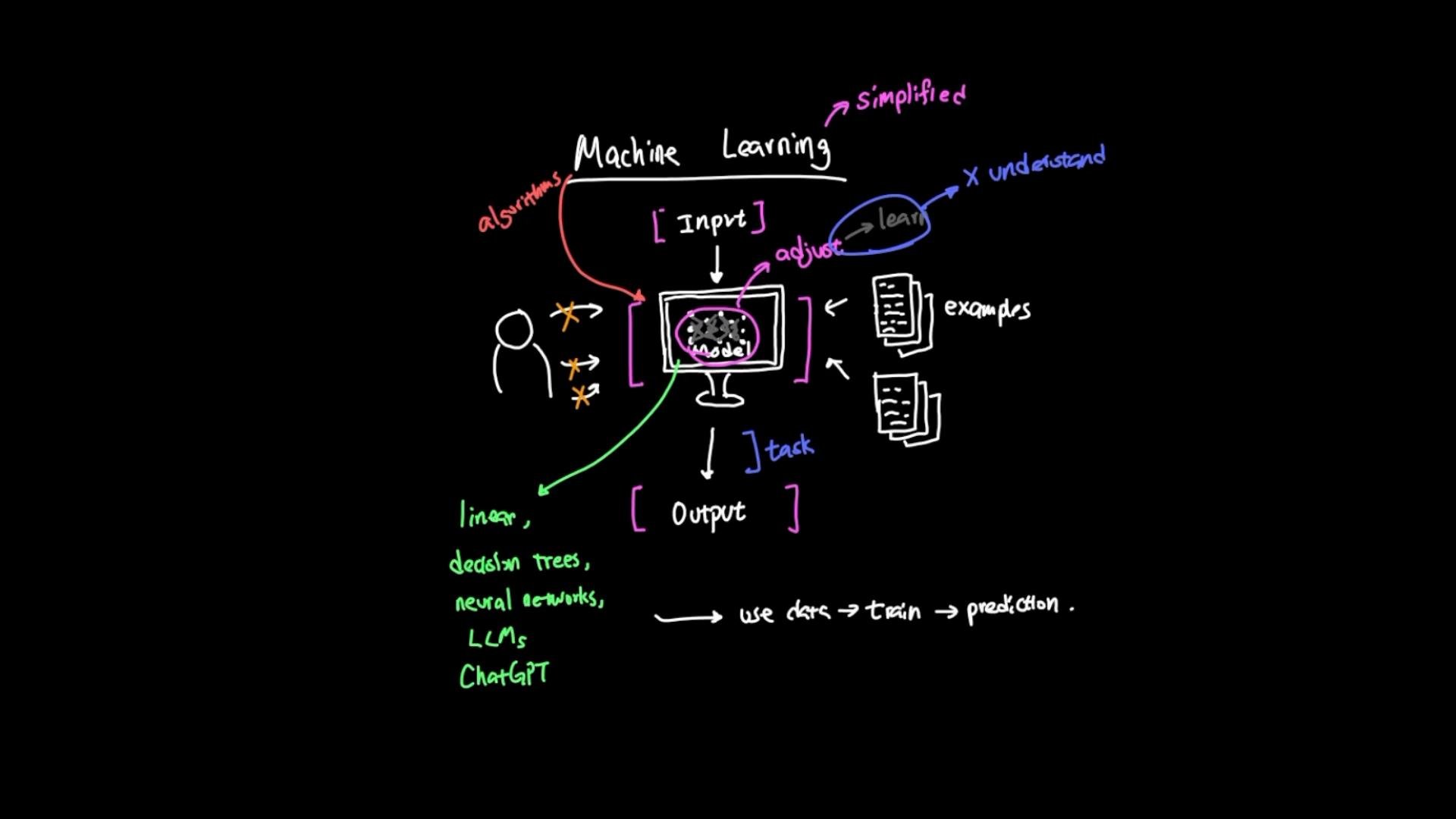
A model is the component that maps inputs to predictions. For the Netflix example, the input could include user IDs, movie IDs, and past ratings; the output is a predicted rating for an unseen movie. A simple mental model for ML:- Input (features) goes in,
- the model performs mathematical computations using internal values (parameters/weights),
- a prediction comes out.
“Learning” in machine learning generally means adjusting model parameters to improve performance on a task; it is not equivalent to human understanding.
Types of models
Machine learning is an umbrella term for many algorithms and architectures:- Simple models: linear regression, logistic regression, decision trees.
- More complex models: random forests, gradient-boosted machines.
- Deep learning: neural networks and large language models (LLMs) such as ChatGPT (https://openai.com/chatgpt).
Core ingredients of a machine learning system
Because ML learns from examples, a typical system includes several essential pieces:When to use ML vs. rule-based systems
Final takeaway and further reading
Machine learning is not a single algorithm but a set of methods for turning data into predictive systems by tuning model parameters on examples. Use rule-based solutions for simple deterministic logic; choose machine learning when the problem is fuzzy, variable, or too complex for hand-written rules. Further reading:- Introduction to Machine Learning — Wikipedia
- Scikit-learn documentation
- Deep Learning overview (Goodfellow, Bengio, Courville)