

Artificial Neural Networks
Artificial neural networks simulate biological neurons by receiving input, processing it, and transmitting output. Each artificial neuron multiplies its input by a weight that reflects the importance of that feature. For instance, when predicting house prices, the number of rooms may be weighted differently than the room size. An activation function then decides whether the neuron’s output should move to the next layer, filtering the most relevant information.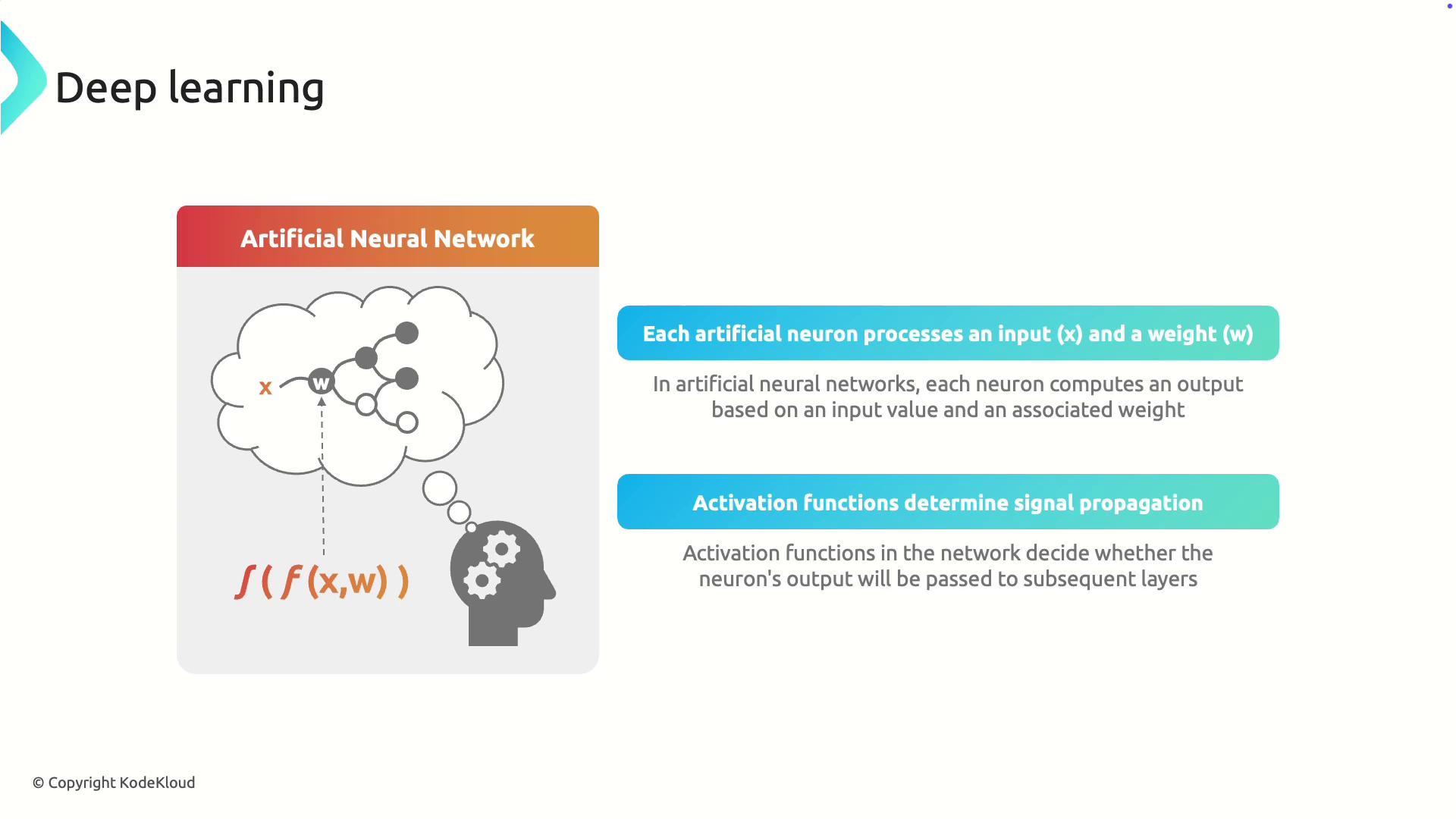
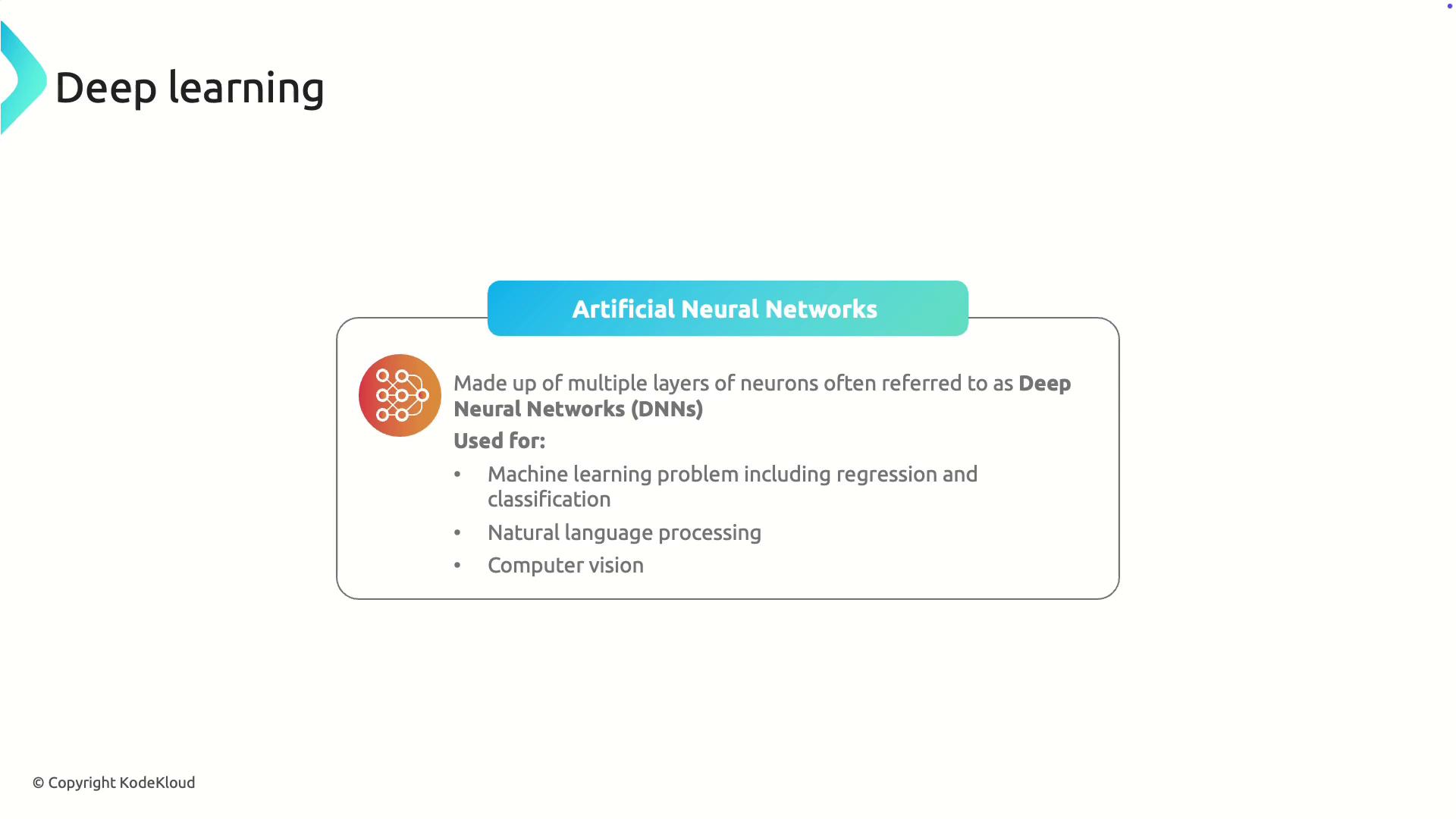
In image recognition tasks, early layers may detect edges, mid-layers capture shapes, and deeper layers recognize complete objects, leading to highly effective classification and prediction.
Example: Classifying Animal Sounds
This section explains how a deep learning model can classify animal sounds using a step-by-step process. The model processes a feature vector X, which includes characteristics such as pitch, duration, amplitude, and frequency. Each feature is processed by a corresponding neuron in the input layer.1. Input Layer and Feature Extraction
Each neuron in the input layer receives a feature and calculates a weighted sum using its specific weight (W). These weights are continuously adjusted during training, enabling the model to learn the contribution of each feature to the final prediction.2. Hidden Layers
The output from the input layer is sent through one or more hidden layers. In these layers, every neuron connects to all neurons in the subsequent layer, allowing the model to refine and abstract features iteratively. This process helps uncover complex patterns essential for accurate predictions.3. Output Layer and Prediction
In the final output layer, the network computes probabilities for each possible class. For example, a probability distribution might be 0.1 for dog, 0.6 for cat, and 0.3 for bird. The model then selects the class with the highest probability as its prediction.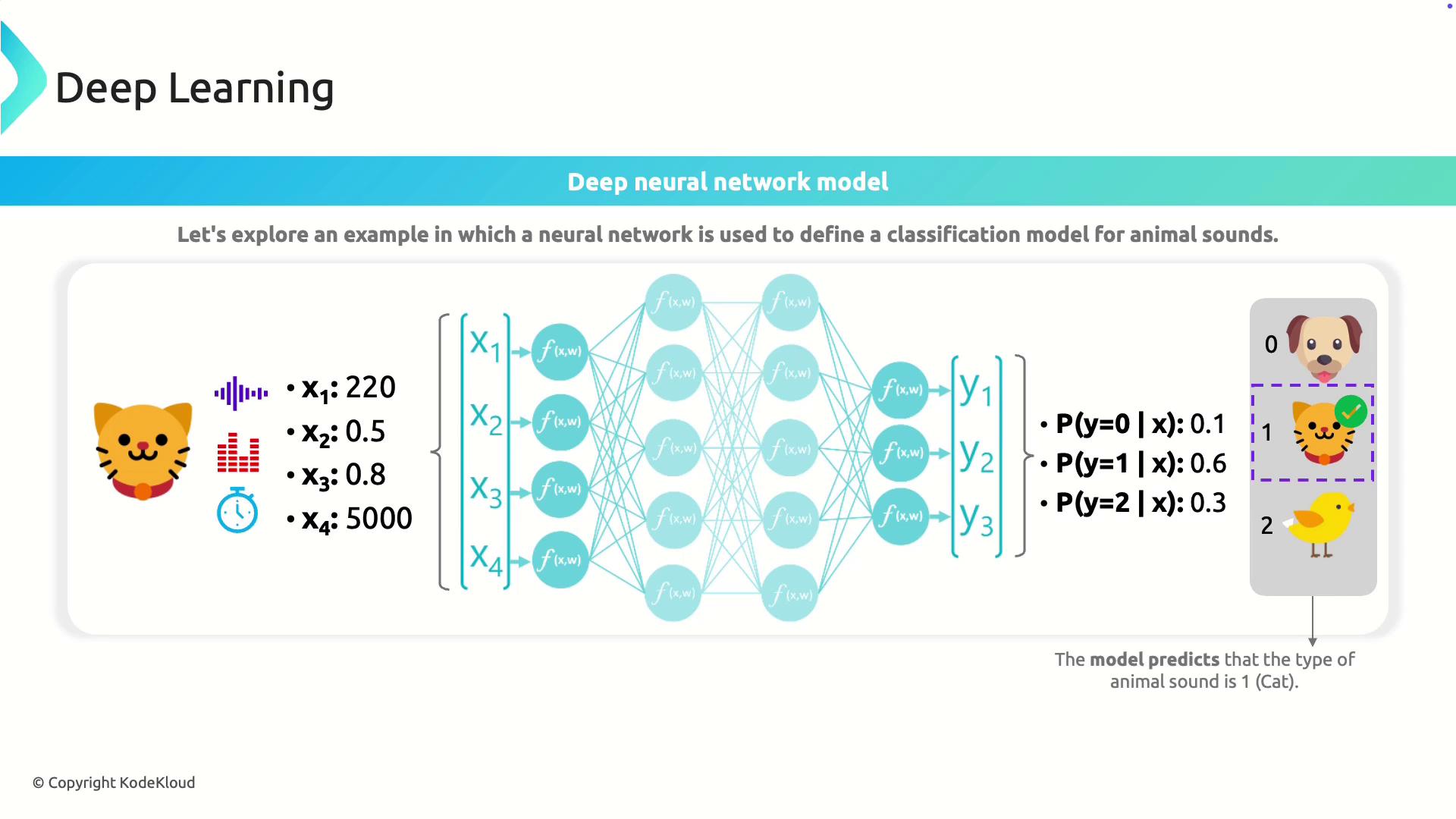
- Start with a feature vector describing the sound.
- Process the features in the input layer with weighted summation.
- Pass the data through multiple hidden layers for iterative feature refinement.
- Compute output probabilities in the final layer and choose the class with the maximum probability.
Learning Through Iterative Training
The power of deep learning lies in its ability to learn from repeated exposure to data. During training, the model performs the following steps:- Forward propagates training data through the network to generate predicted probabilities.
- Compares these predictions with actual labels (ground truth) to determine the loss, which measures the error.
- Adjusts the weights using optimization techniques such as backpropagation to minimize the loss.
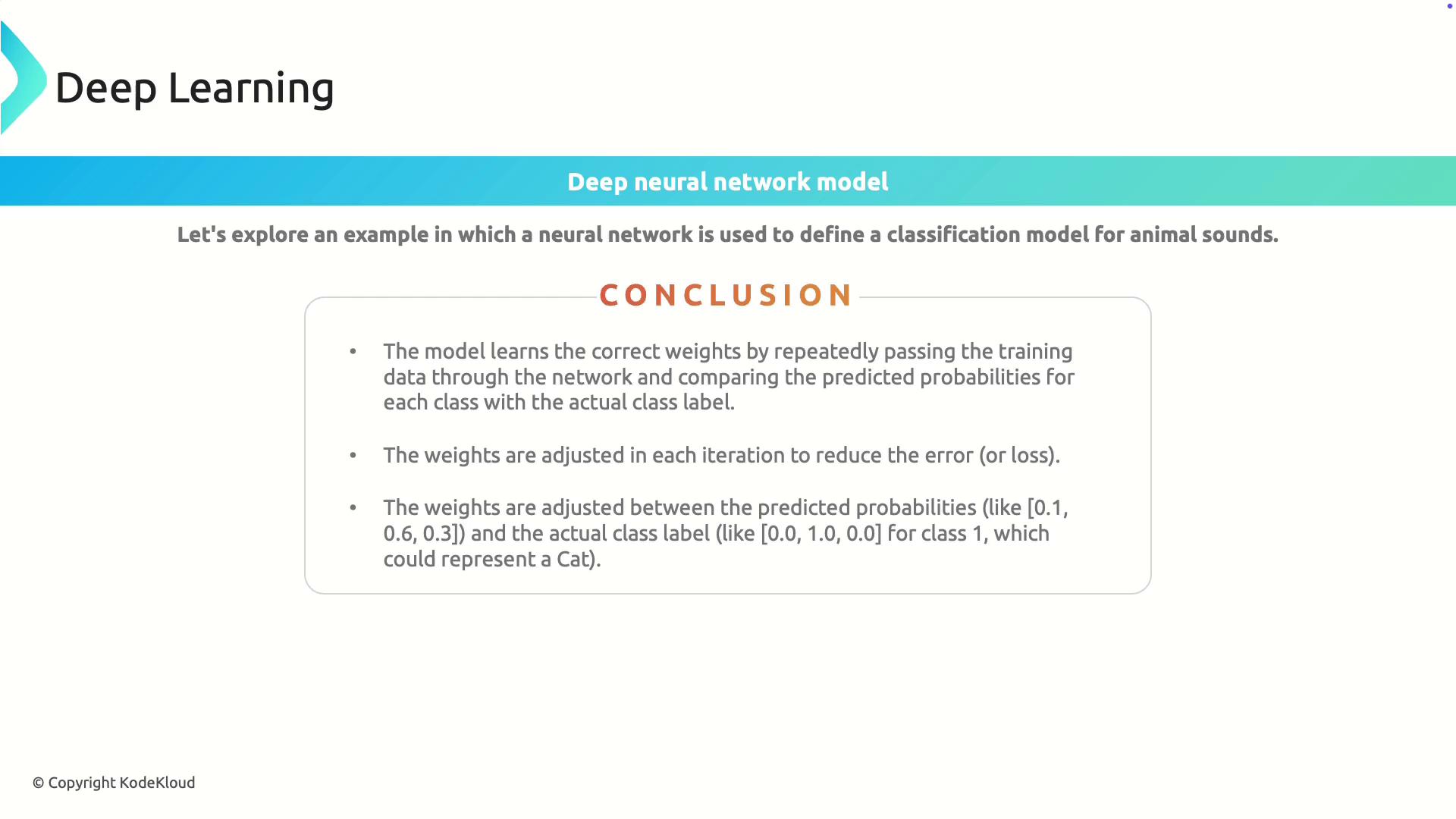
The continuous process of weight adjustment through backpropagation is what makes deep learning models robust and effective for diverse applications in artificial intelligence.
Summary
Deep learning models draw inspiration from the human brain to learn complex patterns from data by processing inputs through multiple layers. The essential aspects include:- Feature extraction in the input layer.
- Progressive abstraction in hidden layers.
- Final prediction in the output layer using probabilities.