The Journey to Success
Team ROI began by pinpointing the core issue: engineers struggled to deploy code from a repository into a scalable production environment tailored to the diverse needs of various in-company organizations. To tackle this, they embraced a rapid iteration process, gathering feedback from a select group of influential internal customers. The initial solution was straightforward—a simple repository that enabled deployment to a non-production environment. Through ongoing feedback, extensive documentation, and active advocacy, the solution evolved markedly. After four months of rigorous refinement, the evolved product caught the attention of another group, Team TCO. They requested the capability to deploy into production rather than a non-production environment. Soon, similar requests flooded in from other teams. At this point, Team ROI had achieved a network effect: by making their internal development platform intuitive and accessible, the adoption of DevOps principles spread organically. This approach not only accelerated development processes but also prompted teams to ask why such an innovative solution hadn’t been implemented sooner.Points to Remember
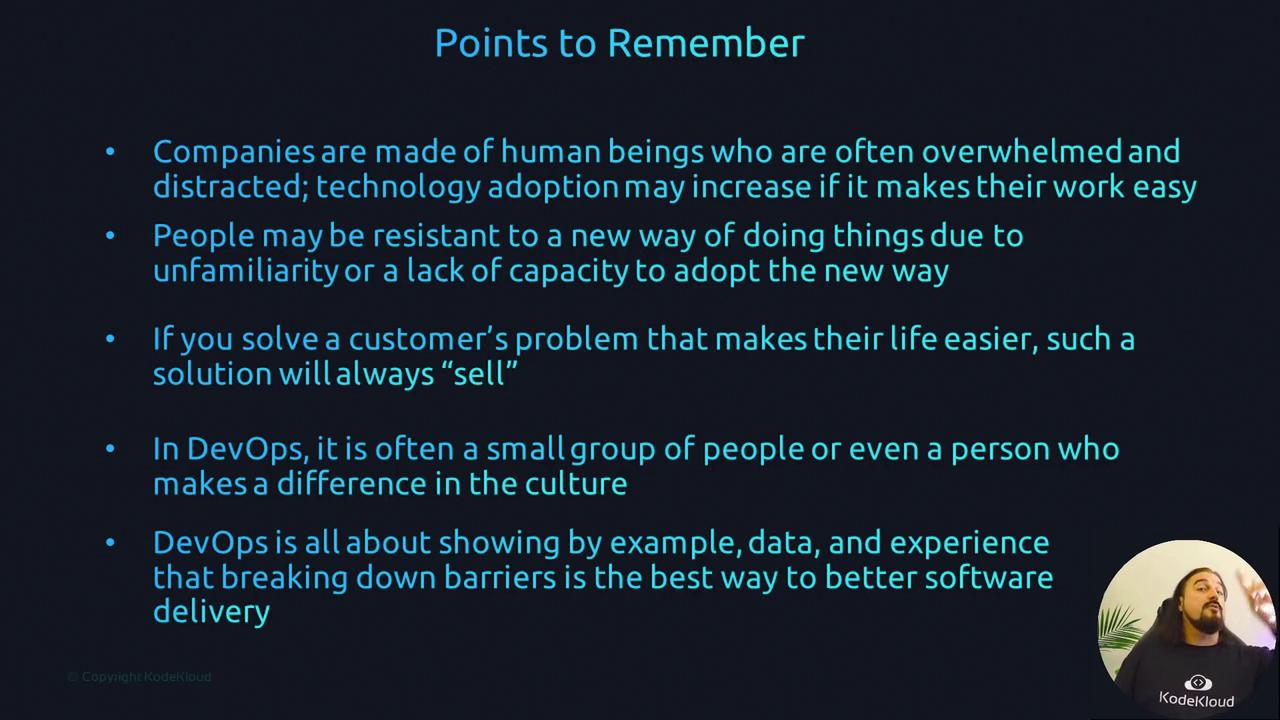
- Organizations consist of individuals who are often overwhelmed by their daily tasks. Simplifying processes is critical to encouraging the adoption of innovative ideas.
- Resistance to new methods frequently arises from unfamiliarity or a lack of capacity. Addressing these concerns is essential to successful implementation.
- Any solution that makes a process easier for internal or external customers is likely to gain rapid acceptance. In DevOps, even a small initiative—or a single person—can catalyze significant cultural shifts.