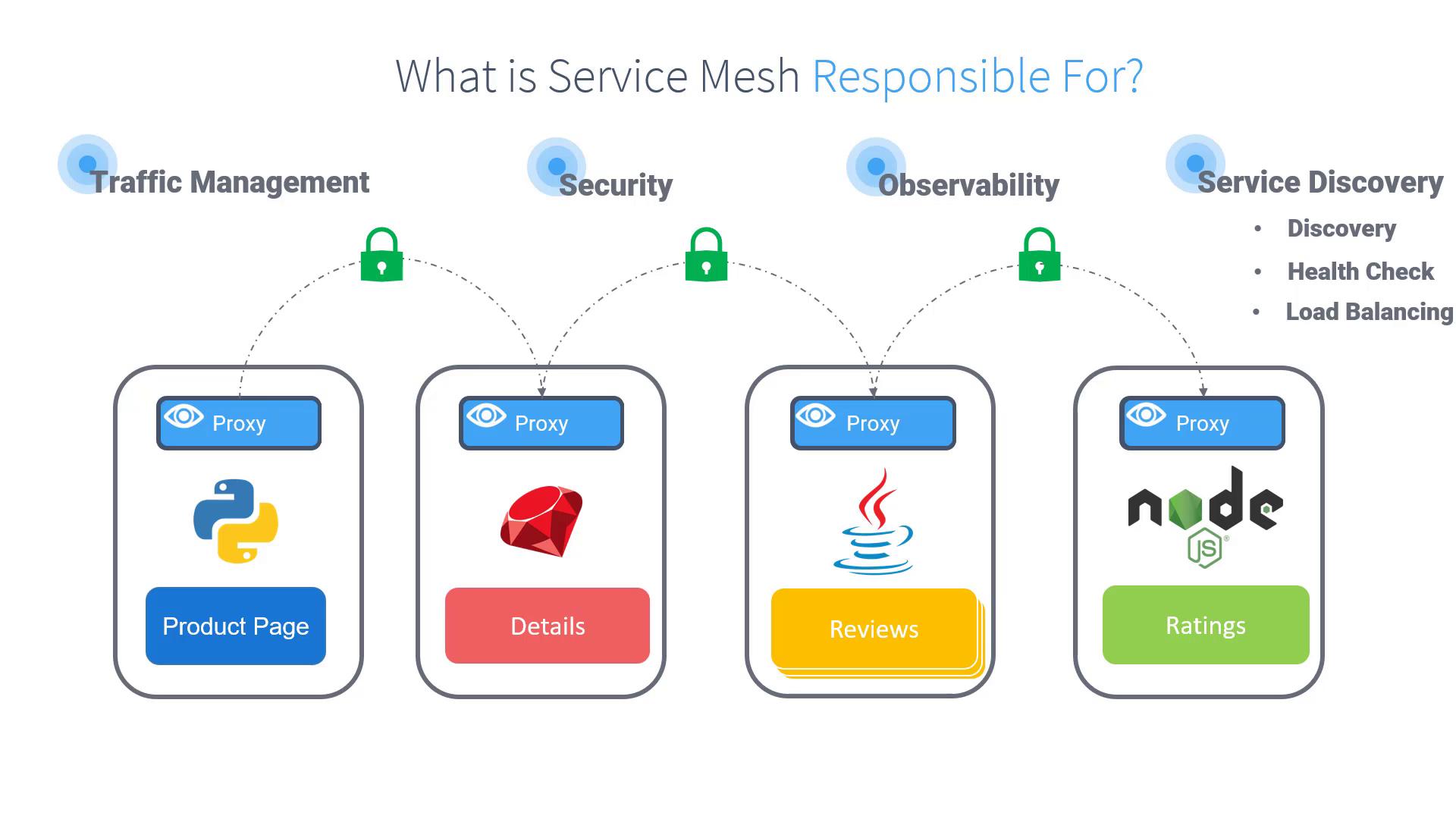
A service mesh is a dedicated, configurable infrastructure layer designed to manage service-to-service communications in microservices architectures without requiring modifications to your business code. In traditional microservice architectures, each service was tasked with handling its own routing, security, and observability functions. With a service mesh, these tasks are offloaded to sidecar proxies deployed alongside every microservice. The network communication between services is managed by these proxies, which also form the data plane. The proxies communicate with a central server-side component known as the Control Plane. The Control Plane oversees and directs all traffic entering and leaving the services, ensuring a larger, cohesive system.Documentation Index
Fetch the complete documentation index at: https://notes.kodekloud.com/llms.txt
Use this file to discover all available pages before exploring further.
- Dynamic configuration of service interactions without direct code changes.
- Enhanced security through mutual TLS, protecting communications between services.
- Comprehensive observability, enabling real-time monitoring, performance assessments, and bottleneck detection.
| Capability | Description | Benefit |
|---|---|---|
| Service Discovery | Automatically identifies the IP addresses and ports where services are exposed. | Simplifies inter-service communication without manual setup. |
| Health Checks | Continuously monitors the status of services and maintains a pool of healthy instances. | Improves resilience and fault tolerance. |
| Load Balancing | Routes traffic intelligently toward healthy instances, isolating or bypassing failing ones. | Optimizes resource usage and minimizes downtime. |
