

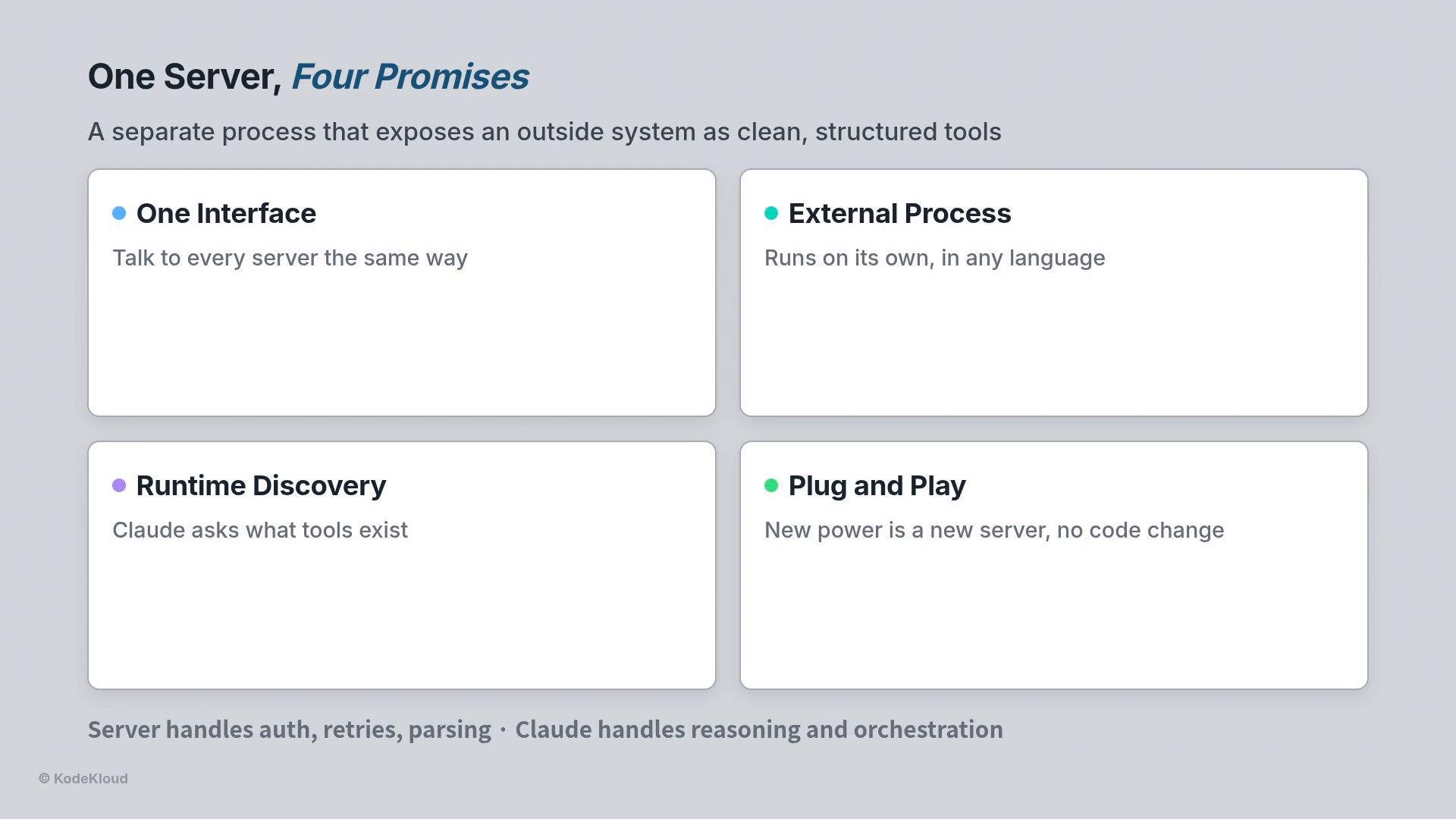
- Keeps the agent focused on reasoning and orchestration.
- Lets integrations handle authentication, retries, and API shapes.
- Makes it easy to add or replace external systems without changing agent code.
- One standard interface for every server so agents interact uniformly.
- Each server runs as an independent process and may be implemented in any language.
- Servers expose their tools at runtime; the agent discovers them automatically.
- Add new capabilities by plugging in servers — no changes to the agent.
ClaudeAgentOptions field named mcp_servers. Each key is the server name; the value describes how to launch it (command, args, env). The server name becomes the namespace prefix for all tools it provides.
Important behaviors:
- You never register individual tools. Once a server runs, the agent discovers its tools automatically.
- The server name prefixes every tool:
mcp__{server_name}__{tool_name}.
Whitelisting (allowed_tools) enforces least privilege. You can allow all tools from a server with a wildcard or grant only specific operations for read-only jobs.
createStack tool, the AWS Labs CloudFormation MCP server models resources as typed entities and exposes focused operations such as:
list_resourcesget_resourceget_resource_schema_information
- To list all stacks: call
mcp__cfn__list_resourceswith resource typeAWS::CloudFormation::Stack. - To inspect an S3 bucket: call
mcp__cfn__get_resourcewith resource typeAWS::S3::Bucket.
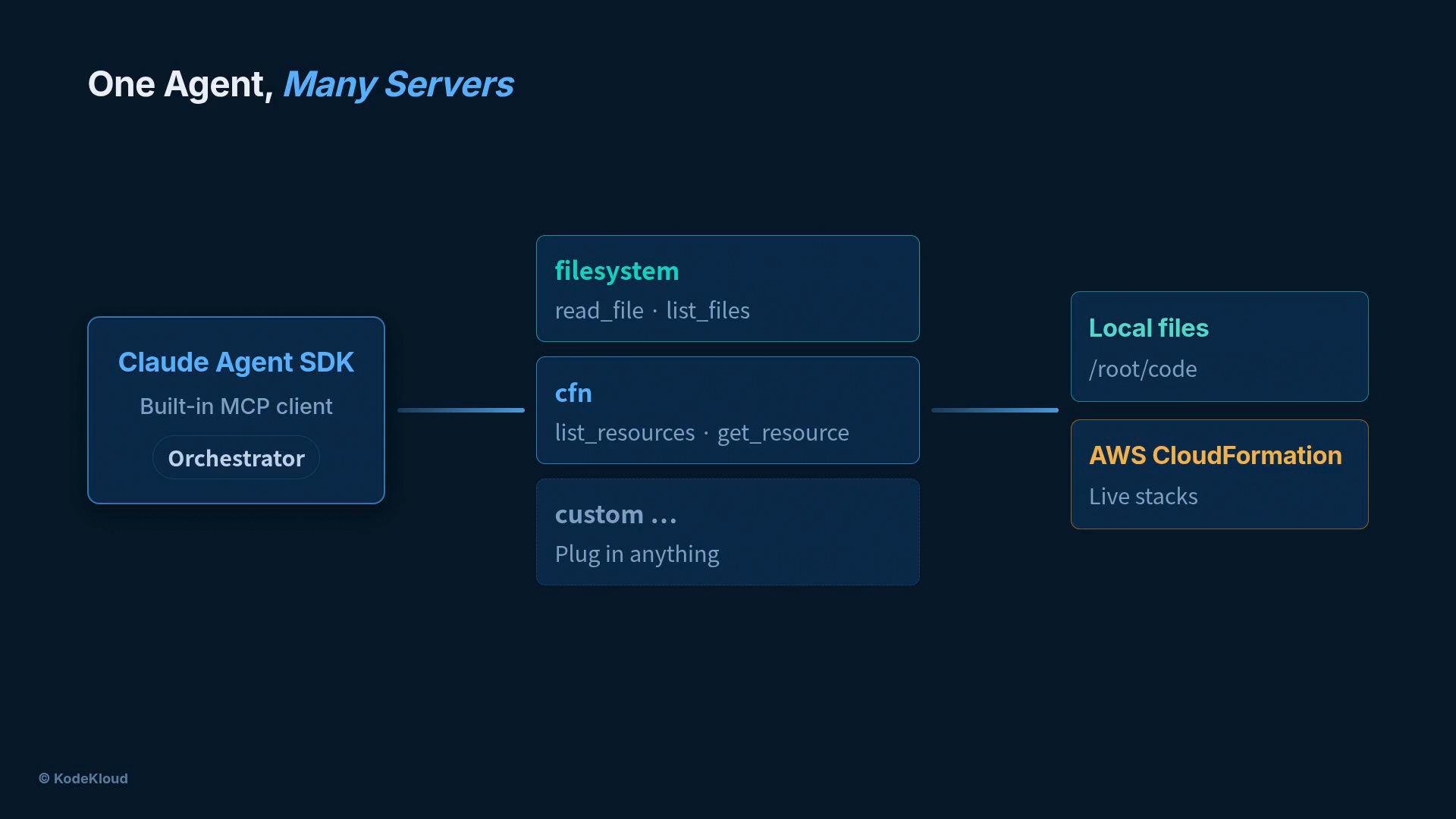
- One agent can connect to many servers. Tools are namespaced by server name so there is no collision between different integrations.
- Each server runs independently. A failure in one server does not bring down others.
- To give the agent new capability, plug in a server and update the whitelist — no agent rewrite required.
- Combine servers for complex workflows (e.g., compare a local CloudFormation template on a filesystem server with the live stack from the CloudFormation server).
- skills defining what Claude can do,
- sub-agents defining who does the work,
- and MCP defining where tools live,
MCP shifts infrastructure integration out of the agent and into small, focused servers. That keeps agent code stable and lets you add or replace external integrations without touching the agent.
- AWS CloudFormation documentation: https://docs.aws.amazon.com/AWSCloudFormation/latest/UserGuide/
- Model Context Protocol (MCP) pattern — architecting LLM agents with external tool servers
- Example MCP server: awslabs CloudFormation MCP server (
awslabs.cfn-mcp-server)