

The six core lessons (in order)
- Query (single-turn)
- The foundation: ask a question and get an answer. This establishes identity and intent for the agent.
- Tools (action surface)
- Give the agent real abilities (read, edit, run Bash) so it can operate systems rather than only describe them.
- Memory (stateful client)
- Persist conversation state so the agent can build multi-step workflows across turns.
- Skills (reusable expertise)
- Package domain knowledge and procedures as files or modules the agent can discover and reuse.
- Subagents (specialists)
- Decompose complex work into focused agents, each with only the tools and permissions it needs.
- MCP (external tool servers)
- Plug in third‑party or hosted tool servers (MCPs) so tooling can be consumed without custom glue code.
A compact mental model
Use these lenses when designing agentic systems:- Foundation: Query + Tools — how the agent thinks and acts
- Scope: Skills — what the agent can reach for
- Assignment: Subagents — which specialist does the work
- Sourcing: MCP — where external tools and services come from
- Continuity: Memory — when context and history matter
Capstone recap — a production deployment
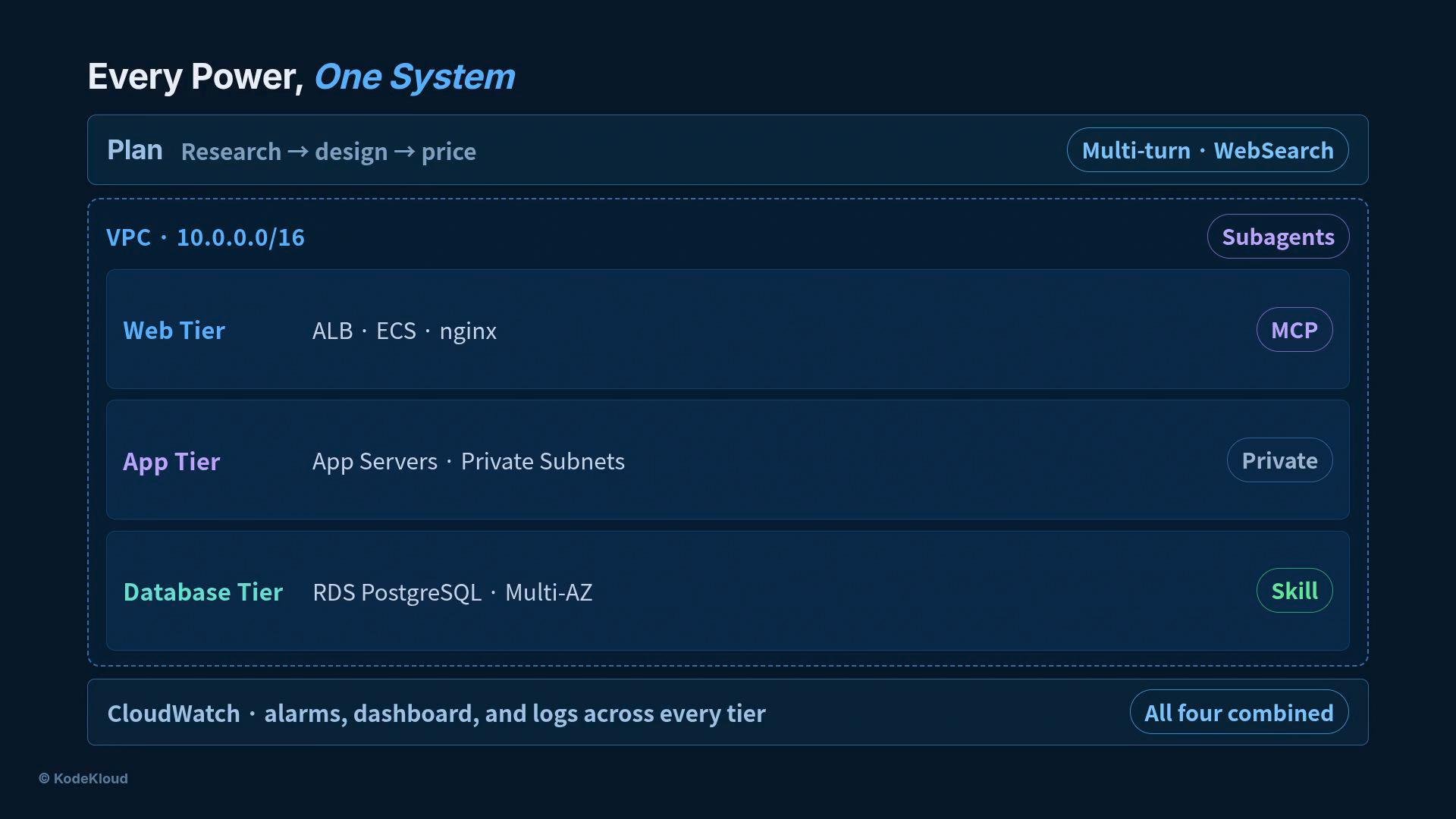
In the capstone you combined every capability to provision a three-tier web application. Each component had a specific responsibility:- Planning: a multi-turn client researched the Well-Architected Framework, designed the stack, and produced cost estimates.
- Network: the VPC wrapped the system and was constructed by parallel subagents (network and security specialists).
- Database: the database tier was provided by a skill encapsulating AWS RDS best practices.
- Web tier: ECS behind an application load balancer was provisioned via an MCP server, avoiding custom orchestration glue.
- Observability: monitoring (CloudWatch and related agents) tied every tier together and validated health, performance, and cost.
Why composition matters
The biggest insight is composition: small, well-defined capabilities — a tool, a memory store, a skill file, a specialist subagent, a plugged-in server — are not powerful in isolation. Combined, they plan, build, and verify real infrastructure while you review the results instead of typing every command. This is the core of Agentic AI: compose focused components so the system reliably produces outcomes you can audit and approve.Quick reference table
A simple mental model to use when designing agentic systems: foundation (query + tools), scope (skills), assignment (subagents), sourcing (MCP), and continuity (memory). Use these five lenses to decide what to implement and where to plug components in.