Learn to create a simple RESTful API in Go, enhancing routing with the Gorilla Mux router for elegant handling and dynamic variable extraction.
In this article, you’ll learn how to create a simple RESTful API in Go. We’ll begin by setting up an in-memory slice for product data and establishing basic endpoints using Go’s standard library. Later, we’ll enhance our routing with the Gorilla Mux router for more elegant route handling and dynamic variable extraction.Below is an organized outline of the development process.──────────────────────────────
Section 1. Defining the Product Data Structure and Creating a Basic HTTP Server
We start by defining a product type as a struct. Each product consists of an ID, Name, Quantity, and Price. Then, we set up a basic HTTP server with a homepage endpoint.
Copy
Ask AI
package mainimport ( "encoding/json" "fmt" "log" "net/http")// Product represents a product with essential attributes.type Product struct { Id string `json:"Id"` Name string `json:"Name"` Quantity int `json:"Quantity"` Price float64 `json:"Price"`}// Products holds our in-memory list of products.var Products []Productfunc homePage(w http.ResponseWriter, r *http.Request) { fmt.Fprintf(w, "Welcome to the HomePage!") log.Println("Endpoint Hit: homePage")}func main() { Products = []Product{ {Id: "1", Name: "Chair", Quantity: 100, Price: 100.00}, {Id: "2", Name: "Desk", Quantity: 200, Price: 200.00}, } http.HandleFunc("/", homePage) http.ListenAndServe(":10000", nil)}
In the code above, the server listens on port 10000 and logs each request to the homepage.──────────────────────────────
Section 4. Introducing Gorilla Mux for Advanced Routing
While the standard library works well for basic routing, slicing URL strings is not the most elegant solution. To simplify route handling and support dynamic URL variables, we integrate the Gorilla Mux router.Gorilla Mux is one of the most popular routing packages in the Go ecosystem. It supports method-based routing and lets you define route variables using patterns like /movies/{id}, where {id} is dynamically extracted from the URL.
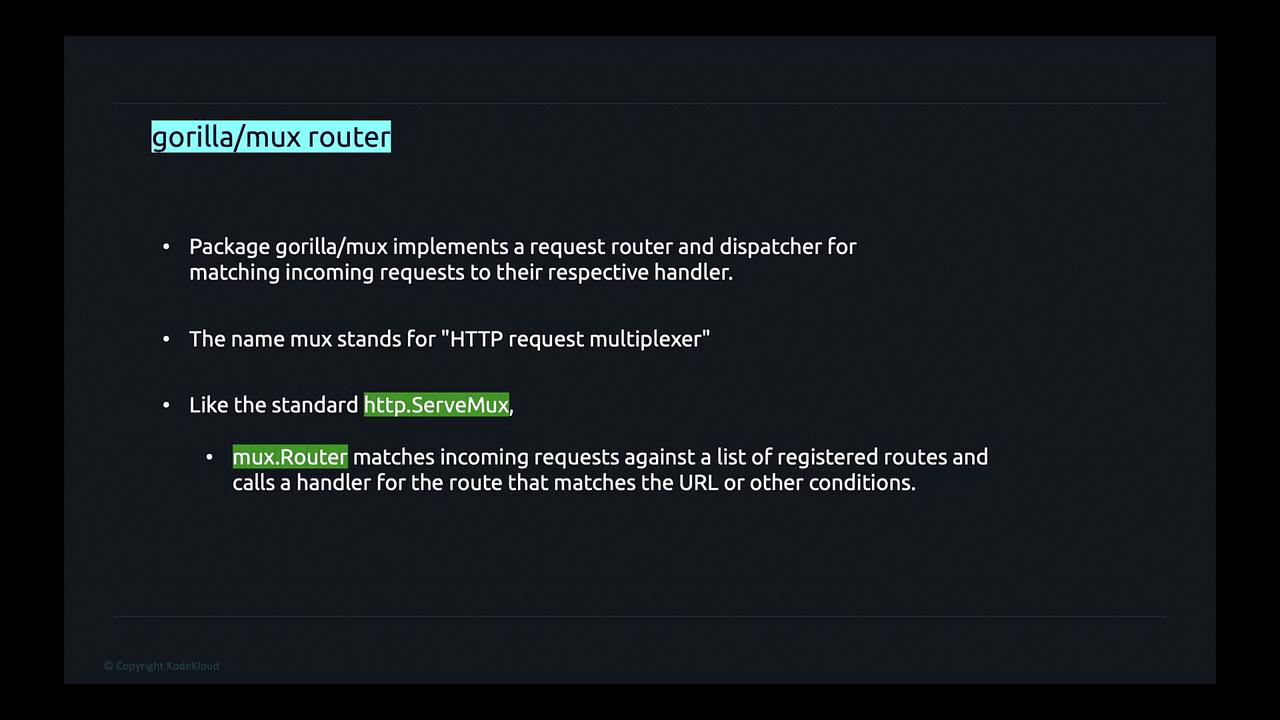
It also enables URL path variables:
To install Gorilla Mux, run the command:go get github.com/gorilla/mux
Now, update your code to integrate Gorilla Mux. Since Mux implements the HTTP.Handler interface, you can pass it directly to http.ListenAndServe:
Copy
Ask AI
package mainimport ( "encoding/json" "log" "net/http" "github.com/gorilla/mux")// Product and Products declarations remain the samefunc homePage(w http.ResponseWriter, r *http.Request) { w.Write([]byte("Welcome to the HomePage!")) log.Println("Endpoint Hit: homePage")}func returnAllProducts(w http.ResponseWriter, r *http.Request) { log.Println("Endpoint hit: returnAllProducts") json.NewEncoder(w).Encode(Products)}func getProduct(w http.ResponseWriter, r *http.Request) { vars := mux.Vars(r) key := vars["id"] for _, product := range Products { if product.Id == key { json.NewEncoder(w).Encode(product) return } } // Return a 404 error if no matching product is found. http.Error(w, "Product not found", http.StatusNotFound)}func handleRequests() { myRouter := mux.NewRouter().StrictSlash(true) myRouter.HandleFunc("/products", returnAllProducts).Methods("GET") myRouter.HandleFunc("/product/{id}", getProduct).Methods("GET") myRouter.HandleFunc("/", homePage).Methods("GET") http.ListenAndServe(":10000", myRouter)}func main() { Products = []Product{ {Id: "1", Name: "Chair", Quantity: 100, Price: 100.00}, {Id: "2", Name: "Desk", Quantity: 200, Price: 200.00}, } handleRequests()}
Running the application with:
Copy
Ask AI
go run main.go
and accessing http://localhost:10000/product/2 will return a JSON response similar to: