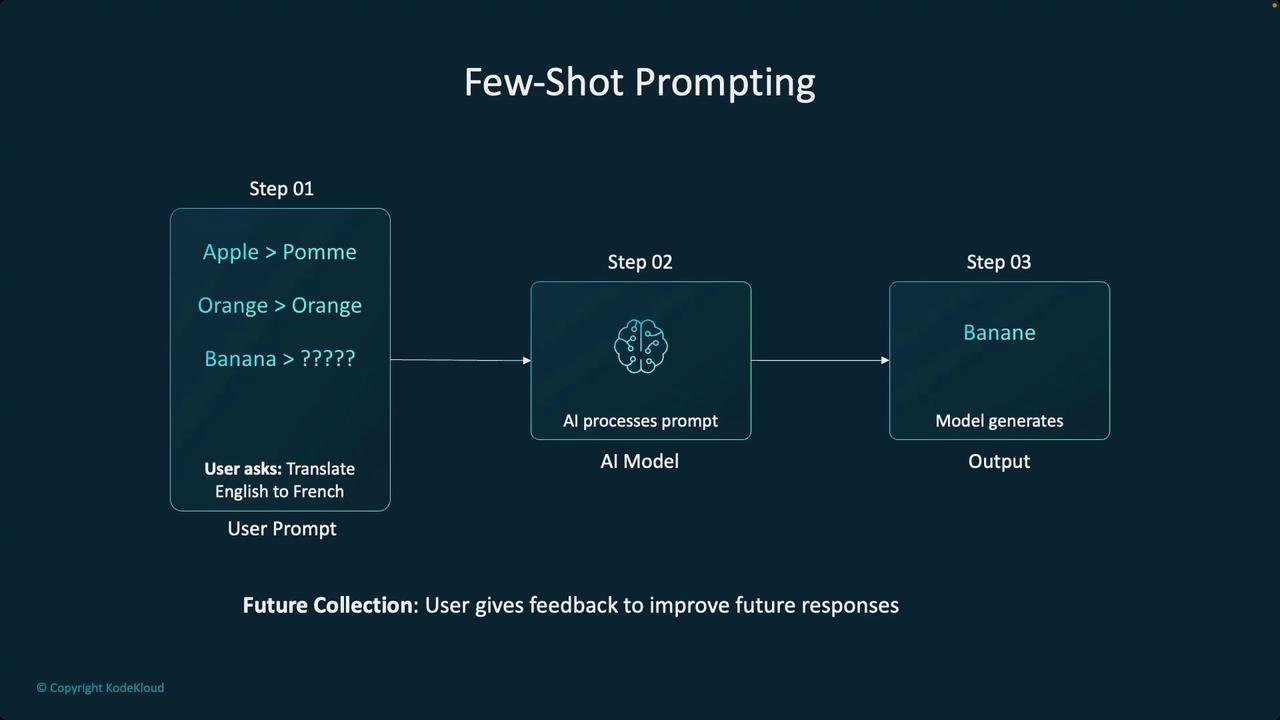
Few-shot prompting enhances model responses by providing examples and expected outputs, allowing for flexible and contextually relevant generation.
Few-shot prompting is a technique where you provide the model with one or more examples along with their expected outputs, and then ask it to generate a response to a new input following the same pattern. This approach significantly enhances the model’s ability to produce relevant and consistent responses by learning from the examples provided.One of the key advantages of few-shot prompting is its flexibility. For example, you can supply a translation pair (such as an English sentence with its French translation) and then ask the model to translate another English sentence into French. The model infers the intent and style from the provided example and generates the output accordingly.Before we dive deeper into the concept, review the following diagram to understand the overall process of few-shot prompting for translating English to French:
Remember that the success of few-shot prompting heavily relies on the quality and relevance of the examples provided.
A common challenge when designing few-shot prompting systems is sourcing high-quality examples. In many business applications, collecting and analyzing user feedback is essential. Responses that consistently receive positive interactions can be used as reliable templates for future prompts. By doing so, you not only enhance the prompt engineering process but also build a valuable repository of intellectual property that reflects your organization’s communication style.
Integrate user feedback and successful examples into your prompt engineering workflow to ensure that the model’s output remains aligned with your goals and continues to improve over time.
Below is a quick reference table summarizing key aspects of few-shot prompting:
Aspect
Description
Example Use Case
Sample Input & Output
Provide an example of the task with its expected response
Translating an English sentence to French
Flexibility
Effective across languages and various problem domains
Adapting to different languages or formats
User Feedback Integration
Enhance examples using consistently well-received responses
Building a repository of high-quality prompts
In conclusion, few-shot prompting is a powerful method to teach AI models to generate high-quality, contextually relevant outputs. By continually refining your examples and integrating user feedback, you can ensure that your model not only meets but exceeds your communication objectives.For further information on AI prompting strategies, consider exploring additional resources and best practices in our related documentation.