

- Parametric knowledge in an LLM can become stale.
- Fine-tuning improves accuracy but has limits (cost, turnaround, coverage).
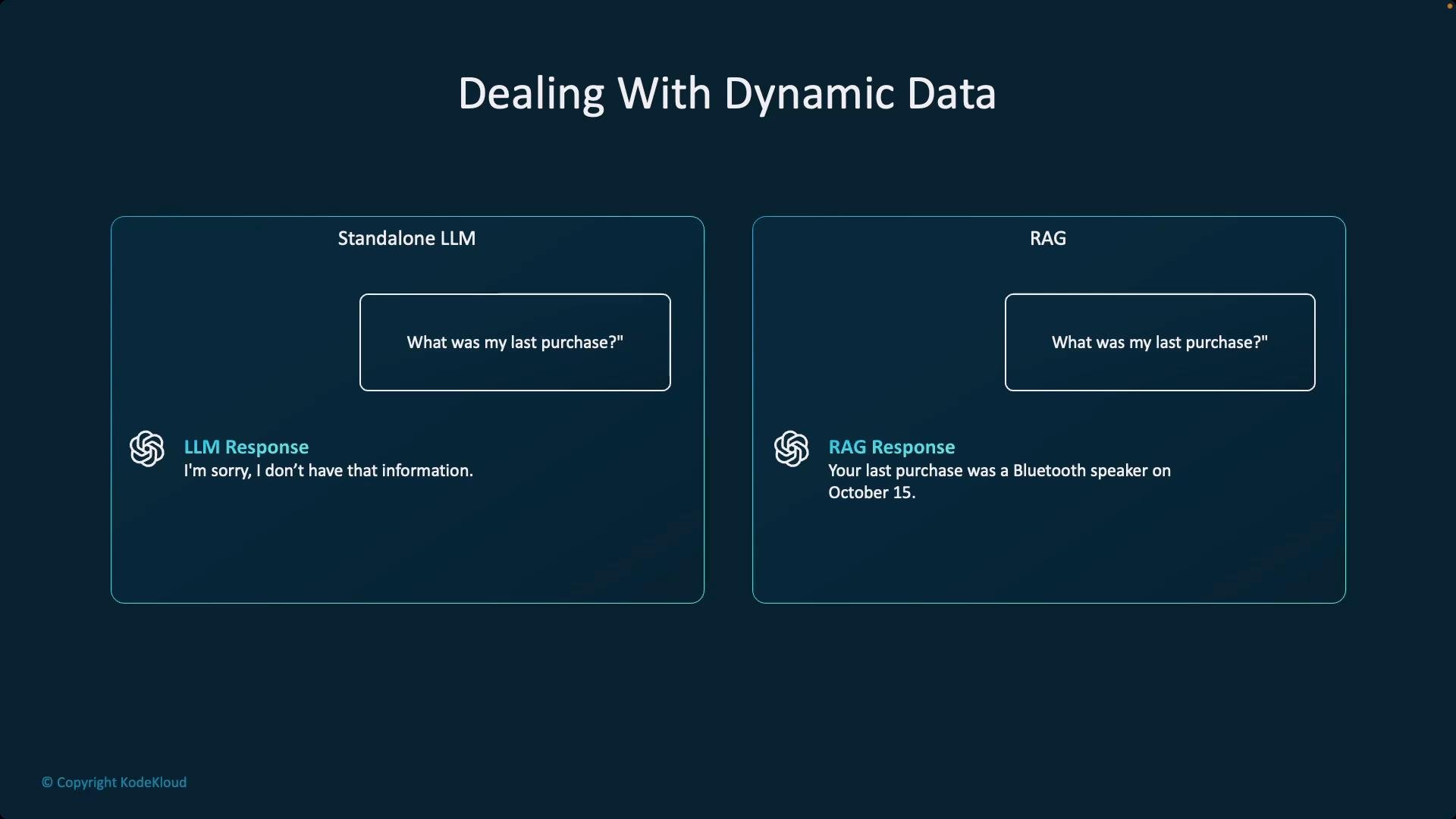
- RAG provides on-demand, relevant context so models can answer questions about events and data that occurred after training.
- Frequently changing data (purchase histories, pricing, inventory).
- Data that cannot be centralized into a single fine-tuning corpus for legal or cost reasons.
- Use cases requiring deterministic, verifiable answers.
Agentic RAG offers flexibility and adaptability, while Static RAG emphasizes predictability and simpler operational guarantees. Both aim to ground generation with retrieved evidence.
RAG complements fine-tuning — it’s not a replacement. Fine-tuning can provide domain-specific improvements, but RAG supplies the dynamic, up-to-date evidence needed for accurate responses in production.
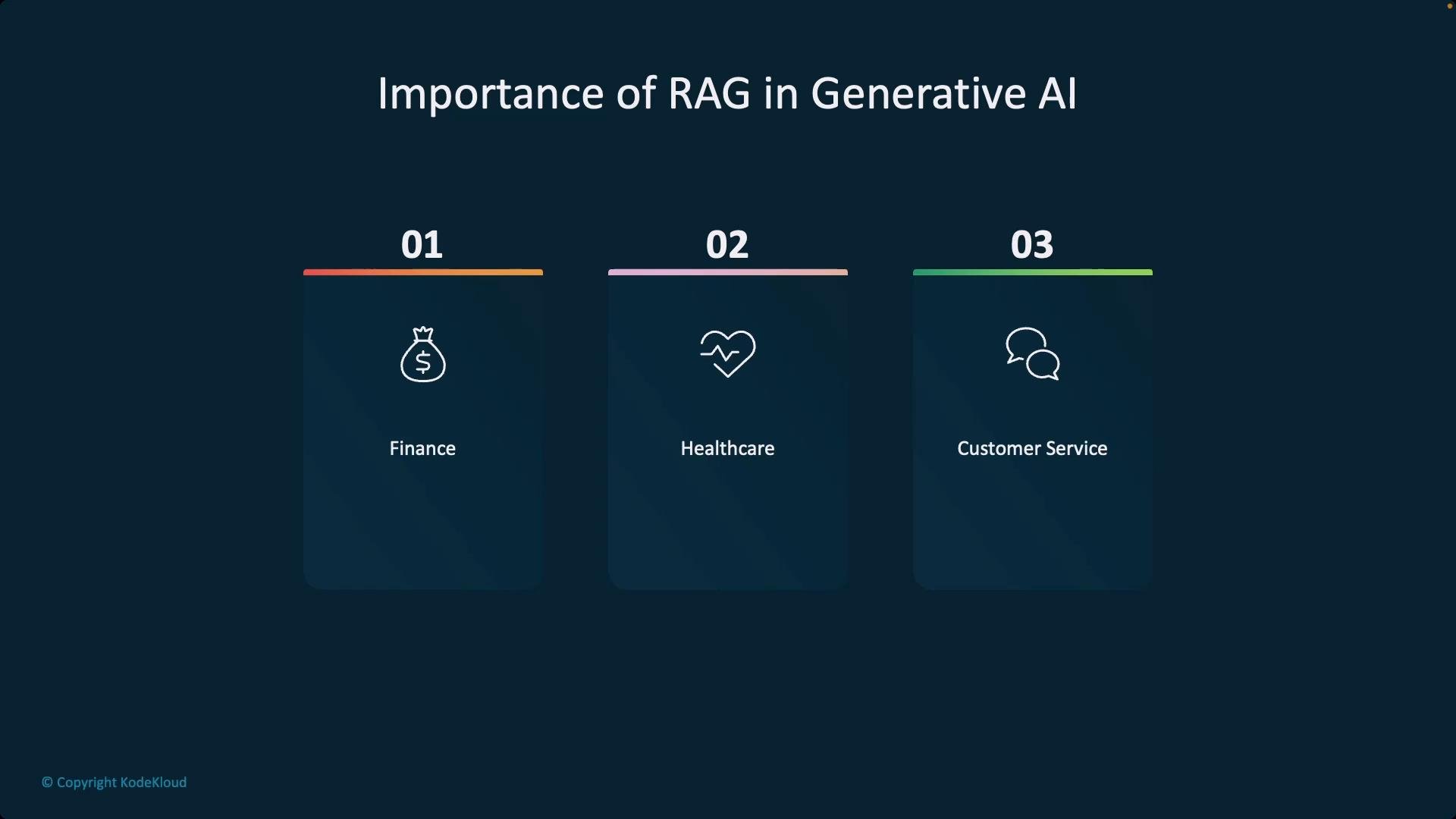
- Finance: up-to-date pricing, transaction histories, and regulatory disclosures.
- Healthcare: current clinical guidelines, patient records (with strict privacy controls).
- Customer service: order history, account status, product availability.
- Retrieval calls (vector search + index lookups) are generally much cheaper than retraining or continuously fine-tuning a large model.
- In enterprise contexts, you often prefer lower variance and higher grounding (deterministic answers tied to retrieved documents). Hyperparameters such as
temperaturestill influence randomness; combine low temperature with strong retrieval and grounding to minimize hallucinations. - Consider caching strategies and ROI: call a large model when the business value of improved accuracy exceeds token cost.
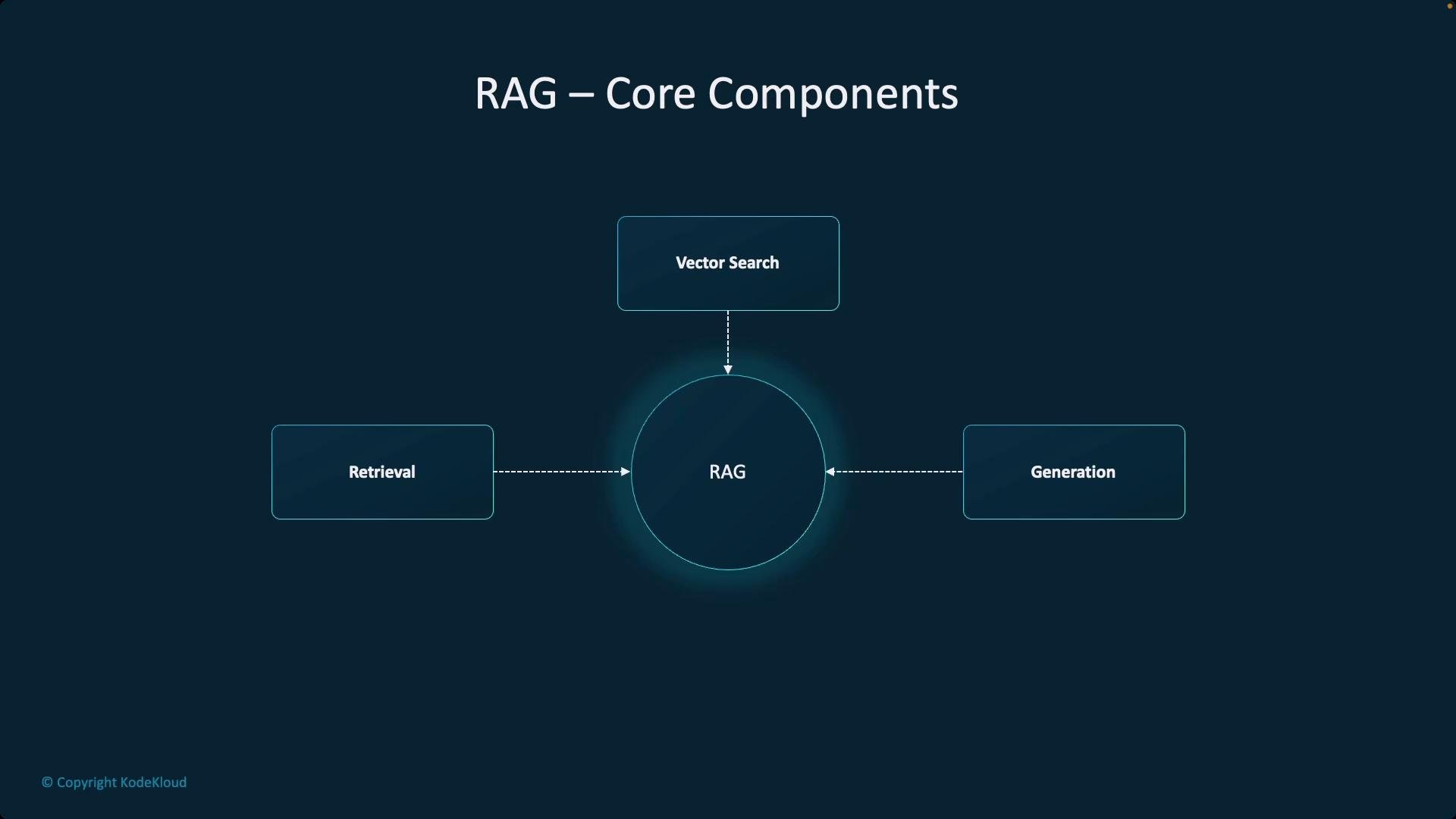
- Ingest & indexing (document parsing, chunking, embedding).
- Vector search / semantic retrieval (nearest neighbors over embeddings).
- Retrieval logic (reranking, filtering, applying business rules).
- Generator (LM that conditions on retrieved context).
- Orchestration (agentic decision-making, prompting templates, logging).
When retrieving personal or sensitive data, enforce strict access controls, auditing, and anonymization. Retrieval makes LLMs more powerful, but also increases exposure to sensitive information—plan governance accordingly.
- How to build an end-to-end RAG pipeline.
- Best practices for vector embeddings and index design.
- Retrieval strategies (dense vs sparse, reranking).
- Prompting, evidence grounding, and evaluation metrics for RAG systems.
- Kubernetes Documentation (for deploying components at scale)
- Docker Hub
- Terraform Registry
- Research on retrieval-augmented models and hybrid approaches.
- Vendor docs for vector databases and embedding models.