

Evolution of Retrieval-Augmented Generation (RAG)
Retrieval-Augmented Generation systems have rapidly evolved:- In a basic RAG setup, simple vector similarity is used for retrieval.
- Advanced RAG techniques, without graph structures, employ enhanced vector methods such as hybrid retrieval.
- Graph-RAG takes it a step further by integrating entity and relationship connections into a graph-based retrieval system. Each knowledge graph—often consisting of interconnected subgraphs—integrates nodes, entities, and their relationships to offer a more holistic context. This interconnected framework is essential for organizations managing vast datasets with limited internal links and is particularly useful for complex query processing, enhanced analysis, and better explainability through data source visualizations.
Graph-RAG not only improves retrieval accuracy but also offers a visual interface, allowing humans to validate and challenge data connections intuitively.
Advantages and Challenges
Advantages
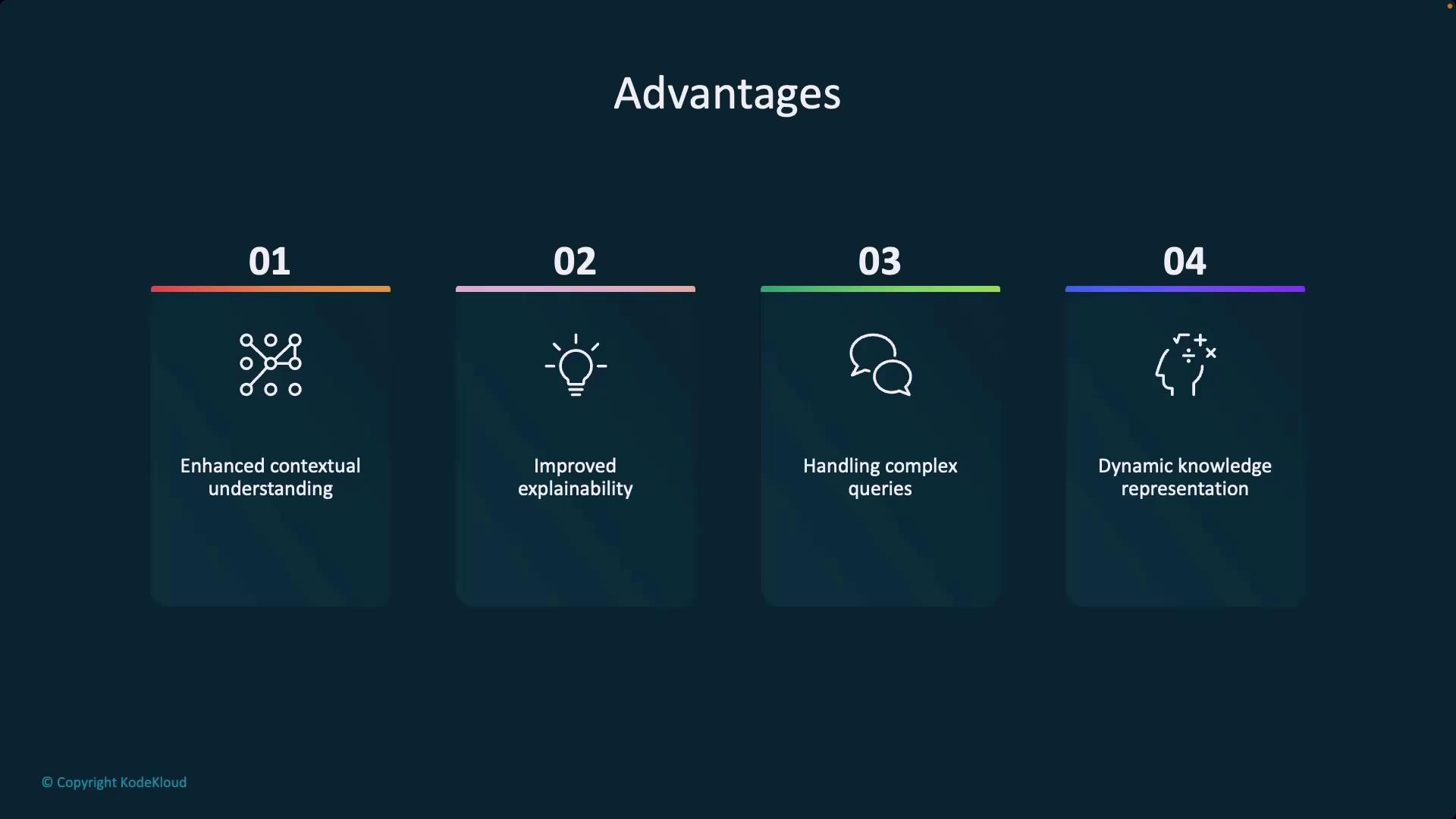
Graph-based retrieval offers several key benefits:Challenges
Implementing graph databases has its own set of challenges:- It can be complex and resource-intensive, requiring stringent data quality control.
- In environments with extensive document collections, PDFs, and rapidly evolving data, maintaining accurate graph connections necessitates continuous human oversight.
Integrating Real-Time Data with LLMs
In addition to graph enhancements, real-time data integration into RAG systems addresses the limitations of static retrieval methods. By incorporating techniques such as:- Query rewriting
- Embedding fine-tuning
- Dynamic embeddings
- Re-ranking and hybrid search
Looking Ahead
The next segment will demonstrate the deployment—or exploration of a near-enterprise level—Retrieval-Augmented Generation system. This practical session will showcase how the discussed concepts converge to form a robust, real-time data integration framework.