

- The
1.1in the (1,1) position increases recorded distance by 10% (compensating for how the sensor measures distance). - The
1/3in the (2,2) position scales height down by a factor of 3. The sensor’s maximum measurable height is 3 units, so dividing by 3 brings height into the range [0, 1], making it easier to combine with other sensor channels. - The
1in the (3,3) position leaves the movement channel unchanged.
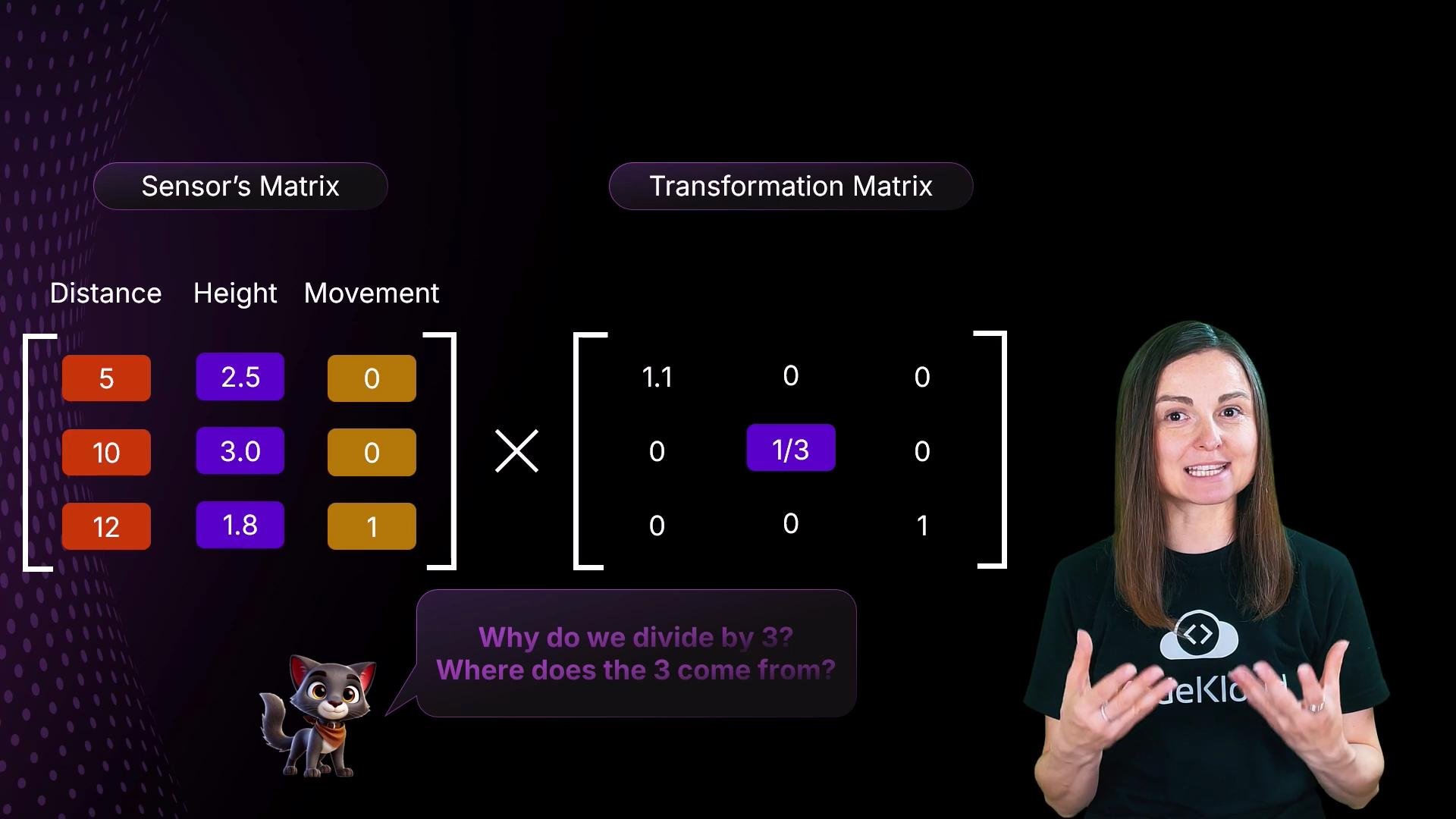
- First column (distance) multiplied by 1.1
- Second column (height) multiplied by 1/3
- Third column (movement) multiplied by 1
-
Row 1:
- distance: 5 × 1.1 = 5.5
- height: 2.5 × (1/3) = 0.833333…
- movement: 0 × 1 = 0
-
Row 2:
- distance: 10 × 1.1 = 11.0
- height: 3.0 × (1/3) = 1.0
- movement: 0 × 1 = 0
-
Row 3:
- distance: 12 × 1.1 = 13.2
- height: 1.8 × (1/3) = 0.6
- movement: 1 × 1 = 1
Each sensor can apply its own transformation matrix so that all sensors “see” the scene in a common scale and coordinate system after transformation. This is why linear algebra is so useful in sensor fusion and robotics.
Exactly!
Before we move on, a concise summary: matrix multiplication applies linear transformations (scales, rotations, or mixes of channels) to many datapoints at once. Diagonal matrices scale individual channels independently; non-diagonal matrices can mix channels.
Now consider the next complication: the vehicle itself is moving. Can you still trust the raw sensor readings?
As the car moves forward, distances to objects change and those objects can appear taller (closer objects take up more of the sensor’s view). If you don’t correct for the car’s motion, your map of the environment will be distorted.
Example scenario: the car detects two objects — a tree (further away) and a pedestrian (closer). The sensor stores its observations in a data matrix while the car’s motion is encoded in a movement matrix that describes how camera motion mixes the sensor channels. A non-zero off-diagonal entry (for example, 0.2) indicates some distance information leaked into the height measurement, making objects appear taller when the car moves.
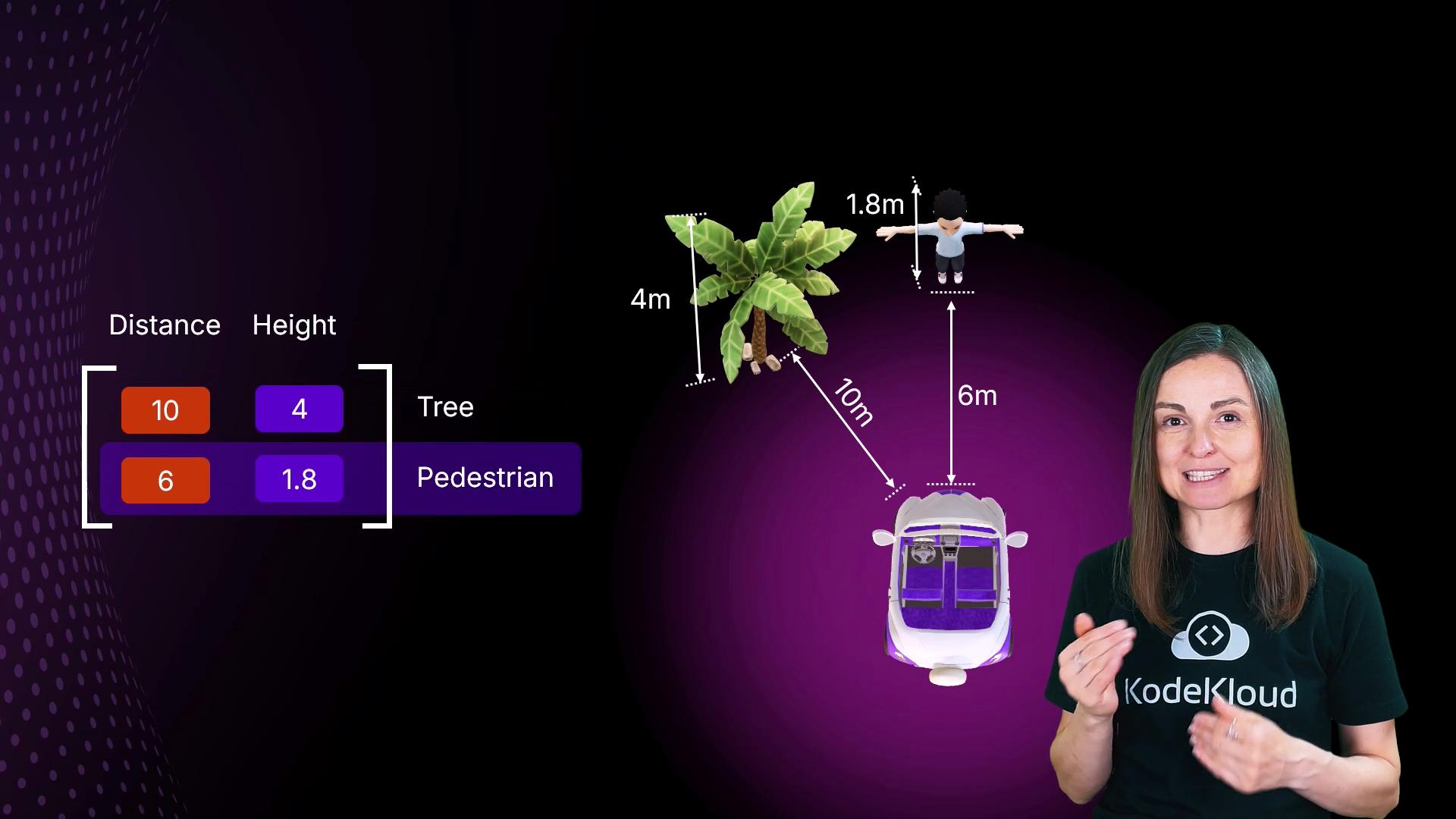
Diagonal transformation matrices scale each corresponding column of the data matrix; their inverse rescales columns back to the original units. For non-diagonal movement matrices, the inverse reverses how channels (distance, height, etc.) were mixed.
- Matrix multiplication — Wikipedia
- Matrix inverse — Wikipedia
- Introduction to linear algebra (concepts & applications)