

Phase 1 — Prefill: the model reads the entire prompt first
Before the model emits a single output token, it must process your entire prompt — every token you provided — in a single forward pass. All input tokens are read together; nothing is gradually “filled in” during this step.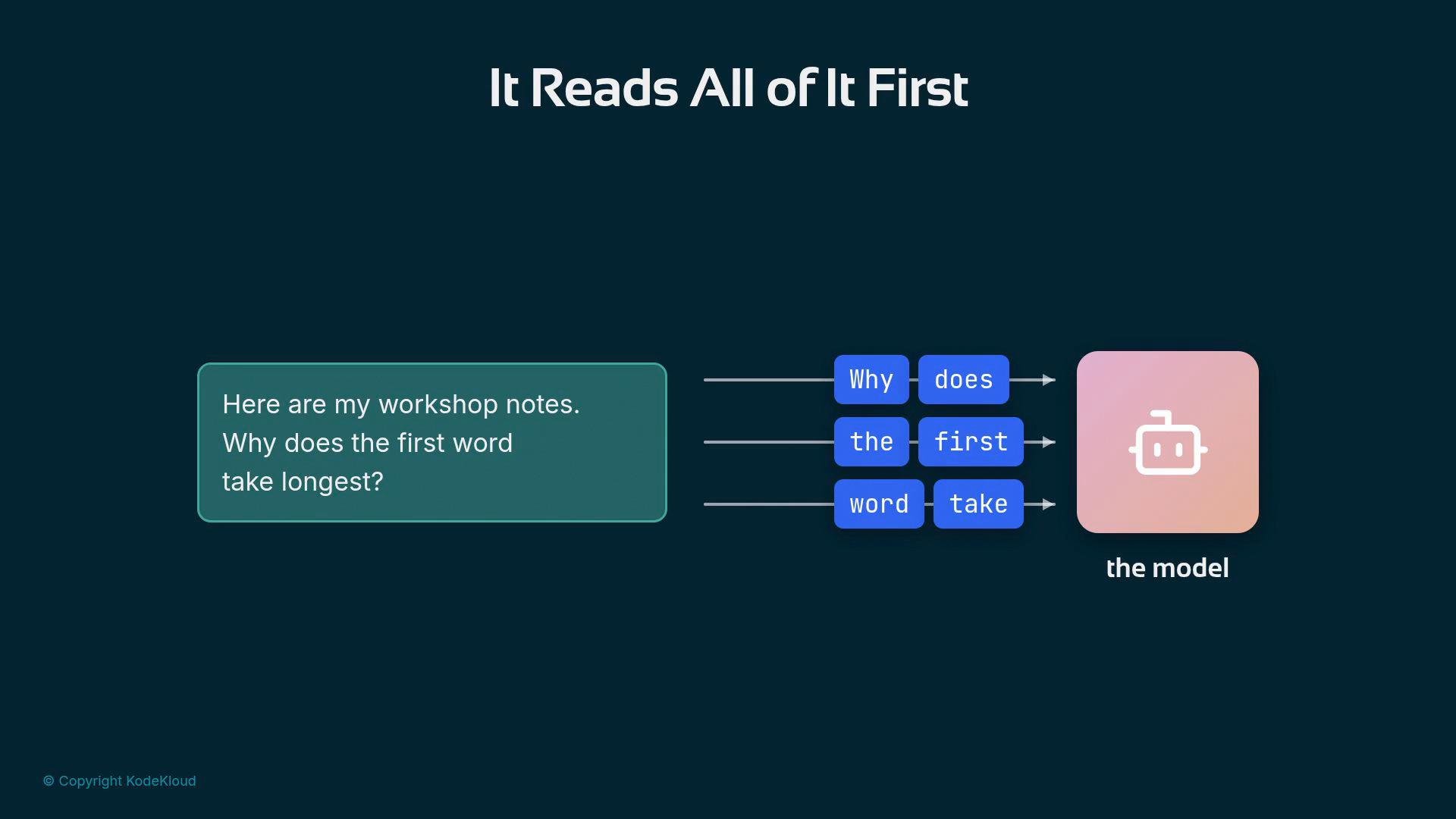
- The model weights and architecture are used to compute activations over the full input.
- Thousands of GPU cores (or equivalent accelerators) work in parallel to produce the intermediate state and the first output token.
- This single, highly-parallel compute burst determines how long you wait before seeing any output.
TTFT). Short prompts (e.g., “What’s the capital of France?”) are only a few tokens, so the prefill pass completes quickly and TTFT is small. Very long inputs (a multi-thousand-token contract or long document) require a much larger pass and create a noticeable pause before streaming begins.
The initial pause you observe when a model starts a response is mostly the prefill step. If you need to reduce perceived latency, reduce the context size or split input into smaller chunks so that the forward pass is faster and
TTFT drops.Phase 2 — Decode: the model writes the answer token-by-token
After prefill produces the first token, the model enters the decode loop: generating tokens one at a time. Each new token requires another pass through parts of the model, but this phase is fundamentally different in what limits performance.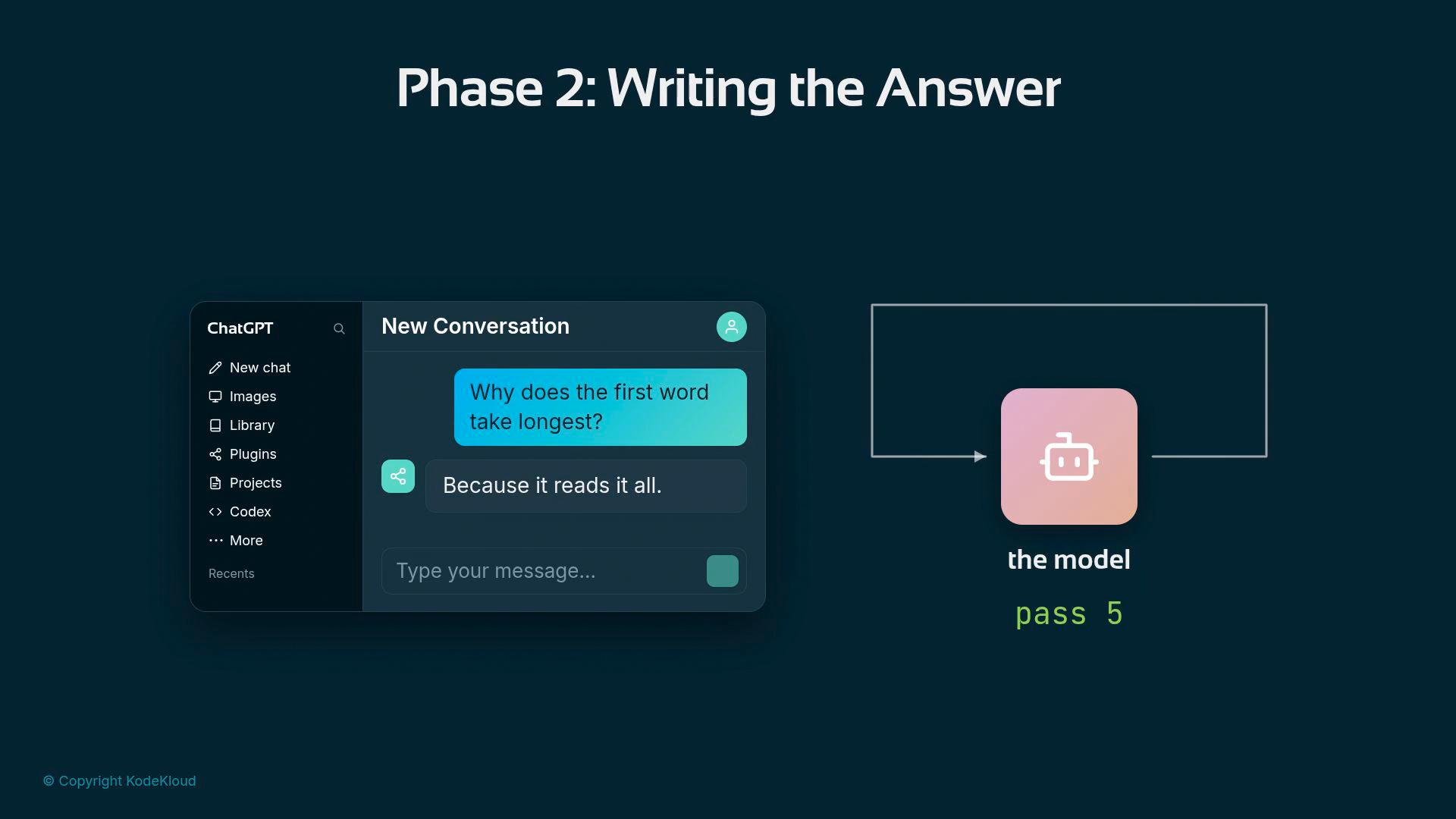
- The decoder uses the growing key/value cache (the
KV cache) to store intermediate attention states from earlier tokens for efficient autoregressive decoding. - For each new token, the GPU must repeatedly read model state (weights and the
KV cache) from VRAM. - Because the loop is iterative, many memory reads are repeated: generating N tokens involves repeated access to large model state for each iteration.
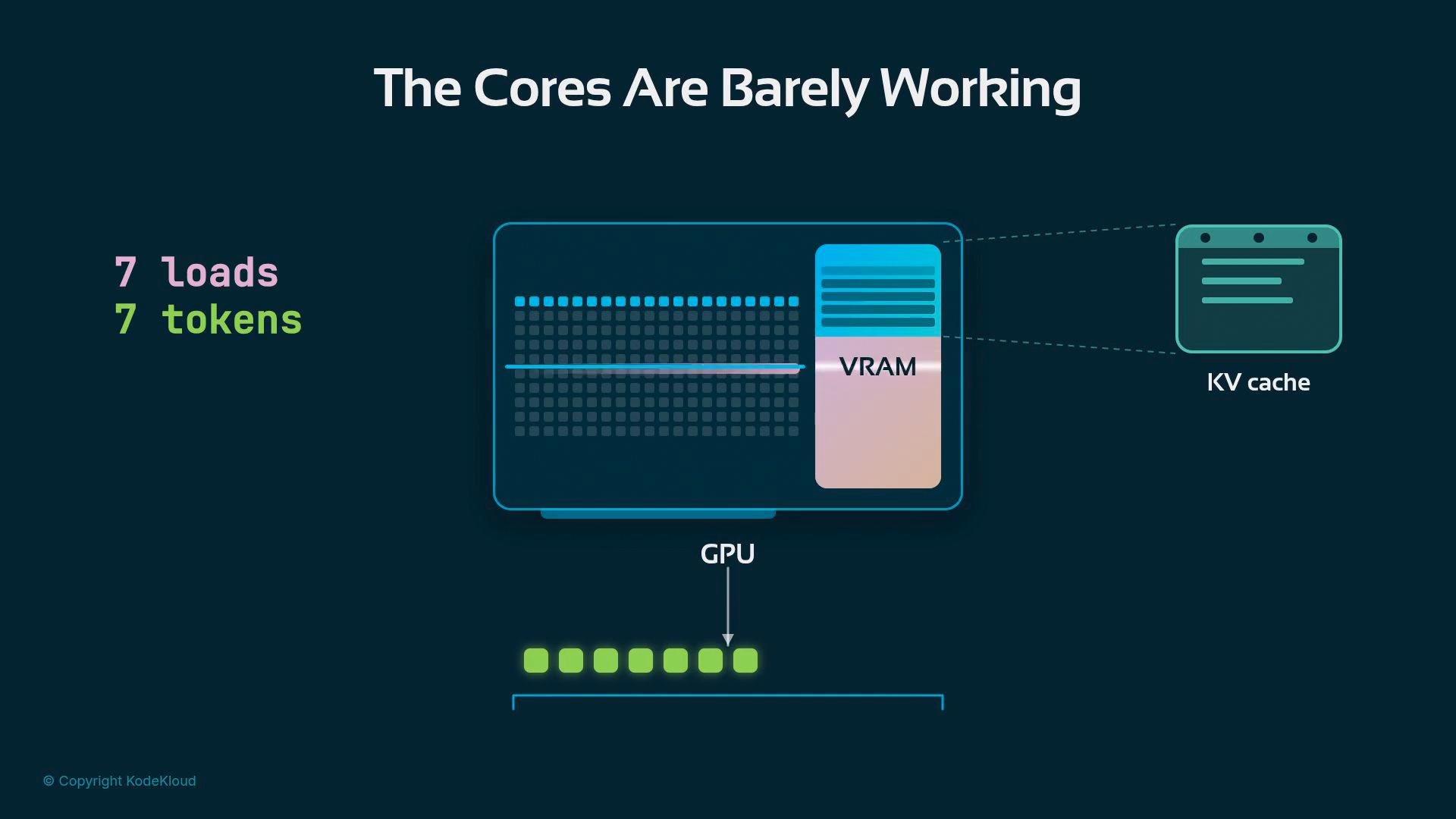
Decode is typically memory-bound: adding more compute cores alone won’t improve streaming rate if the GPU’s memory bandwidth is the bottleneck. For faster streaming, look to architectures or hardware with higher VRAM bandwidth or optimizations that reduce repeated memory reads (e.g., more compact KV representations or caching strategies).
Quick comparison
Practical takeaways
- The initial pause you notice is dominated by prefill and scales with the prompt size; keep context sizes reasonable when low latency is important.
- The steady streaming speed is set by the decode phase and often limited by GPU memory bandwidth and
KV cachebehavior. - Optimizations for lower latency will differ depending on which phase dominates: reduce context length to improve
TTFT; reduce memory access per token or increase memory bandwidth to improve steady-state throughput.
- ChatGPT — example of the familiar pause-then-stream behavior
- Memory bandwidth and GPU architecture discussions (search hardware vendor docs for specifics on
VRAMand bandwidth trade-offs)