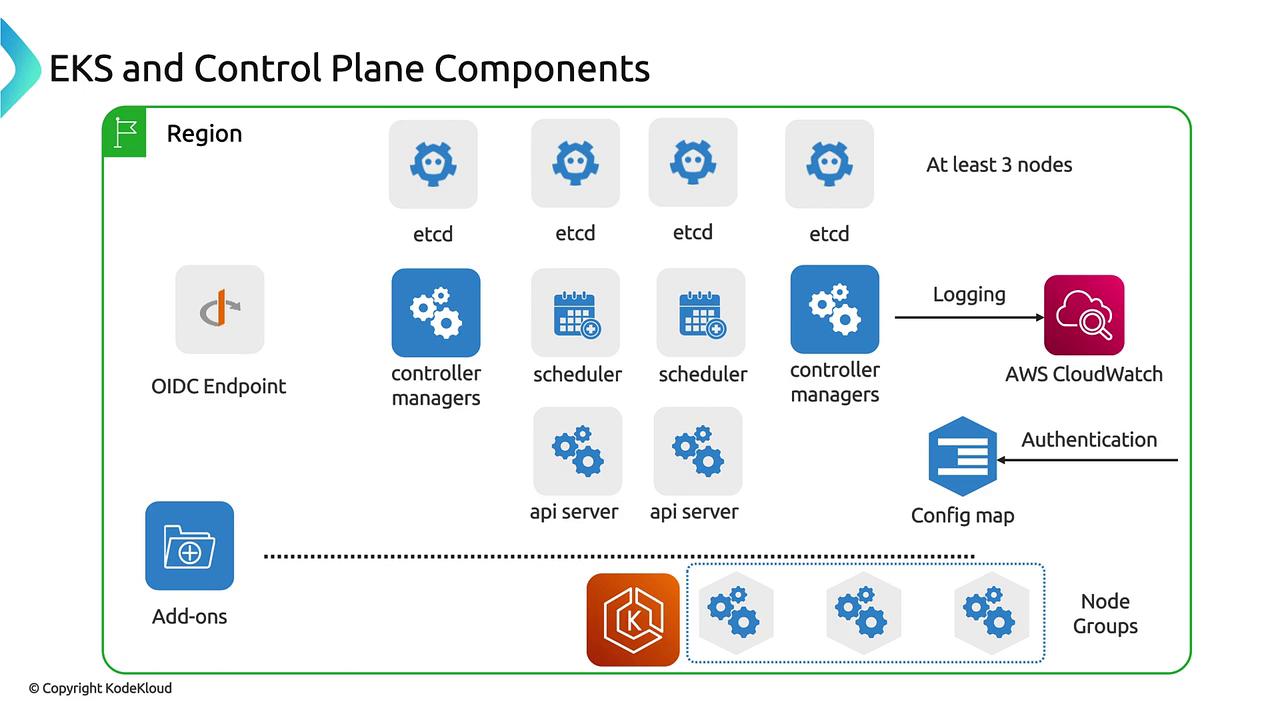
Kubernetes Control Plane Components
When you create an Amazon EKS cluster, AWS automatically sets up the core Kubernetes control plane, ensuring high availability and fault tolerance:Amazon EKS automatically manages patching, scaling, and failover for these control plane components so you can focus on deploying applications.
Regional and Availability Zone Distribution
Amazon EKS is a regional service. Each cluster’s control plane is distributed across at least three Availability Zones (AZs) to guarantee high availability:- Automatic Failover: If one AZ becomes unavailable, etcd maintains quorum (read-only until a new leader is elected), and API servers route traffic through healthy AZs.
- Cross-AZ Replication: AWS handles networking, latency optimization, and data replication between AZs without any additional configuration.
When deploying your own Kubernetes cluster, you’d need to configure multiple data centers, replicate etcd manually, and set up API servers, controllers, and schedulers across zones. EKS eliminates this operational overhead.
AWS-Specific Control Plane Integrations
Beyond the standard Kubernetes control plane, EKS includes built-in AWS integrations to streamline authentication, logging, and access control:
For more details, see the Amazon EKS User Guide.
EKS Data Plane Extensions
EKS extends the Kubernetes API with custom resources and services in your AWS account, handling your workloads and cluster add-ons:
These data plane components reside within your AWS account, giving you control over scaling, updates, and monitoring.