

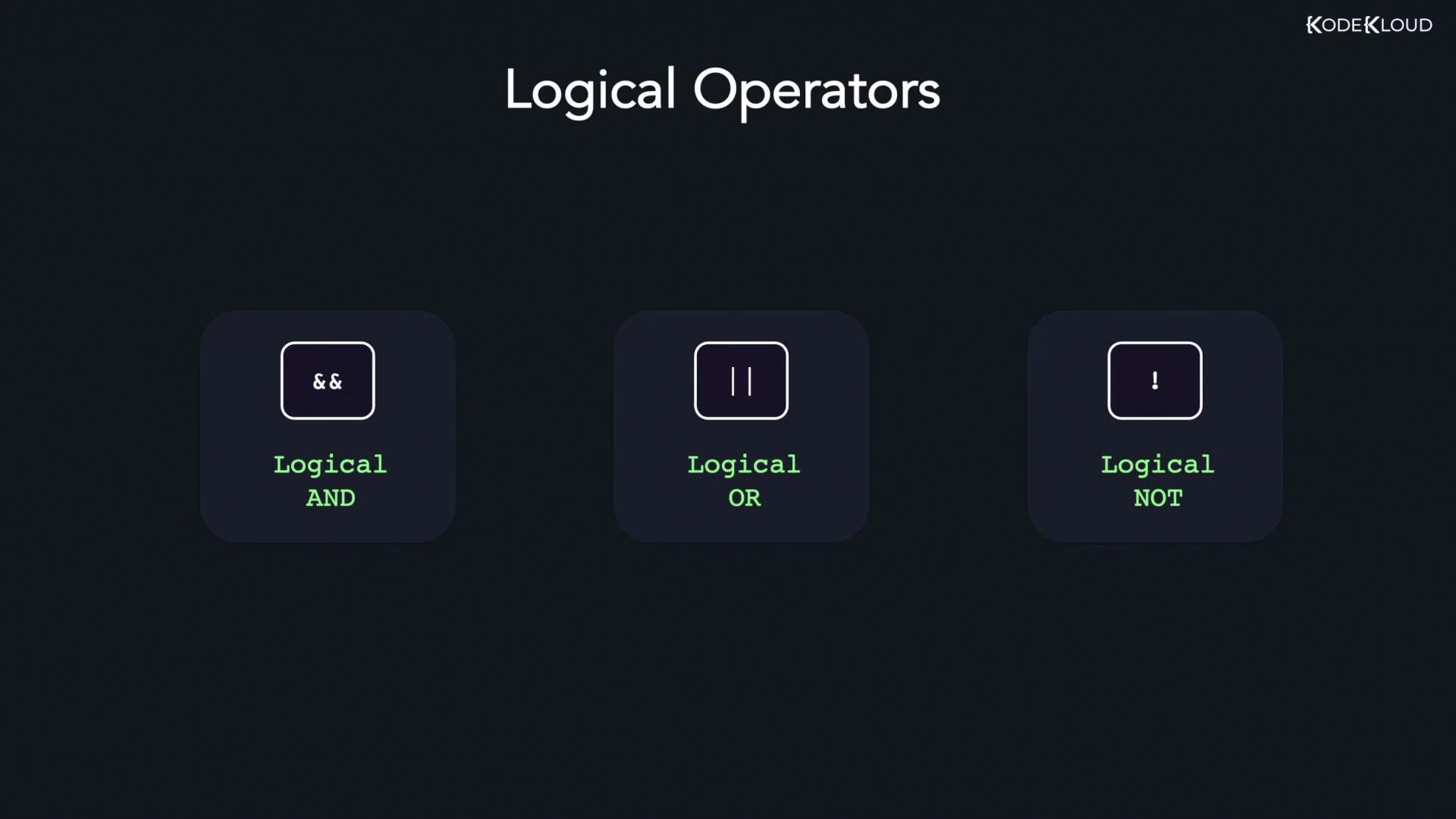
Logical operators are fundamental in programming as they allow developers to construct complex logical statements by combining simpler Boolean expressions.
AND Operator (&&)
The AND operator, represented by two ampersand symbols (&&), returns true only when both operands are true. If either condition is false, the overall expression evaluates to false.Example
OR Operator (||)
The OR operator is denoted by two vertical bars (||) and returns true if at least one of the expressions is true. It only yields false when both expressions are false.Example
x < 200 is true, resulting in a true expression. In the second print statement, both conditions evaluate to false, so the overall result is false.
NOT Operator (!)
The NOT operator is a unary operator represented by the exclamation mark (!) that inverts the Boolean value of an expression. In other words, if an expression evaluates to true, applying the NOT operator will change it to false, and vice versa.Example
x > y is false because 10 is not greater than 20. The NOT operator inverts the false value to true. Similarly, using the NOT operator on true results in false and on false results in true.
Understand how logical operators can be combined to form more complex conditions in your programs, making your code more dynamic and efficient.