

Do not store large media blobs in your primary database. Databases are optimized for structured data and transactional consistency—not for serving high-bandwidth binary assets. Use object storage + CDN instead.
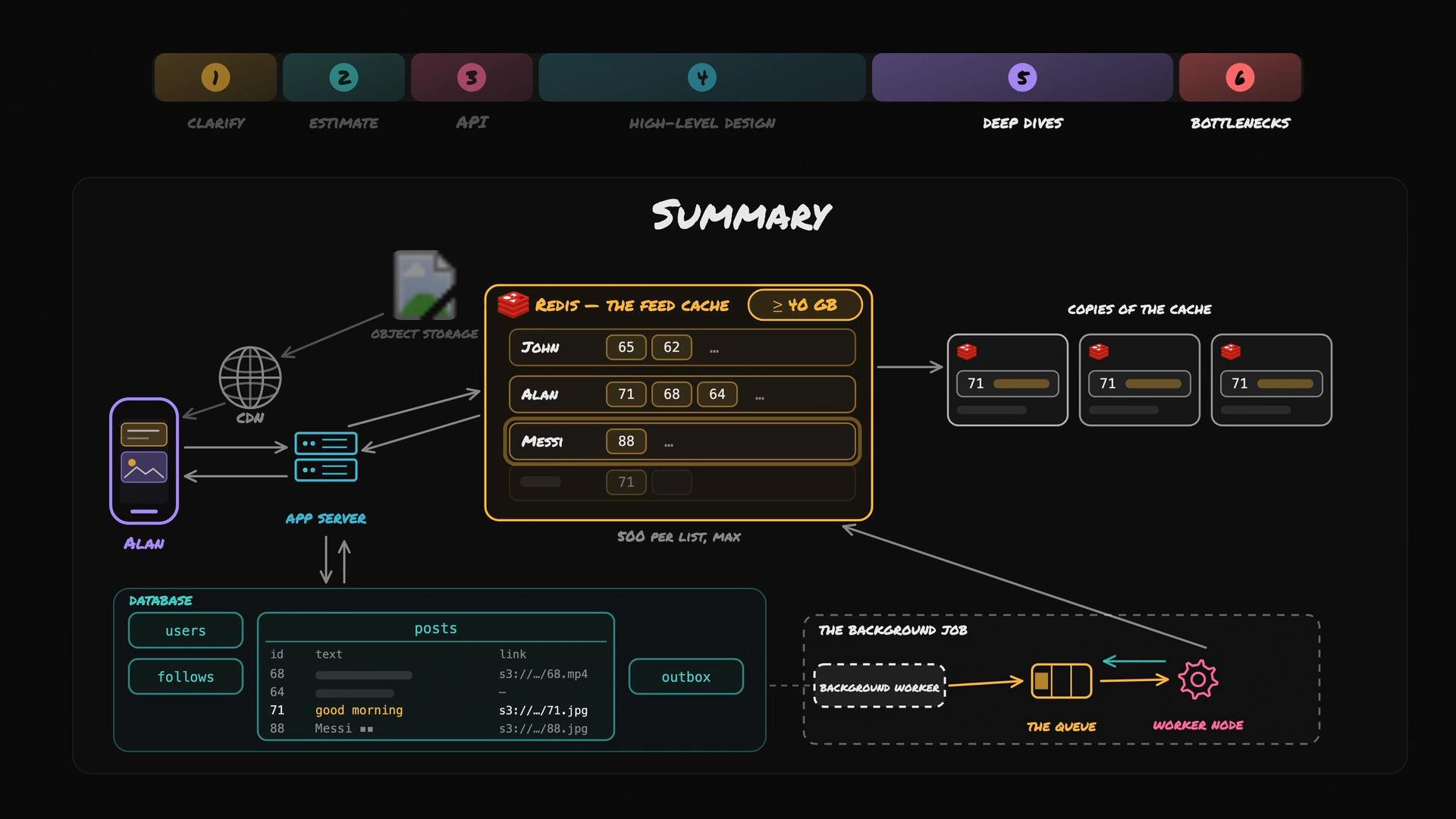
- Client uploads the image/video to an object store (for example, Amazon S3).
- The object store is fronted by a CDN which caches and accelerates delivery to end users.
- The app, feed caches, and the client all use the CDN URL to load the media.
- The database stores only the media URL(s), never the binary.
- The second-level post cache stores these same URLs so the caches and DB never carry the heavy binary payloads.
Handling viral posts and extreme read load
A viral post creates a concentrated, heavy read hotspot. If that post’s cache entry is only on a single cache node, that node becomes a bottleneck. Strategies to handle viral traffic:
- Replicate hot cache entries across multiple cache instances, or use a distributed cache that automatically replicates hot keys.
- Load-balance read requests across those cache copies.
- Offload bulk media delivery to the CDN so application and cache nodes are not overwhelmed.
- For normal users:
- Fan-out on write (push): When a user posts, we push the post ID into each follower’s Redis feed list via background workers.
- Each Redis list retains up to a configured limit (e.g., 500 IDs) to bound memory.
- For celebrities / high-follower-count users:
- Avoid pushing to millions of followers at write-time (write amplification).
- Use a hybrid push/pull model: keep a precomputed feed for the ordinary follower set, but pull recent celebrity posts at read-time and merge them in.
- For inactive users:
- Do not precompute feed lists. Build their feed on demand when they return.
Celebrity / high-follower model (read-optimized)
- At read time, the GetFeed API:
- Reads the user’s precomputed Redis list.
- Fetches post objects from the second-level cache.
- Pulls recent posts from celebrities the user follows (on-demand).
- Merges precomputed posts + pulled celebrity posts, sorts them, and returns top N (e.g., 50) to the client.
- Do not allocate cache/list resources for rarely active users.
- When they return, build their feed on demand (pull + merge).
Design tips:
- Store only media URLs in your DB and caches; never the binaries.
- Serve media via object storage + CDN for scalability and low latency.
- For viral posts, replicate hot cache entries or use an auto-replicating distributed cache to avoid single-node hotspots.
- Apply a hybrid fan-out/fan-in strategy for celebrity accounts to limit write amplification while keeping feed reads fast.