

How it works
- Each user (or client) has a bucket that holds up to 100 tokens.
- Each API request consumes one token (or a configurable
cost). - The bucket refills continuously at 100 tokens per minute (100 / 60 ≈ 1.67 tokens/s).
- Tokens stop accumulating once the bucket reaches its capacity (100 tokens).
- If the bucket has insufficient tokens when a request arrives, the request is rejected with HTTP 429 (Too Many Requests).
Example behavior
- If Alan makes 100 requests back-to-back, he can drain the bucket almost instantly.
- Immediately after the burst, tokens will replenish at ≈1.67 tokens/sec, allowing him to continue making requests at the sustained rate (roughly 1–2 calls/sec).
- The token bucket never fully locks a user out — tokens keep replenishing, and requests can resume as soon as enough tokens accumulate.
Properties and guarantees
- The token bucket does not enforce a strict ceiling of 100 requests per rolling 60-second window. If a bucket is full, a user can spend all 100 tokens at once (explicit burst).
- It guarantees a sustained refill rate of 100 tokens/minute.
- Burst capacity is explicit and configurable via the bucket size (e.g., reduce capacity to 20 tokens for a smaller allowed burst while keeping the same refill rate).
- For each user we store the minimal state needed to compute token availability at any moment — the current token count and the timestamp of the last refill.
What we store per user
This state is compact — typically on the order of tens of bytes per user.
Comparison to other approaches
Responses and headers
- When a user exceeds available tokens, return:
- HTTP 429 (Too Many Requests)
Retry-Afterheader with seconds to wait (or an estimated time until tokens are available)- Optionally:
X-RateLimit-Remainingto show available tokens
Retry-After (for a request that costs 1 token)
- If
tokens >= 1, allow immediately. - Otherwise:
seconds = ceil((1 - tokens) / REFILL_PER_SEC).
Basic refill/check logic (Python example)
- Uses fractional tokens so refills are continuous.
- Updates
last_refillonly on refill/check to minimize write churn. - Exposes a
retry_after_secondshelper to populateRetry-Afterheaders.
Deployment notes and distributed considerations
- Single gateway: token-bucket state can be stored in memory on one instance.
- Horizontally scaled gateways: when requests for the same user hit different instances, you must keep state consistent. Common strategies:
- Centralized store (e.g., Redis) to store tokens and timestamps atomically.
- Sticky routing (consistent hashing) so a user is routed to the same gateway instance.
- Best-effort synchronization or probabilistic algorithms (less strict, but simpler and faster).
- When using Redis, prefer commands that perform read-modify-write atomically (e.g., Lua scripts or Redis tokens implementation) to avoid race conditions.
Practical headers and client guidance
- Return these headers to help clients:
X-RateLimit-Limit: 100(configured capacity or sustained rate)X-RateLimit-Remaining: <tokens>(fractional value is acceptable)Retry-After: <seconds>when returning 429
- Encourage clients to back off (exponential or jittered) when they receive 429 and to use
X-RateLimit-Remainingto pace requests.
Token bucket advantages:
- Allows explicit bursts while enforcing a long-term rate.
- Continuous refill avoids hard lockouts and lets clients resume as soon as tokens accumulate.
- Easy to report remaining capacity to clients via response headers.
Summary
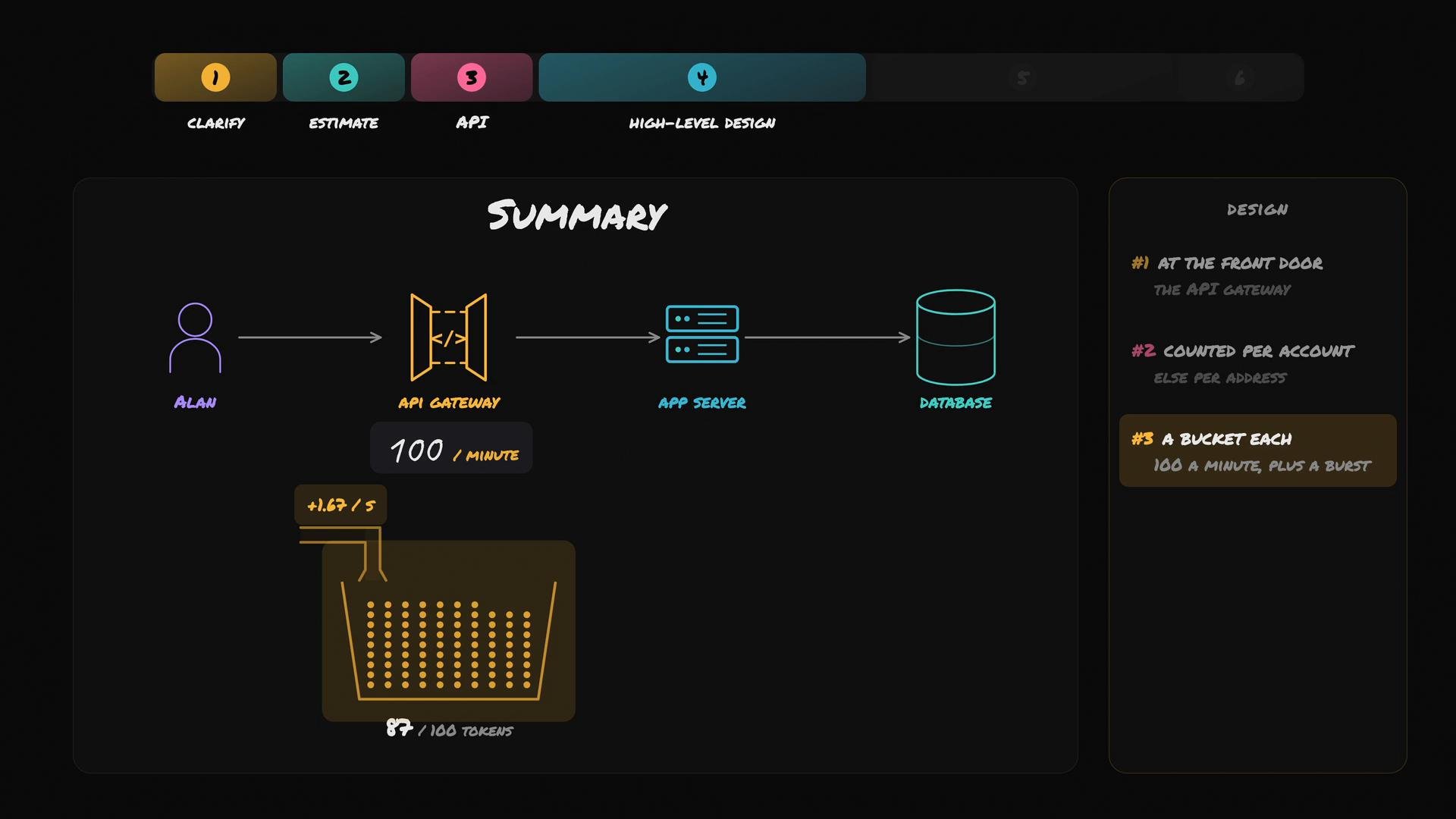
- Implement rate limiting at the API gateway (front door).
- For authenticated users, rate-limit per-account; for unauthenticated traffic, consider per-IP limits.
- Each user/account receives a token bucket that enforces a sustained rate of 100 requests/minute and allows bursts up to the bucket capacity (100 tokens).
- When tokens are exhausted, return 429 with helpful headers (
Retry-After,X-RateLimit-Remaining).
Next topic
How do we keep token buckets consistent when traffic for the same user lands on multiple gateway instances? Next we will explore distributed strategies: centralized stores (Redis), sticky routing, and best-effort synchronization.Links and references
- Redis — common choice for centralized counters and token buckets
- RFC 6585 — 429 Too Many Requests
- Rate Limiting Patterns and Practices