

- A reproducible framework to structure interview responses.
- Practical heuristics for making trade-offs under time pressure.
- Hands-on experience implementing common building blocks used in interviews.
- Sample solutions for common interview problems like URL shorteners and news feeds.
Six-step Framework
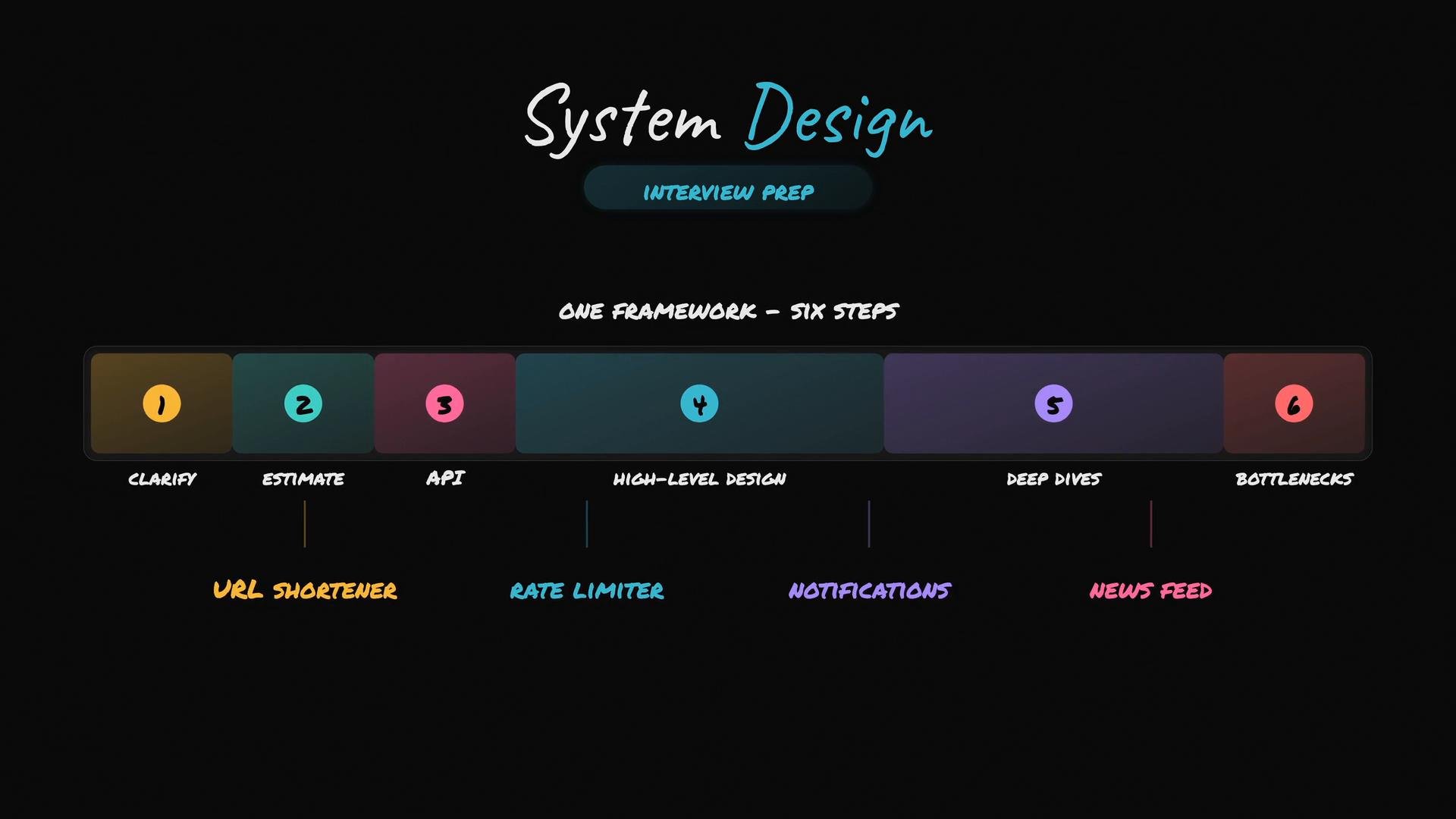
We use a six-step framework that helps you move from vague problem statements to concrete designs you can explain confidently in interviews:
Use the framework as a checklist during interviews: ask clarifying questions first, then estimate to show you can reason numerically, define APIs so your design has a contract, draw a high-level system diagram, deep dive into the most important components, and finish by discussing bottlenecks and mitigations.
Common interview systems covered
- URL Shortener
- Rate Limiter
- Notifications Service
- News Feed / Timeline
Hands-on Labs
You will complete four practical labs that reinforce the course concepts and give you implementation experience with typical interview building blocks:- Implementing a basic URL shortener service (API, data model, storage).
- Building a distributed rate limiter (token bucket, counters, and storage).
- Designing a notification delivery pipeline (push vs pull strategies).
- Creating a simplified news feed pipeline (fan-out vs fan-in approaches).
Study tips: Practice the six-step framework aloud. Use a whiteboard (or a digital notepad) to sketch high-level diagrams quickly. Timebox each framework step in mock interviews to simulate real constraints.
Interview warning: Interviewers expect trade-off rationale. When you choose a component (e.g., SQL vs NoSQL, cache eviction policy), explain why that choice fits the constraints you established during Clarify and Estimate.
How to use this lesson
- Start by learning the framework; then apply it to one sample problem end-to-end.
- Complete a lab after each topic to reinforce concepts.
- In mock interviews, narrate your thought process and explicitly follow the framework steps.
Links and References
- Grokking the System Design Interview
- Designing Data-Intensive Applications — Martin Kleppmann
- System Design Primer (GitHub)