

- Database
- CloudNativePG operator — a PostgreSQL operator to run stateful Postgres clusters on Kubernetes.
- Observability
- Kubetail — a utility to tail logs from multiple pods at once for live troubleshooting.
- Kube Prometheus Stack — a bundled observability stack (Prometheus, Alertmanager, Grafana, exporters, and default dashboards) for metrics collection and visualization.
- Continuous delivery
- Argo CD — a GitOps continuous delivery tool to deploy and sync Kubernetes manifests from Git repositories.
- Analytics (namespace-scoped)
- QuickWit — an analytics package that we’ll deploy scoped to a single namespace.
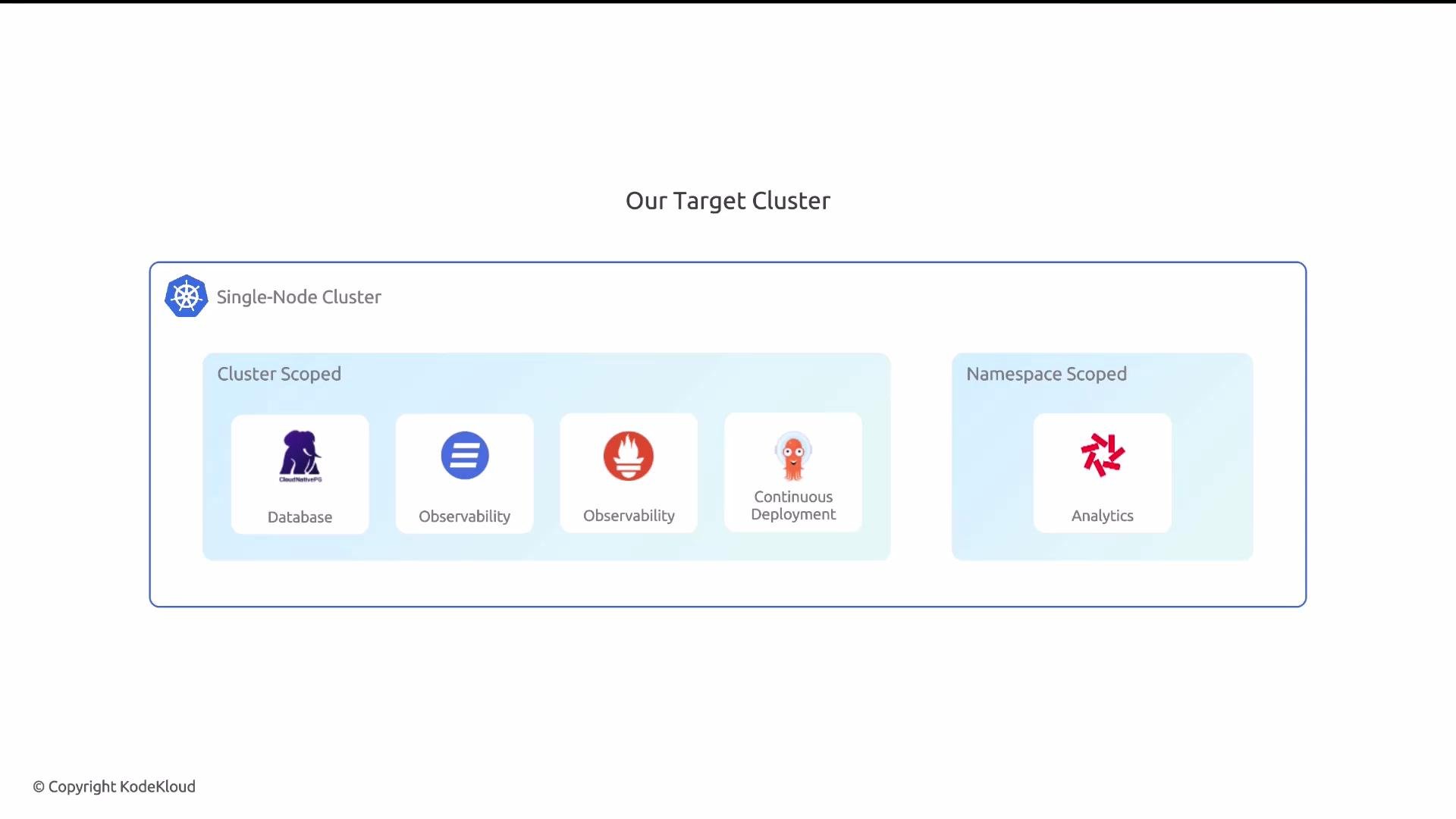
You’ll receive credentials to access the single-node cluster for hands-on exercises. During the lesson we’ll install each package in turn, verify basic functionality, and point out any scope-specific configuration (cluster vs namespace).
Cluster-scoped installs typically require elevated permissions (cluster-admin or equivalent). Ensure you run cluster-scoped commands with the appropriate context and credentials to avoid permission errors.
- We will provision and configure the cluster components in the following logical order:
- Observability (Kube Prometheus Stack) — get metrics and dashboards running early so you can monitor installs.
- Continuous delivery (Argo CD) — install GitOps tooling to manage subsequent manifests.
- Database (CloudNativePG) — provision stateful Postgres after operators are available.
- Observability utility (Kubetail) — use for troubleshooting during other installs.
- Namespace-scoped analytics (QuickWit) — deploy last into its own namespace to demonstrate scoped installs.
- Kubernetes Documentation
- CloudNativePG
- Kube Prometheus Stack (prometheus-operator)
- Argo CD
- QuickWit
- Kubetail repository