

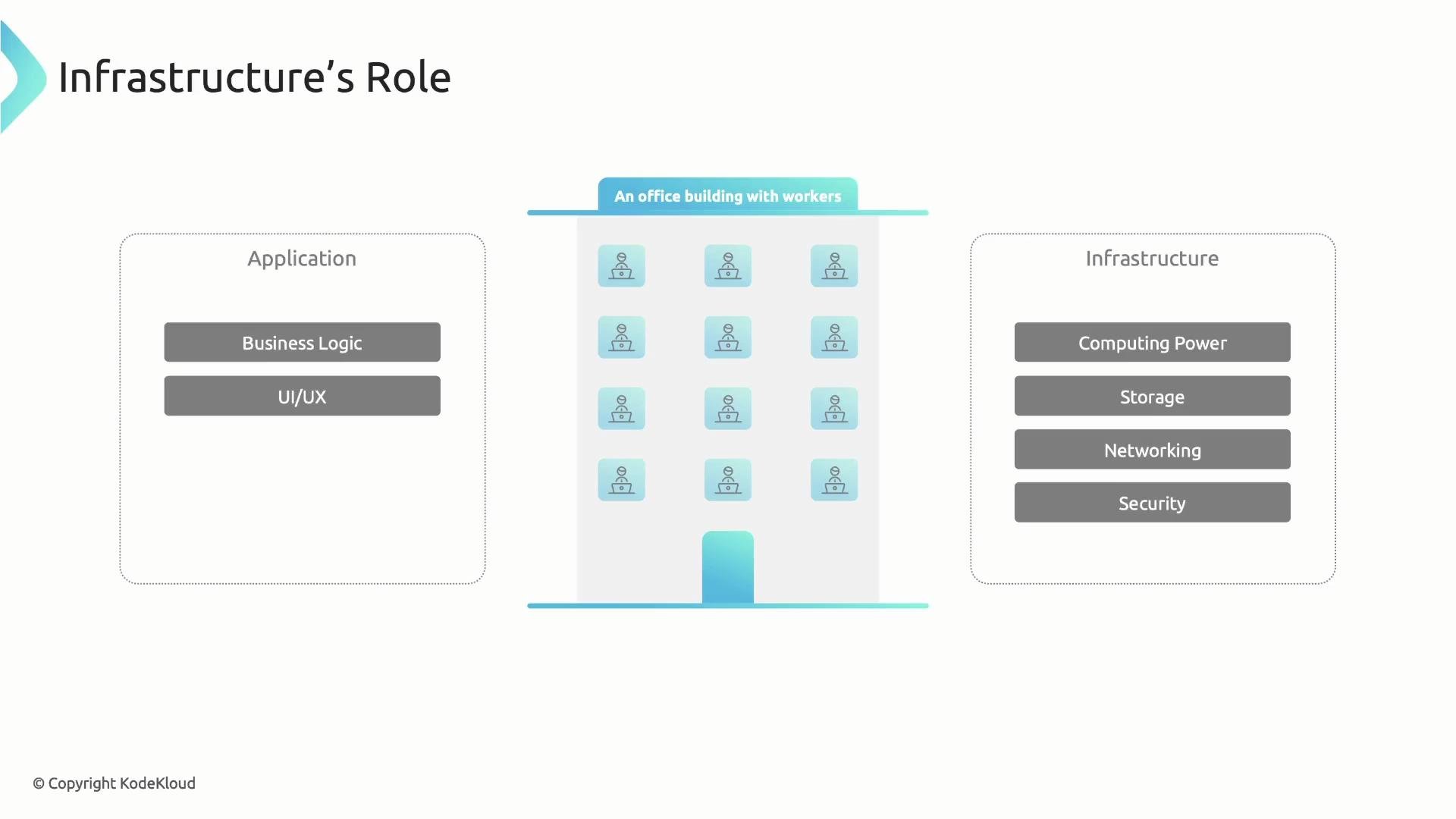
- The building itself—the walls, rooms, power supply, heating/cooling, and network cabling—represents the infrastructure.
- The people who work inside the building, who perform tasks, collaborate, and deliver value, represent the applications (and teams) that run on that infrastructure.
What infrastructure provides
Infrastructure delivers the runtime, capacity, connectivity, and protections that enable applications to operate reliably and securely. Common infrastructure responsibilities include:- Compute resources (virtual machines, containers, serverless functions)
- Storage (object storage, block storage, file systems)
- Networking (VPCs, subnets, routing, DNS, load balancers)
- Identity and access management (IAM, service principals)
- Security (network policies, encryption, firewalls)
- Observability and telemetry (logging, metrics, tracing)
- Resilience and backups (replication, snapshots, disaster recovery)
Key takeaway: Well-designed and correctly configured infrastructure is the foundation that enables applications to deliver value reliably, securely, and efficiently—just as a well-designed office supports productive work.
Quick comparison: Office analogy vs. Cloud infrastructure
Examples of infrastructure components
Why the distinction matters
Understanding the separation between application and infrastructure helps teams:- Design scalable and resilient architectures
- Choose appropriate managed services vs. self-hosted solutions
- Apply security and compliance controls at the right layer
- Automate delivery and infrastructure through Infrastructure as Code (IaC)