


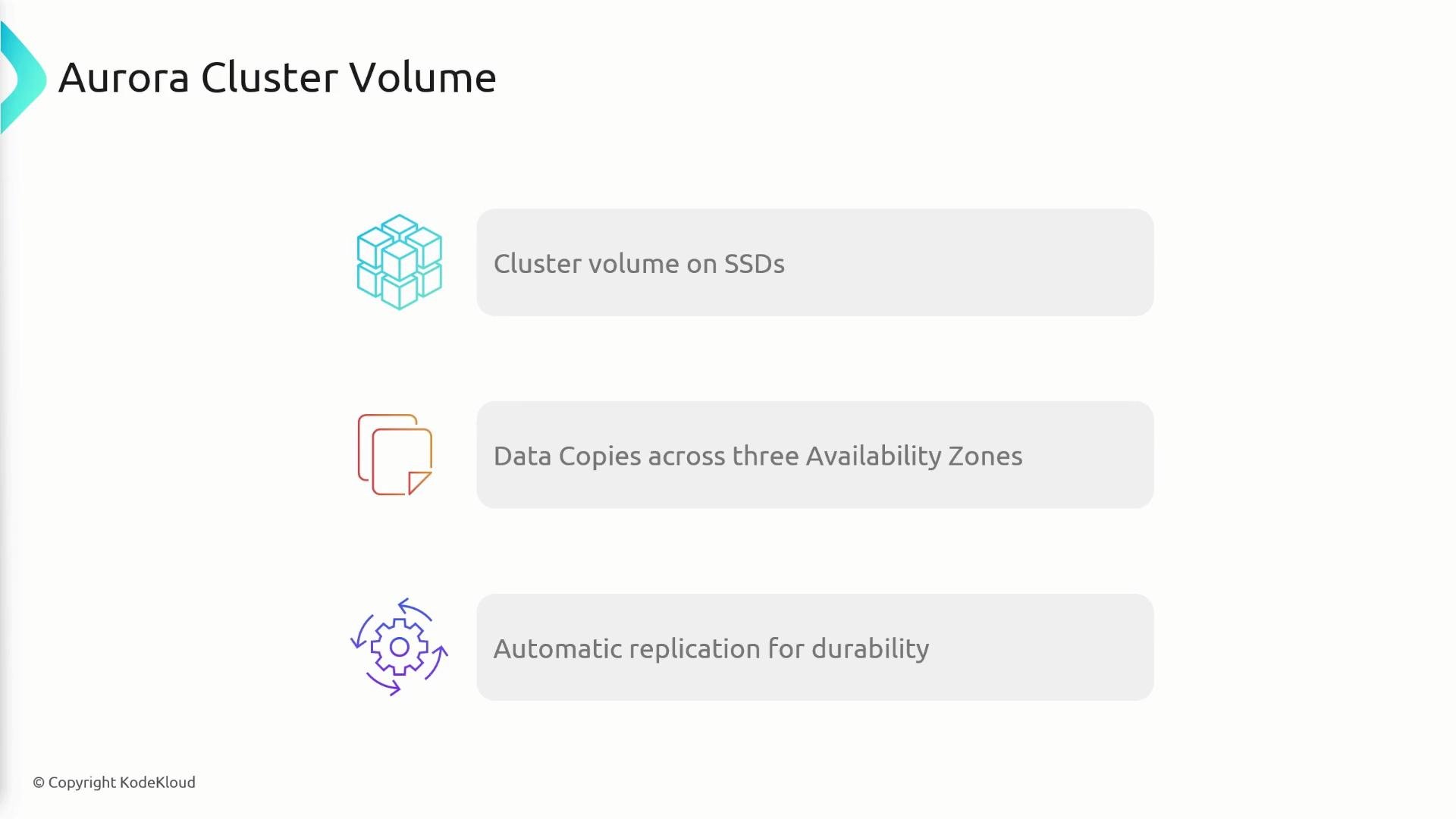
- Data is replicated across three Availability Zones (AZs) by default.
- Aurora keeps six copies of your data (two copies per AZ).
- Storage is decoupled from compute, automatically managed, and scales up to 128 TB per cluster.
- The storage layer is SSD-backed and continuously scans/repairs blocks and disks (self-healing).
Aurora is fully managed and optimized for high performance, but that often comes at a higher cost than a comparable standard managed relational instance. Evaluate performance needs and budget before migrating.
- Primary (writer) instance: a single primary handles writes and can also serve reads. It performs data modification operations against the shared cluster volume.
- Reader (replica) instances: up to 15 read-only replicas can serve read traffic and help scale read-heavy workloads.


- Single, distributed storage layer for the entire cluster.
- Automatically managed and provisioned by Aurora; you do not directly manage SSDs or volume allocation.
- Auto-scaling storage up to 128 TB per cluster.
- Data copies across three AZs (two copies per AZ), providing durability and protection if an AZ fails.
- Cluster (writer) endpoint: routes write traffic to the current primary instance.
- Reader endpoint: load-balances read-only connections across available replicas.
- Instance endpoints: direct connections to a specific instance (primary or replica).
- Custom endpoints: route specific workloads (for example, read-only workloads with higher-memory replicas) to a defined subset of instances.
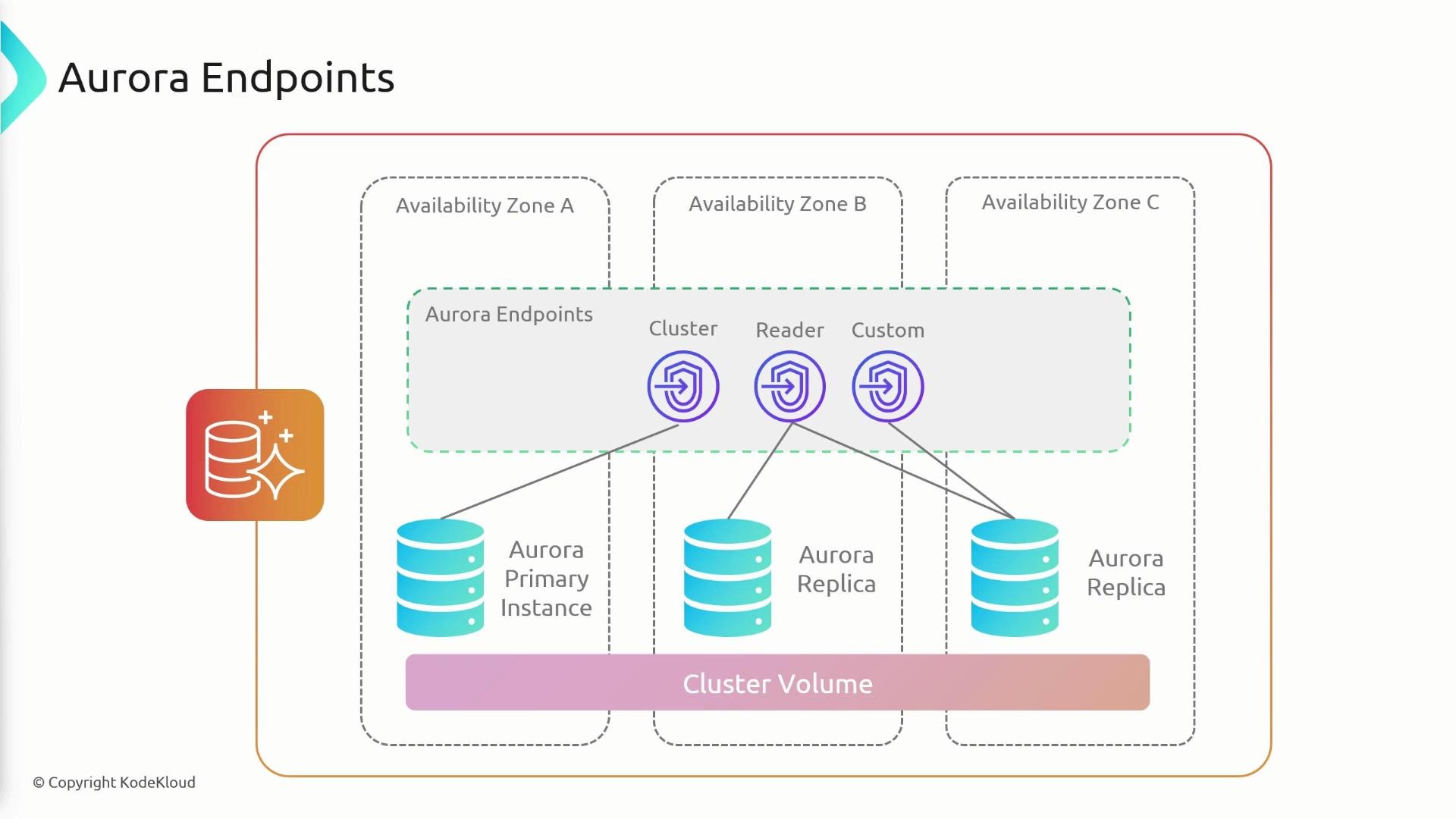
Use the writer (cluster) endpoint for all write operations and the reader endpoint to distribute read traffic. Custom endpoints are ideal for directing specific workloads to instances with different instance classes or resource profiles.
- Amazon Aurora is a fully managed, high-performance relational database compatible with PostgreSQL and MySQL.
- AWS claims up to 5× MySQL and 3× PostgreSQL throughput for Aurora.
- Data is replicated across three Availability Zones with six copies (two per AZ) for durability.
- Clusters have one primary (writer) instance and up to 15 read-only replicas.
- The cluster volume spans multiple AZs, is SSD-backed, auto-scales (up to 128 TB), and self-heals.
- Use the writer (cluster) endpoint for writes and the reader endpoint to distribute read traffic across replicas.

- Amazon Aurora documentation: https://docs.aws.amazon.com/aurora/latest/userguide/CHAP_AuroraOverview.html
- Amazon RDS documentation: https://docs.aws.amazon.com/rds/index.html
- MySQL: https://www.mysql.com/
- PostgreSQL: https://www.postgresql.org/