

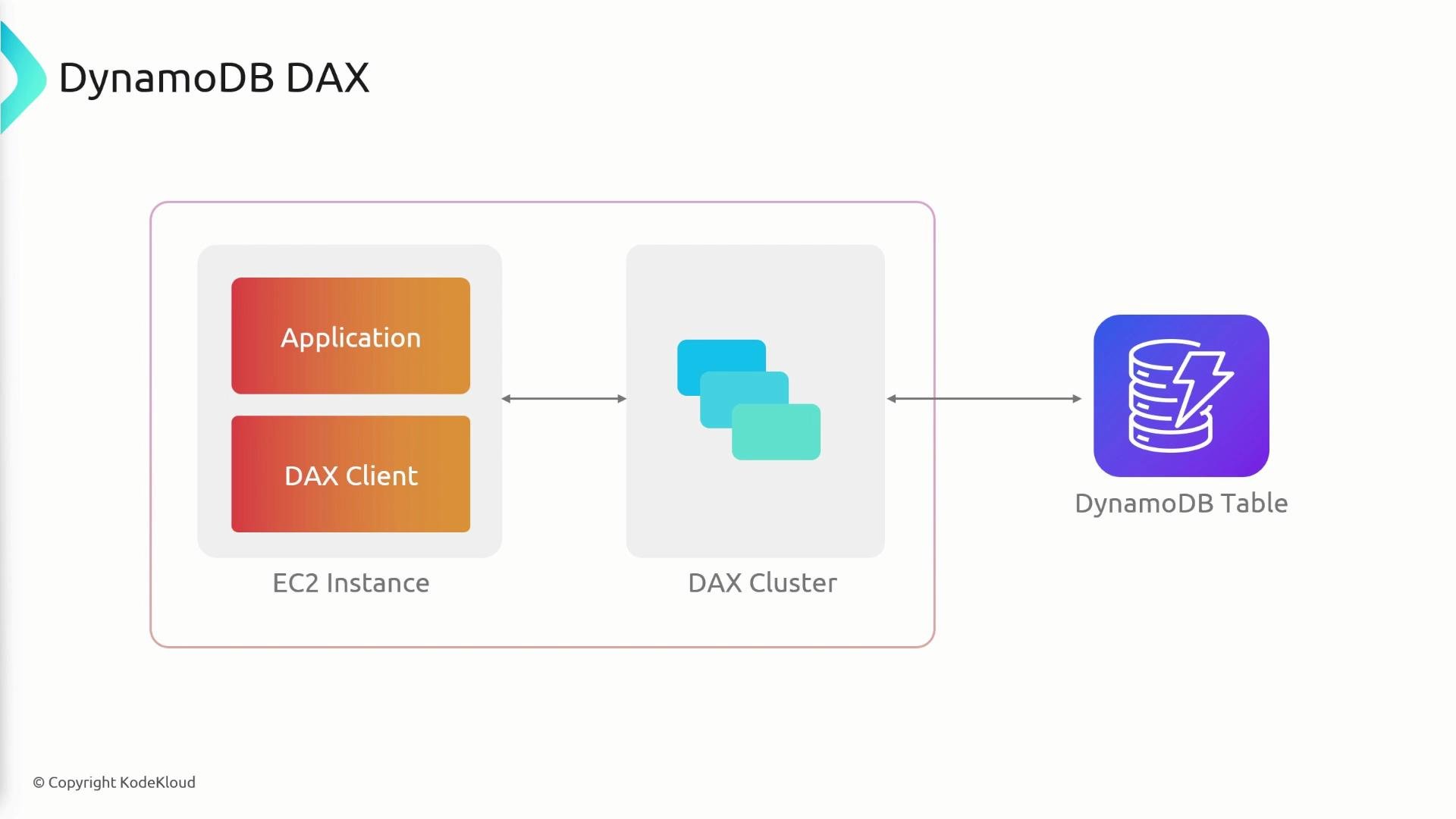
How DAX works (high level)
- DAX runs as a clustered, in-memory cache that sits between your application and DynamoDB.
- Your application uses a DAX-enabled client (or AWS SDK wrapper) instead of the standard DynamoDB client.
- On a cache hit, DAX returns the cached item with very low latency (microseconds to milliseconds).
- On a cache miss, DAX reads from DynamoDB, returns the result to the application, and caches the item for future requests (read-through behavior).
Key features and when to use them
Supported operations and limitations
- Supported: GetItem, BatchGetItem, Query, Scan (eventually-consistent reads).
- Not supported: DynamoDB transactional APIs (TransactGetItems, TransactWriteItems) and strongly-consistent reads.
- DAX is not a replacement for DynamoDB’s durability or transactional guarantees — it is a performance layer for read optimization.

Exam tip: If a question describes a read-heavy DynamoDB table that needs lower-latency reads, the correct service to consider is DynamoDB DAX.
Best practices
- Use DAX for read-heavy, latency-sensitive workloads where eventual consistency is acceptable.
- Prefer DAX for workloads with a high cache hit ratio (frequent repeated reads of the same items).
- Configure TTLs appropriately to balance freshness vs. cache performance.
- Run DAX clusters in multiple Availability Zones for high availability.
- Monitor DAX and DynamoDB with Amazon CloudWatch (cache hit rate, latency, node health).
- Start with a small DAX cluster and scale up; DAX supports clusters up to 10 nodes.
- Test your application with realistic traffic to measure cache hit ratio and end-to-end latency improvements.
Quick integration notes
- Switch your DynamoDB client to the DAX client or use the AWS-provided DAX client wrapper in your language SDK to keep application changes minimal.
- Ensure your application logic does not rely on strongly consistent reads when using DAX.
References and further reading
- Amazon DynamoDB
- DynamoDB Accelerator (DAX)
- AWS documentation: DynamoDB caching concepts and DAX developer guide